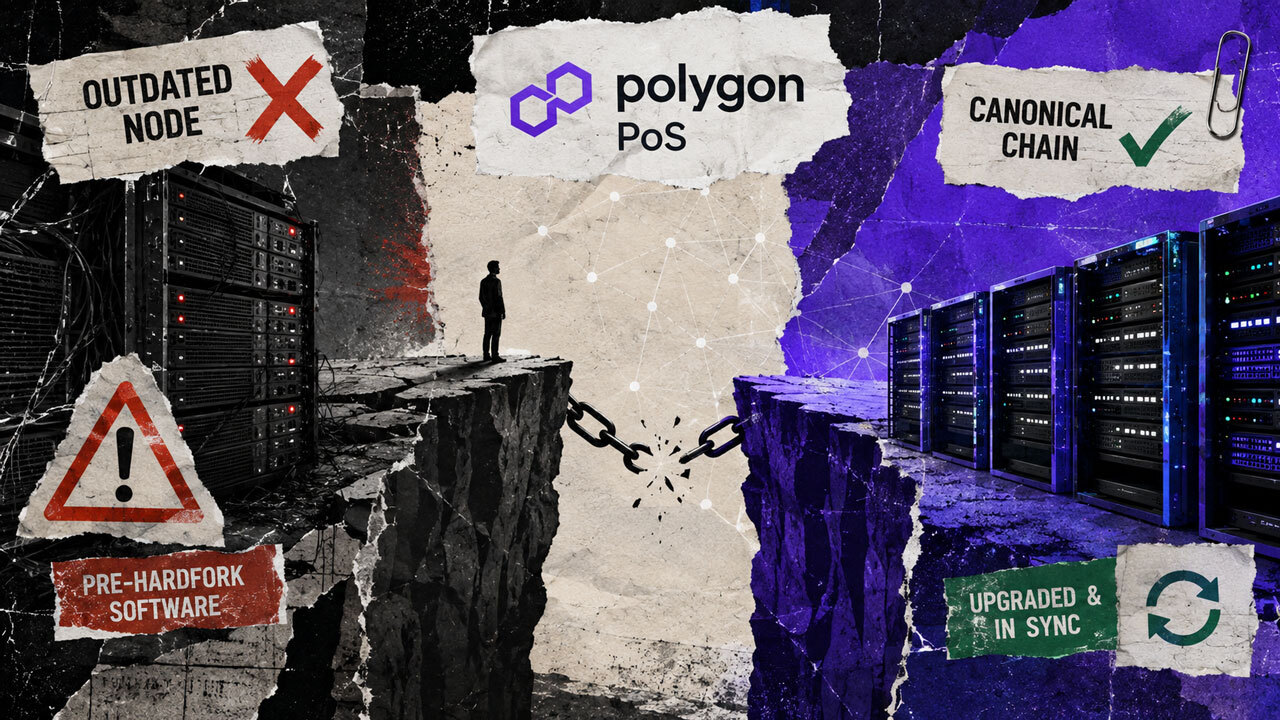
Polygon Labs has issued an urgent client upgrade notice following the deployment of two hardforks designed to address security vulnerabilities in its network infrastructure.
Any Polygon PoS node that remained on pre-hardfork Bor or Heimdall binaries past the activation heights in August has already fallen out of canonical consensus, according to the company. Affected nodes must upgrade and resynchronize to follow the network's accepted transaction history.
Upgrade Requirements
Bor, Polygon PoS's execution client, requires version 2.10.0 or later following the Austin hardfork activation at mainnet block 91,949,700. Heimdall validators and full nodes need version 0.11.0 or later following Kyoto's activation at height 51,533,000 on August 18 at 10:10:31 UTC.
Both hardforks are binary upgrades requiring no state migration or genesis change. Nodes that have not diverged require no resynchronization, though operators on older clients should install the applicable release and resync under Polygon's guidance if needed.
Austin Hardfork Fixes
The Austin upgrade addressed two resource-exhaustion risks in Bor. The first fix capped the gas consumed while processing state-sync events from Layer 1-to-Layer 2 bridge deposits. Previously, unchecked gas usage from contract code execution could accumulate enough to stall chain processing transiently.
The second fix removed the TxDependency extra-data field from the wire format. This field, used as a hint for parallel execution, had no size limit, allowing block producers to insert arbitrarily large data blobs that could crash peers attempting to process them.
Kyoto Hardfork Improvements
Kyoto addressed multiple vulnerabilities in Heimdall. The highest-severity fix targets deeply nested google.protobuf.Any messages, which could be cheaply constructed to force validators into expensive decoding operations. The hardfork added a byte-level nesting check at both mempool admission and block-proposal stages.
Additional Kyoto changes include capping fee-coin lists before validation scanning, normalizing checkpoint signature recovery bytes to prevent anchoring failures, making repeated producer-downtime messages idempotent, binding milestone-range votes to signed parent hashes, and preventing failed future-span creation from blocking milestone commitment. Replay keys for topup, clerk, and stake events were made injective to prevent distinct Layer 1 events from shadowing each other.
Polygon Labs reported no mainnet disruption from either hardfork and characterized the changes as proactive security enhancements.