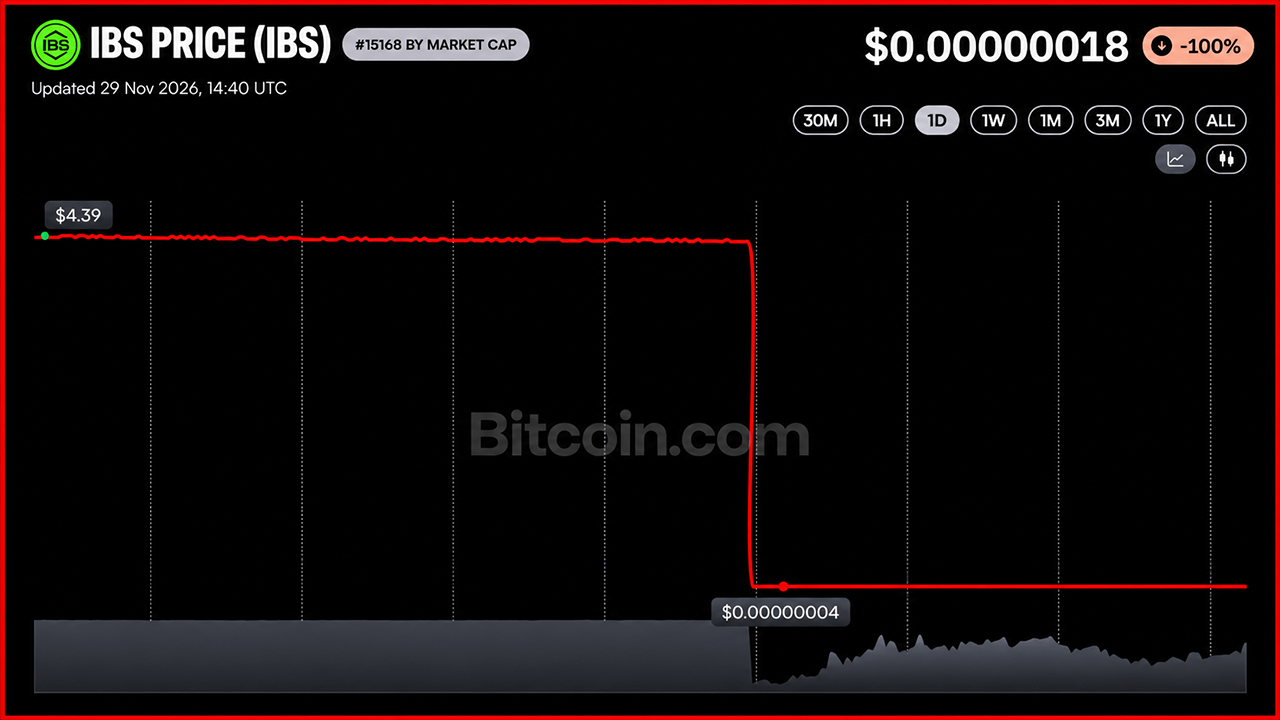
On November 28, the DeFi protocol Pots Money suffered a major exploit that emptied its IBS/USDT liquidity pool on the BNB Chain. Security firms Blockaid and Peckshield reported that a privileged governance account used its minting authority to create 101 billion IBS tokens, which were then swapped for USDT on PancakeSwap V2.
Exploit Details
At 04:47 UTC, the first transaction minted 1 billion IBS tokens and extracted 5,710,306.09 USDT from the pool. Within 62 seconds, a second transaction minted an additional 100 billion IBS tokens, swapping them for another 14,212.91 USDT. The pool was left with roughly 76 USDT.
Peckshield traced the proceeds to a wallet identified as 0x25D21c…ccceD2. Prior to the attack, IBS traded around $4.40; after the exploit, its price fell to approximately $0.00000008, effectively wiping out its USD value.
Impact on the Protocol
Pots Money, which described itself as an algorithmic monetary system, had listed a circulating supply of about 871,020 IBS before the incident. The exploit did not involve flash loans or reentrancy but leveraged existing administrative permissions, showing that locked liquidity offers limited protection when tokens are swapped rather than withdrawn directly.
Broader Context
The incident adds to a year marked by high‑value crypto security breaches. Defillama records indicate roughly $8.8 billion in losses across 372 incidents in 2026, a figure heavily influenced by a $6.36 billion Binance theft in October. Other reports note increasing losses from compromised keys, infrastructure weaknesses, and operational security failures.
Research highlighted the growing role of AI in reproducing known smart‑contract exploits, though no evidence links AI to the Pots Money attack. The event underscores the importance of robust governance controls, multisignature authorizations, and timelocks to mitigate risks associated with privileged access.