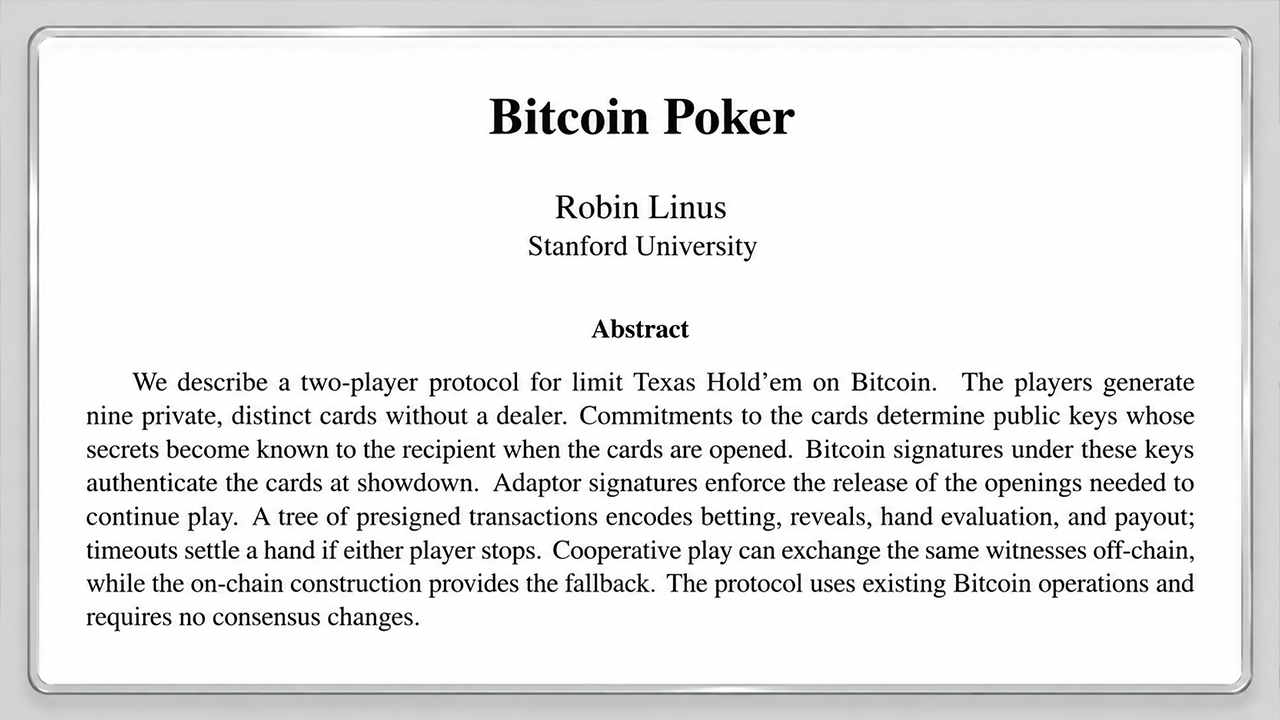
Nearly 18 years after Satoshi Nakamoto included an unfinished poker interface in Bitcoin's original software, researcher Robin Linus has developed a working protocol to make the game possible. On September 6, Linus published Bitcoin Poker, a system that allows two players to play Texas Hold'em without a dealer, privately generate cards, and enforce payouts through Bitcoin's existing rules.
The original Bitcoin source code contained a file called uibase.cpp with graphical components for a poker lobby and table, dated April 16, 2008—roughly six months before Satoshi published the Bitcoin white paper. Buttons labeled Deal Hand, Fold, Call and Raise suggested gaming functionality, though the interface contained no actual poker mechanism and Satoshi never publicly explained the intended purpose.
How Bitcoin Poker Works
Linus, a Stanford PhD candidate known for developing BitVM and other cryptographic systems, describes the protocol as "a two-player protocol for limit Texas Hold'em on Bitcoin." Rather than relying on a casino server or trusted dealer to determine cards, both participants contribute secret information to generate cards using cryptographic commitments and zero-knowledge proofs.
The system generates only nine distinct cards per hand instead of shuffling a 52-card deck. Neither player can decrypt the cards alone, ensuring neither can secretly control the outcome. The protocol checks for duplicate cards without exposing their identities; if matches occur, the attempt is discarded.
Before play begins, Bitcoin transactions representing all possible game outcomes are prepared. Each branch represents a permitted action—folding, checking, calling, raising, revealing cards, or settling the pot. Players authorize these possibilities in advance, and Bitcoin's transaction rules prevent unauthorized moves.
Technical Requirements and Limitations
The reference configuration requires 56,132 logical nodes, 54,855 ordinary signatures, and 1,306 card-reveal packages, totaling approximately 8.4 MB of setup data. Desktop browser trials showed preparation and saving the transaction tree took between 26.39 and 27.26 seconds.
Gameplay occurs off-chain, with players exchanging messages privately and keeping Bitcoin transactions in reserve if cooperation breaks down. The blockchain serves as a referee to settle disputes when necessary.
The protocol supports only two participants, as additional players could secretly share information about their cards. Linus acknowledges the cryptographic construction still requires independent security review and notes that existing tests do not constitute a formal security proof.
Addressing Non-Cooperation
When a player refuses to continue, the protocol enforces financial consequences through timeout mechanisms. After a specified delay, the remaining participant can collect the committed pot while the departing player's unused balance is returned. Bitcoin cannot force someone to reveal a card or finish playing, but it enforces the financial consequences of abandonment.