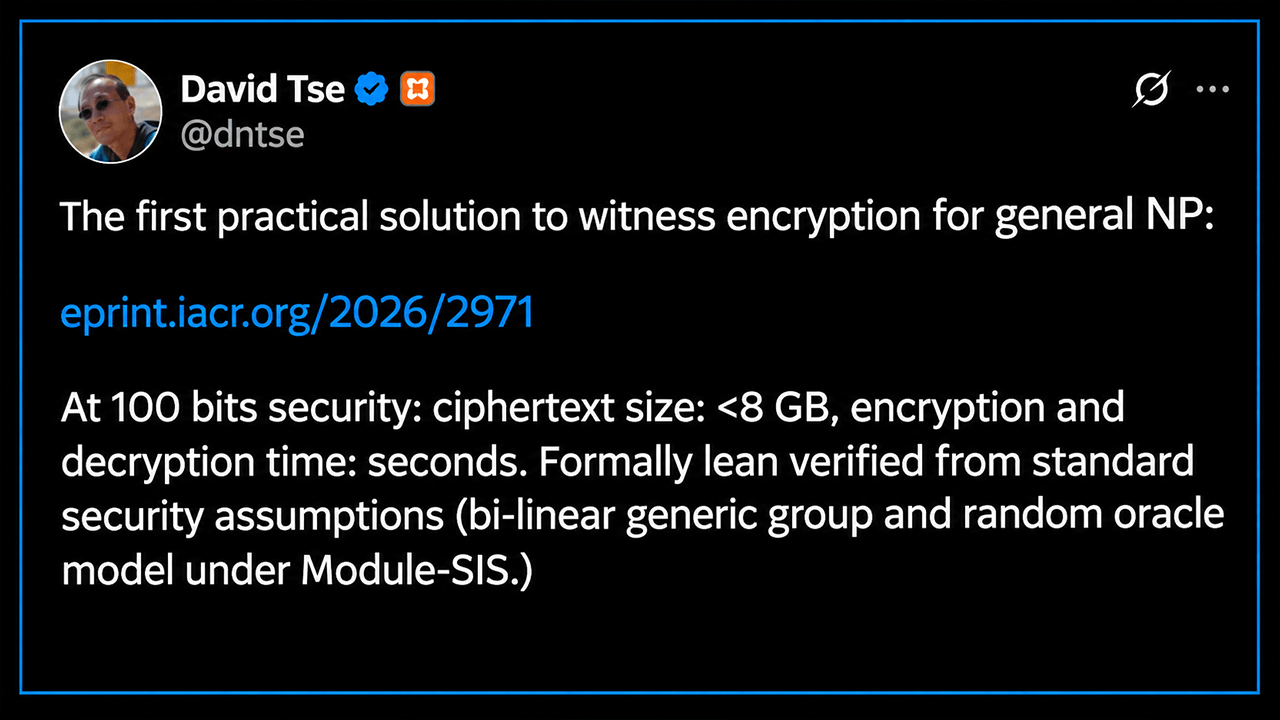
Researchers from Stanford University and Byzantine Research have introduced Praxis, a witness encryption scheme designed to make a previously impractical cryptographic technique accessible on ordinary computers. The construction, published on November 23, 2026, could potentially enable Bitcoin bridges, conditional payments, and sophisticated smart contracts without modifying the network's consensus rules.
The research paper, titled "Praxis: Practical Witness Encryption for NP," was published by the International Association for Cryptologic Research (IACR) and authored by Stanford professor David Tse, alongside Byzantine Research colleagues Nikhil Vanjani and Psi Vesely. Tse is also co-founder of the Babylon Bitcoin staking protocol.
Witness Encryption Explained
Witness encryption, first introduced in 2013, reverses the conventional relationship between encrypted information and cryptographic keys. Rather than encrypting a message for someone who already possesses a particular key, a sender encrypts information against a mathematical statement. Anyone possessing evidence that satisfies the statement can decrypt the message. That evidence could establish that a payment occurred, a computation was executed correctly, or a blockchain reached a predetermined length.
The person encrypting the message need not know who will eventually decrypt it, nor must that person remain available to authorize its release. As the researchers explain, "A ciphertext carries its own release condition, with no key to distribute and no party trusted to release the message."
Dramatic Efficiency Improvements
Praxis achieves substantial improvements over previous witness encryption constructions. At the 100-bit security level, the construction produces a ciphertext measuring 7.88 gibibytes (GiB). Encryption requires approximately 20 billion base-field multiplications, while decryption with a valid proof requires an average of 8.6 billion. Both processes can be executed within seconds on a laptop, with encryption requiring approximately 12 GB of memory and decryption requiring about 5 GB when the ciphertext is streamed.
Compared to an earlier witness encryption construction published in 2026, Praxis reduces ciphertext size and encryption costs by more than ten orders of magnitude, while reducing decryption costs by more than six orders of magnitude.
Implications for Bitcoin Bridges
For Bitcoin, witness encryption could enable new applications without expanding the network's native scripting capabilities. Bitcoin's scripting language is deliberately limited, making direct verification of sophisticated cryptographic proofs difficult.
Current approaches like BitVM, introduced in 2023, employ interactive verification mechanisms requiring at least one honest participant to contest fraudulent activity. Witness encryption presents an alternative: developers could encrypt the cryptographic material necessary to spend bitcoin against a statement establishing that a computation was completed correctly.
For example, in a Bitcoin bridge connecting to another blockchain, a withdrawal could be conditioned on the existence of a valid cryptographic proof establishing that corresponding assets were properly withdrawn on the other network. Bitcoin would then process the resulting transaction using its existing consensus rules, without directly evaluating the underlying computation.
Robin Linus, who introduced BitVM, stated that if the construction withstands independent peer review, it "will fundamentally improve Bitcoin bridges. Eliminating the need for operators and making deposits and withdrawals non-interactive."
Potential applications extend beyond blockchain bridges to include cross-chain atomic swaps, private auctions, time-locked payments, and Bitcoin covenants, which impose restrictions on how funds may subsequently be spent.
Remaining Limitations
Despite efficiency gains, Praxis remains a research construction rather than a production-ready solution. The Groth16 implementation requires an honest trusted setup. If the secret randomness generated during that setup is retained, someone possessing it could fabricate proofs and decrypt ciphertexts.
The 7.88 GiB ciphertext also presents practical challenges. Although manageable for modern computers, it remains unsuitable for direct inclusion in Bitcoin transactions. Applications would require dependable off-chain storage, distribution mechanisms, and assurances that encrypted information remains accessible when participants need it.
Praxis is not a quantum-resistant encryption system. Although it uses lattice-based mathematics studied in post-quantum cryptography, the construction also depends on pairing-based cryptography and its associated classical security assumptions.
The paper has yet to undergo formal peer review, and its concrete security parameters, computational estimates, and implementation requirements warrant further independent examination.