Robinhood Chain, an Ethereum layer-2 network, continued producing blocks throughout its Sept. 4 disruption. Full-day measurements correct an earlier report that block production had stopped for at least 14 minutes, clarifying that the network maintained continuous operation while users experienced a steep drop in successful app traffic for roughly 40 minutes.
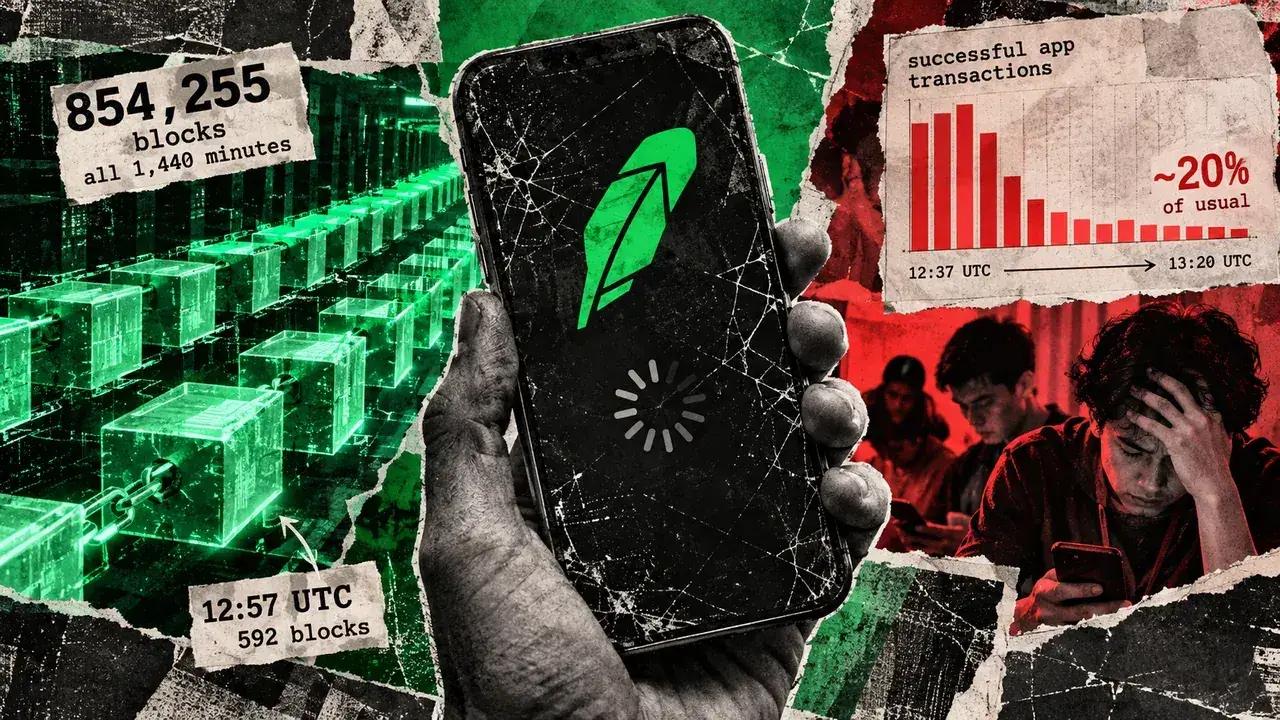
Data from Glass Hull on Sept. 29 counted 854,255 blocks across all 1,440 minutes of Sept. 4 UTC, noting that the longest gap between consecutive recorded block timestamps was two seconds. In the minute beginning 12:57 UTC, the reported start of a supposed halt, the network produced 592 blocks.
While block production did not stop, Glass Hull measured a separate 14-minute total comprising two pauses in posting Robinhood Chain transaction data to Ethereum: one from 12:29:47 to 12:38:23 UTC and another from 12:42:47 to 12:48:11 UTC. L2BEAT's liveness record lists comparable gaps in Ethereum data submissions, demonstrating that a layer-2 network can continue generating blocks even when its separate data-posting process is delayed.
App Impact and Provider Investigation
Analysis from Walnut on Sept. 23 indicated that successful traffic through busy Robinhood Chain apps fell sharply from about 12:37 to 13:20 UTC, with the median busy app completing roughly one-fifth of its usual successful transactions. Walnut interpreted delayed oracle updates and smart-wallet transaction failures as signs that attempted submissions were lost before reaching blocks, though public chain data leaves the exact point of failure unresolved.
QuickNode began investigating increased Robinhood Chain mainnet latency at 13:10 UTC and warned users at 16:20 UTC about degraded performance and failing transactions due to sequencer-feed connection issues. In a Sept. 4 statement, @arbitrum reported that the chain experienced no downtime and that direct user transactions suffered no delays, though it noted a brief performance impact for some providers relying on the data stream.
While Walnut suggests a low batch-poster tip was outbid during an Ethereum fee spike to cause data-posting delays, Glass Hull leaves the cause of the posting gaps unresolved. The public record establishes continuous block production alongside impaired app traffic, while the precise off-chain failure point remains open.