Revenue Milestone for a Young Network
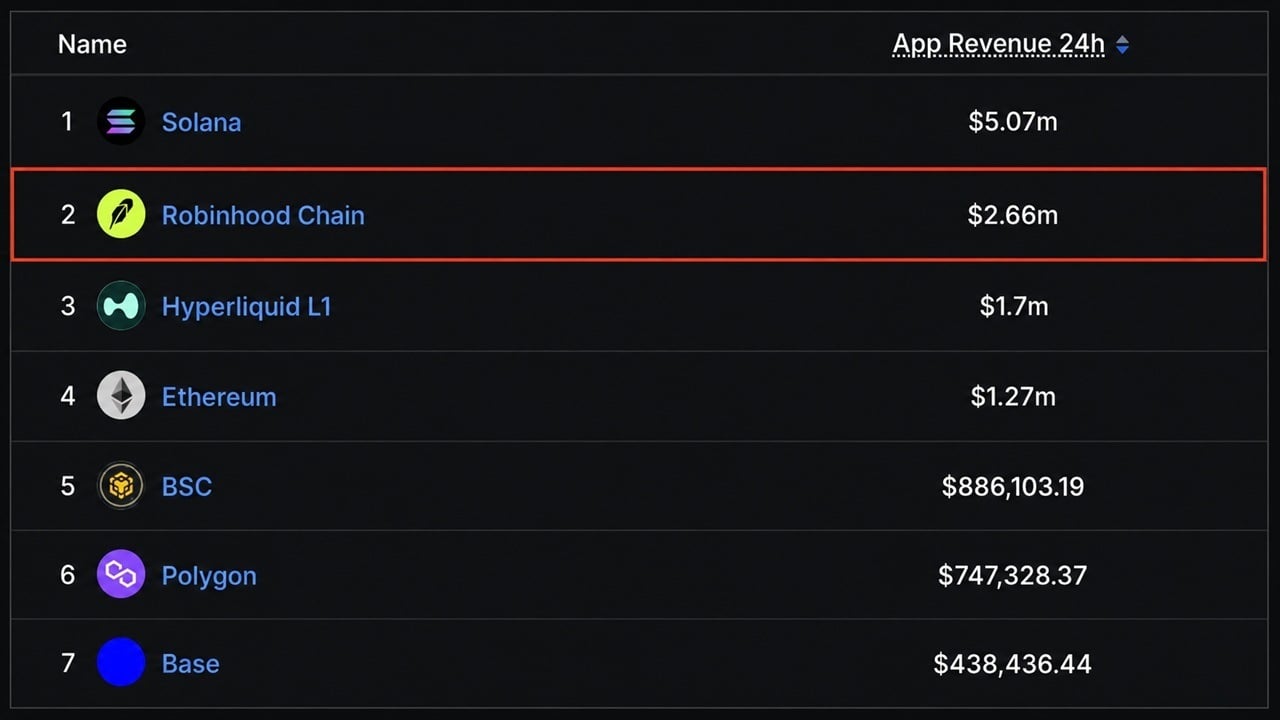
Robinhood Chain's decentralized applications generated $2.66 million in fees over a 24-hour period ending August 30, exceeding Ethereum's $1.27 million and Hyperliquid L1's $1.7 million recorded on the same day, according to publicly available data. The result also placed the chain nearly six times ahead of Base, which logged approximately $438,436 in application revenue.
The Arbitrum-built layer 2 launched its public mainnet on July 1 during Robinhood's "The World Is Flat" event in London. Despite its short history, the network has repeatedly led individual performance metrics since going live. It briefly surpassed both Base and Ethereum in 24-hour DEX volume within its first two weeks and reportedly overtook Ethereum in NFT trading volume by mid-August.
Concentrated Fee Generation
Three protocols accounted for close to 88% of Robinhood Chain's daily revenue:
- Gmgn, an onchain trading terminal favored by meme coin traders, contributed roughly $1.11 million.
- Pons, a token-launch and social-trading platform, generated about $930,587.
- Uniswap, operating its spot-trading product on the network, added approximately $306,877.
That distribution contrasts with the chain's original design focus on tokenized real-world assets, stock tokens, and ETFs, supported by Chainlink oracles covering 95 tokenized stocks. The revenue mix suggests that speculative trading activity, much of it potentially originating from Robinhood's own brokerage user base, currently drives the network's economics.
Hyperliquid Maintains Volume Dominance
The revenue comparison should not be read as a broader shift in market structure. Hyperliquid processed $8.9 billion in perpetual futures volume on July 13 alone, compared with just $5.9 million on Robinhood Chain the same day. Hyperliquid has also captured an estimated 9% of global perpetual contract open positions, a share that no other network currently matches.
Application revenue and trading volume measure distinct aspects of network activity. A lead in fees does not offset a deficit of several orders of magnitude in derivatives throughput. What the August 30 figures do indicate is that Robinhood has begun successfully routing retail trading flow onto its own infrastructure, capturing fees that would otherwise accrue to Ethereum or Base.
The numbers arrived amid a relatively flat crypto market, with bitcoin trading near $78,000.