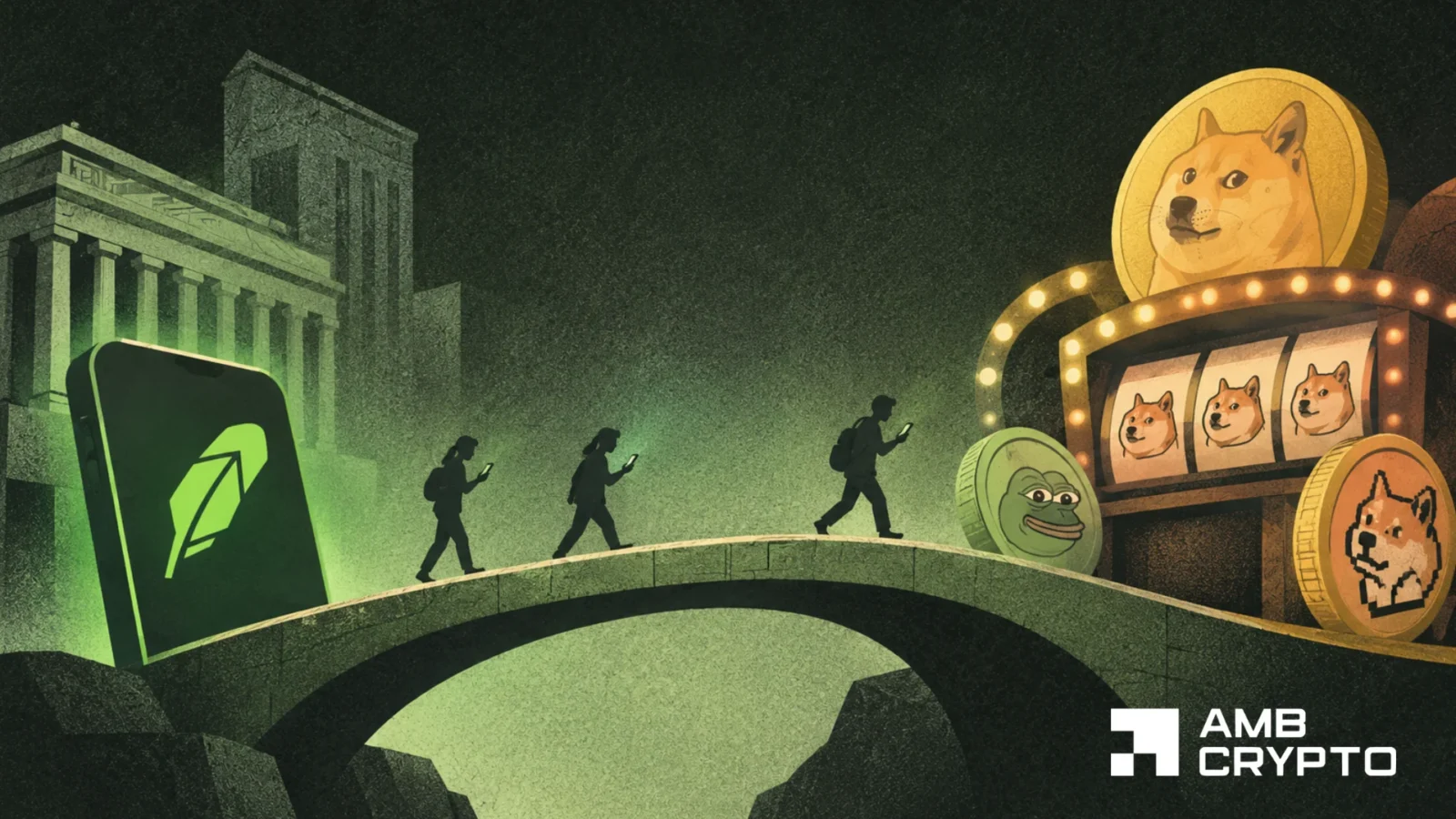
Robinhood Chain was introduced as an Ethereum Layer-2 network intended to bring traditional financial markets on-chain, combining tokenized stocks, real-world assets (RWAs), and decentralized finance (DeFi) applications. Early trading activity, however, has been driven overwhelmingly by memecoins rather than the tokenized equities the network was designed to showcase.
A use case that shifted on arrival
When Robinhood launched the network, the company described a three-in-one infrastructure layer spanning tokenized stocks, RWAs, and DeFi. Johann Kerbrat, SVP and General Manager of Crypto and International at Robinhood, framed the effort as bringing traditional finance and DeFi together to expand financial ownership globally.
Actual demand told a different story. According to Bitquery's analysis of trading activity between July 16 and July 28, 2026, memecoins accounted for approximately 93.5% of trading across 63.5 million transactions, while tokenized equities represented just 6.5%.
CoinGecko's July 2026 assessment found a similar pattern: memecoins made up 79.2% of Robinhood Chain's DEX volume, compared with 9.69% for RWAs.
Stock tokens as trading currency
Robinhood Chain has allowed creators to pair memecoins with tokenized versions of established companies. As a result, tokenized equities are not necessarily being used for traditional investment purposes but have instead become the trading currency through which users speculate on unrelated digital assets.
Bloomberg reported that daily trading volume in pairs combining Robinhood stock tokens with memecoins reached approximately $443 million in early September. Robinhood CEO Vlad Tenev commented on the dynamic, saying, "If you hold a memecoin, you just get stock tokens airdropped to you."
Growth metrics tell another story
Despite the speculative character of its activity, Robinhood Chain has recorded significant growth. CoinGecko's Q3 2026 Crypto Industry Report identified the network as the third-most-active blockchain within three months of its public launch.
In Q3 2026, Robinhood Chain generated more than $88.9 billion in trading volume, averaging approximately 9.5 million transactions per day. Daily trading volume on its native decentralized exchanges rose from about $1.3 million on launch day to a peak of $3.5 billion on September 4.
Separately, the company added approximately $25 million worth of Bitcoin to its corporate balance sheet in October, describing the purchase as an asset-diversification strategy.
Risks beneath the activity
Memecoin trading on the network carries notable risks. Bitquery's investigation found that approximately 84% of the nearly 15,000 tokens launched daily never traded again after their initial transaction, and that three out of every four open trading positions were underwater.
Fortune subsequently reported that trading volume in memecoin-stock pairs had fallen by approximately 96% from its early-September peak, illustrating how quickly speculative enthusiasm can fade.
Still, it would be premature to conclude that memecoin activity is undermining Robinhood's broader ambitions. Speculation may be serving as an unexpected entry point into tokenized finance. Whether traders stay for tokenized stocks and RWAs, rather than the next viral memecoin, remains the bigger question.