

Strategy co-founder and executive chairman Michael Saylor said Bitcoin needs “disciplined expansion” through banks, companies, securities, credit and capital markets, laying out a path for the asset as spot exchange-traded fund (ETF) outflows and a broader market sell-off test institutional demand.
On Friday, Saylor published an essay, saying Bitcoin’s base layer should be treated as “sacred infrastructure,” with most innovation occurring through higher layers, applications, custody systems, credit instruments and financial infrastructure.
The comments frame Bitcoin’s next phase as a clash between two institutional channels: passive spot ETF exposure, which has broadened access but remains sensitive to redemptions, and the corporate and credit-market adoption model favored by Saylor’s Strategy.
Saylor argued Bitcoin should become embedded in the machinery of finance rather than depend only on spot buyers or ETF inflows. He said Bitcoin’s future requires balancing adoption, innovation and self-custody while preserving the network’s core properties.
The essay comes during a sharp Bitcoin market sell-off that has put both major institutional channels under pressure. Spot Bitcoin ETFs posted weekly net outflows of $1.42 billion, $1.26 billion and $1 billion in the last three weeks of May, while the current week’s outflows have reached $1.4 billion so far.
Strategy also recently sold 32 Bitcoin to fund preferred stock dividends, its first sale since 2022, denting the “never sell” narrative that has long surrounded Saylor’s corporate Bitcoin strategy.
Spot Bitcoin ETF inflows and outflows in the last four weeks. Source: SoSoValue
Analysts split on demand reset
The pressure has sharpened a broader debate over whether Bitcoin’s recent decline is a temporary reset after excessive leverage, or a sign that institutional demand is weakening after months of ETF-led buying.
Lacie Zhang, research analyst at Bitget Wallet, said Bitcoin may already be closer to clearing the episode than equity markets after a $1.8 billion liquidation wave, deeply negative funding rates and a sharp reset in open interest. Zhang said a retest of $55,000 to $57,000 remains possible if outflows persist. She added:
“The key question is not just whether BTC holds $63K, but whether ETF flows stabilize, exchange reserves keep falling, and whale accumulation picks up.”
Nicolai Sondergaard, research analyst at Nansen, gave a more cautious view, saying exchange flow data suggests participants are using Bitcoin’s bounce from around $61,000 to reduce exposure rather than add to positions.
Sondergaard said Bitcoin’s ETF demand narrative has been unwinding since May, and that a durable recovery would require more than the removal of immediate market pressure. Without visible re-entry from institutional buyers, he said the market may struggle to rebuild momentum.
Related: Strategy’s leveraged Bitcoin model has faced its first stress test: Grayscale
Saylor argues for Bitcoin beyond ETFs
Saylor, in his essay, described four broad Bitcoin ideologies: maximalists, capitalists, technologists and fundamentalists. He said each group protects something important, but each can also go too far if its view becomes absolute.
The “disciplined expansion” thesis most closely fits the capitalist view, which treats Bitcoin as digital capital that can be integrated into balance sheets, securities, credit markets, banks, brokers, insurers and asset managers.
That framing differs from ETF-based exposure, where institutional adoption is measured largely through inflows and outflows.
Saylor’s preferred channel points to a more embedded model, where Bitcoin is used in corporate treasuries, collateral structures and capital markets rather than held only through spot investment products.
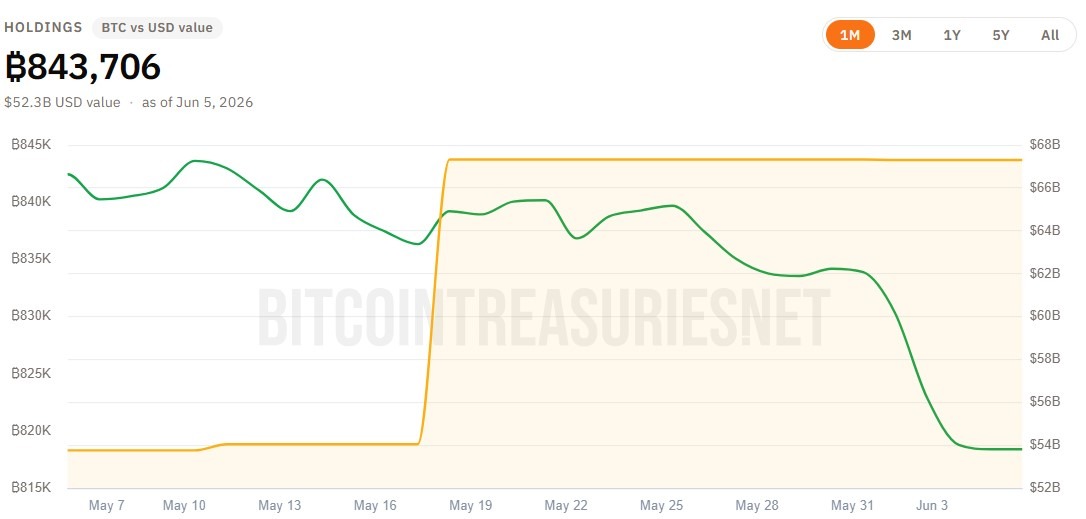
Strategy’s BTC holdings versus USD value. Source: BitcoinTreasuries.net
Magazine: Bitcoin miners are pivoting to AI, so why is the hashrate near ATHs?