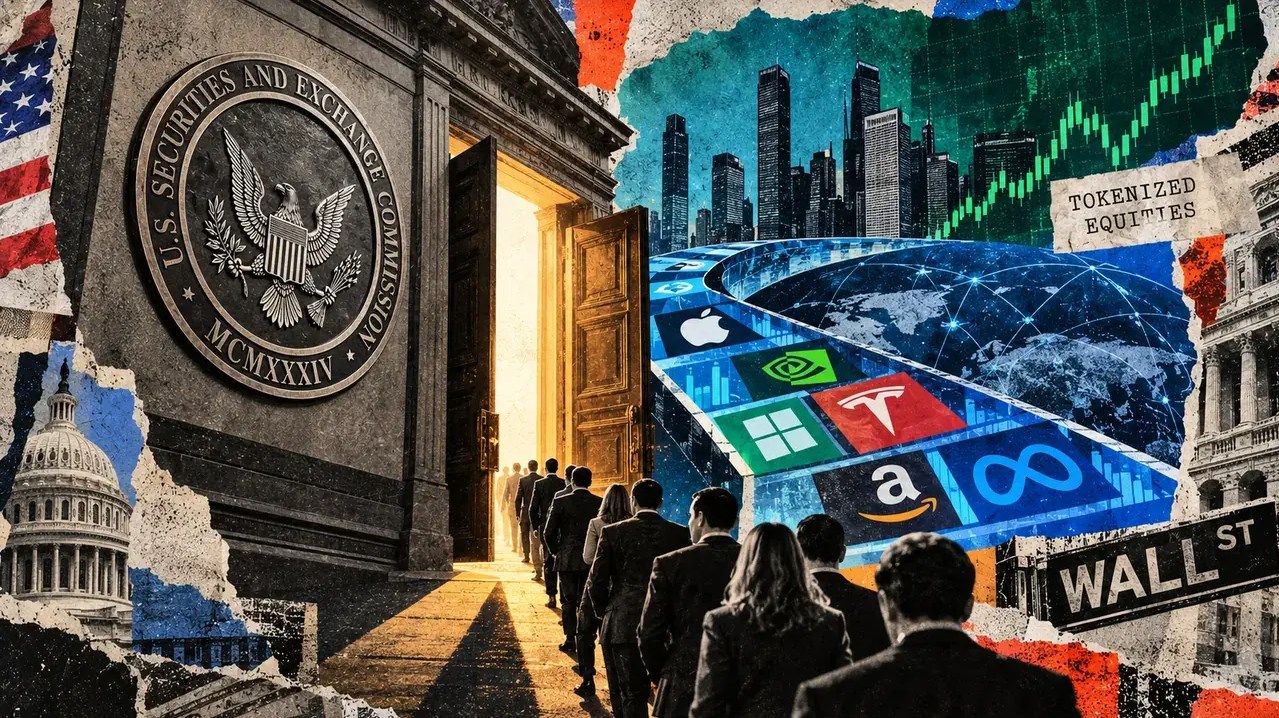
The US Securities and Exchange Commission (SEC) has established a five-year framework allowing regulated US stocks to trade on blockchain-native venues through its Innovation Exemption. The move came two days after the Senate failed to advance the CLARITY Act, a comprehensive crypto market-structure bill that would have established statutory rules for digital assets. The procedural vote fell short at 49-50, missing the 60 votes required to proceed.
SEC Chair Paul Atkins explicitly tied the action to the stalled legislation, noting the agency was moving "within its statutory authority" to facilitate on-chain trading of tokenized stocks. The exemption effectively opens the $77 trillion US stock market to blockchain-based trading infrastructure.
How the Framework Works
The exemption creates a structure for Tokenized Securities Venues (TSVs) that connect buyers and sellers through permissioned automated market makers and liquidity pools. Qualifying venues receive temporary relief from being classified as exchanges under the Securities Exchange Act, while certain liquidity providers can receive related relief from dealer-registration requirements.
The exemptions expire after five years, giving the SEC time to collect trading data before determining what a permanent framework should resemble. Commissioner Mark Uyeda described the structure as deliberately constrained, with symbol and volume caps alongside requirements for transaction transparency, trading halts, recordkeeping, and technology safeguards. Venues must publish prices, trade sizes, timestamps, pool addresses, and daily trading volumes.
Atkins emphasized that economic and corporate events no longer occur neatly within traditional market hours and investors increasingly want the ability to adjust positions when news breaks. He also pointed to tokenization as a potential tool for real-time inventory management, which could improve efficiency and reduce settlement failures.
Offshore Market Activity
Tokenized stocks have already developed substantial trading volume in offshore markets. Token Terminal data show tokenized stocks reached $3.2 billion in market capitalization, up 1,219.3% over the past year. These products generated $15.75 billion in decentralized-exchange trading volume over the past 30 days, including $2.95 billion on weekends when traditional US exchanges are closed.
Weekend turnover increased 4.4-fold in three weeks, from $360 million to $1.6 billion per weekend, suggesting investors are using tokenized equities to trade outside conventional market hours. Token Terminal counted 3.7 million tokenized-stock holders, though this figure reflects on-chain holders rather than necessarily distinct investors.
Capital has also moved into decentralized finance, with tokenized-stock value deployed in DeFi rising 1,960.8% over the past year to $247.8 million. Grayscale estimated in late August that only about 5% of the tokenized-equity market was deployed in on-chain finance, indicating investors have primarily valued continuous trading and global access over lending and collateral applications.
Regulatory Boundaries
The SEC has placed significant limits on the exemption. It applies only to tokenized National Market System stocks representing genuine securities that give holders the same rights as traditional shares, including dividend and voting rights. Synthetic instruments that merely reproduce a stock's price exposure are excluded.
Issuers retain considerable control, with the ability to object when unaffiliated third parties seek to tokenize their securities. Venues must be US persons, comply with sanctions requirements, and restrict participation through permissioned access. Trading is also subject to limits on the number of stocks and volumes that can trade.
Atkins acknowledged that around-the-clock market infrastructure must preserve functions and protections available during traditional trading hours. He noted that market activity may need to deepen before services such as securities lending can operate effectively overnight. The five-year exemption creates a controlled test of whether regulators and market participants can manage these challenges.
For crypto firms already offering tokenized equity products overseas, including Robinhood, Kraken, and Coinbase, the exemption provides a pathway to bring offshore activity into the US regulatory system.