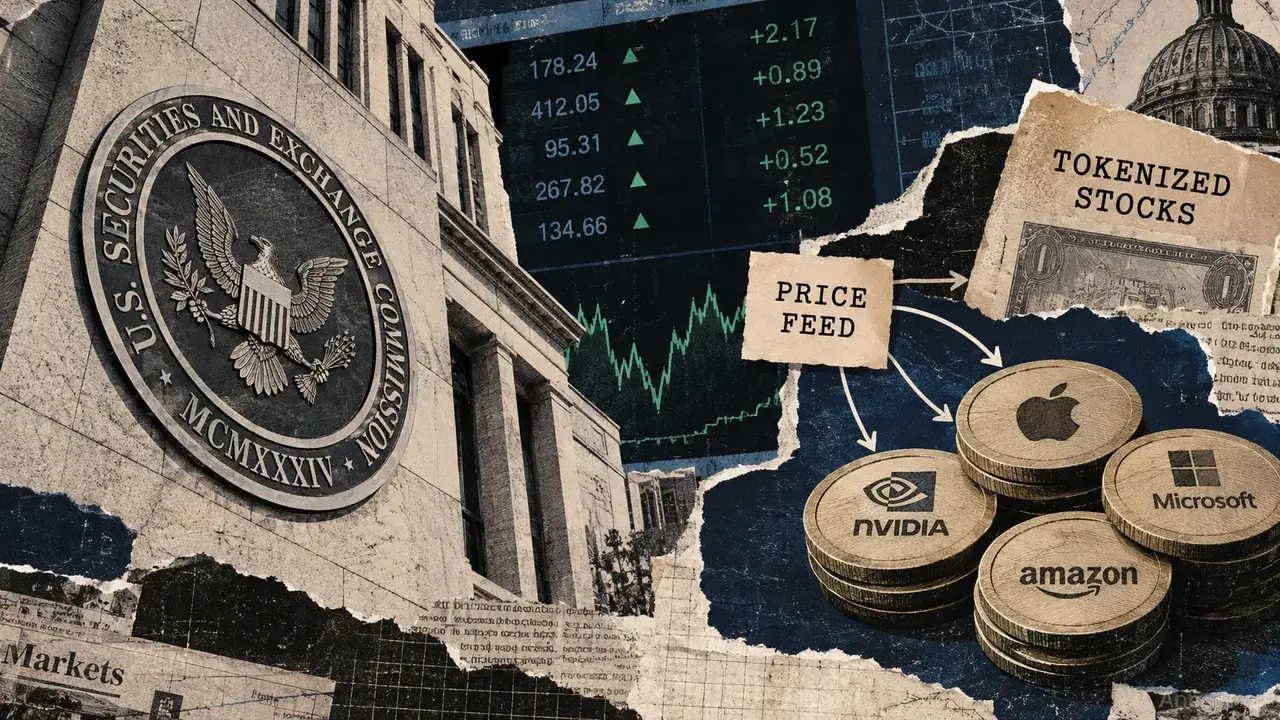
The SEC's September exemption for tokenized stocks permits trading venues to operate outside key Regulation NMS protections, even as tokenized shares must carry equivalent shareholder rights to traditional stock. This creates a split between what investors own and how their orders are executed.
The September 17 exemption grants temporary relief from exchange definitions to venues offering permissioned automated market maker pools for eligible tokenized National Market System stock. These pools use software to allow approved participants to trade against committed assets. The exemption also provides separate dealer relief for certain liquidity providers using their own capital.
Shareholder Rights vs. Trading Protections
For eligible shares, venues must verify that tokenized stock carries the same rights and privileges as traditional stock of an equivalent class, including an interest in the company, dividends, voting rights, and a share of residual assets upon liquidation. However, a venue meeting the exemption's conditions operates outside the exchange framework for Regulation NMS rules, including Rule 611's protection against trading at prices worse than certain protected quotations elsewhere.
The exemption excludes third-party securities providing synthetic exposure, including tokenized linked securities and security-based swaps, as well as rights and warrants.
External Price Data Requirements
Venues must disclose whether and how they use external data sources and oracles—services that bring outside information to blockchain applications. Public notices must identify providers and sources, explain data purposes, and describe oracle use. Venues must also disclose known material risks, including oracle manipulation, and any reference-price bands or other risk controls.
The order does not prescribe a single provider, minimum contributor count, common aggregation method, confidence threshold, or uniform response to stale prices. Venues must publish free, machine-readable dollar-denominated data covering transactions in the preceding 30 days, updated within ten minutes of each transaction.
Broker Best-Execution Duties Remain
FINRA-member brokers retain applicable best-execution duties when handling covered customer transactions. Rule 5310 requires reasonable diligence to find the best market and obtain prices as favorable as possible under prevailing conditions. The assessment considers market character, transaction size and type, markets checked, quotation accessibility, and customer order terms, including speed, execution likelihood, and costs.
Brokers cannot transfer this duty to another party and must conduct execution reviews at least quarterly by security and order type when using automated routers. Sparse pricing information calls for particular diligence and documented compliance.
Investor Considerations
Investors should examine both what a tokenized share represents and how their order is priced and handled. When reading a venue notice, investors can assess whether external data sets the execution price, supports displayed valuation, converts transactions for reporting, or triggers a halt. Investors should verify whether a FINRA member is handling their transaction before relying on broker protections.