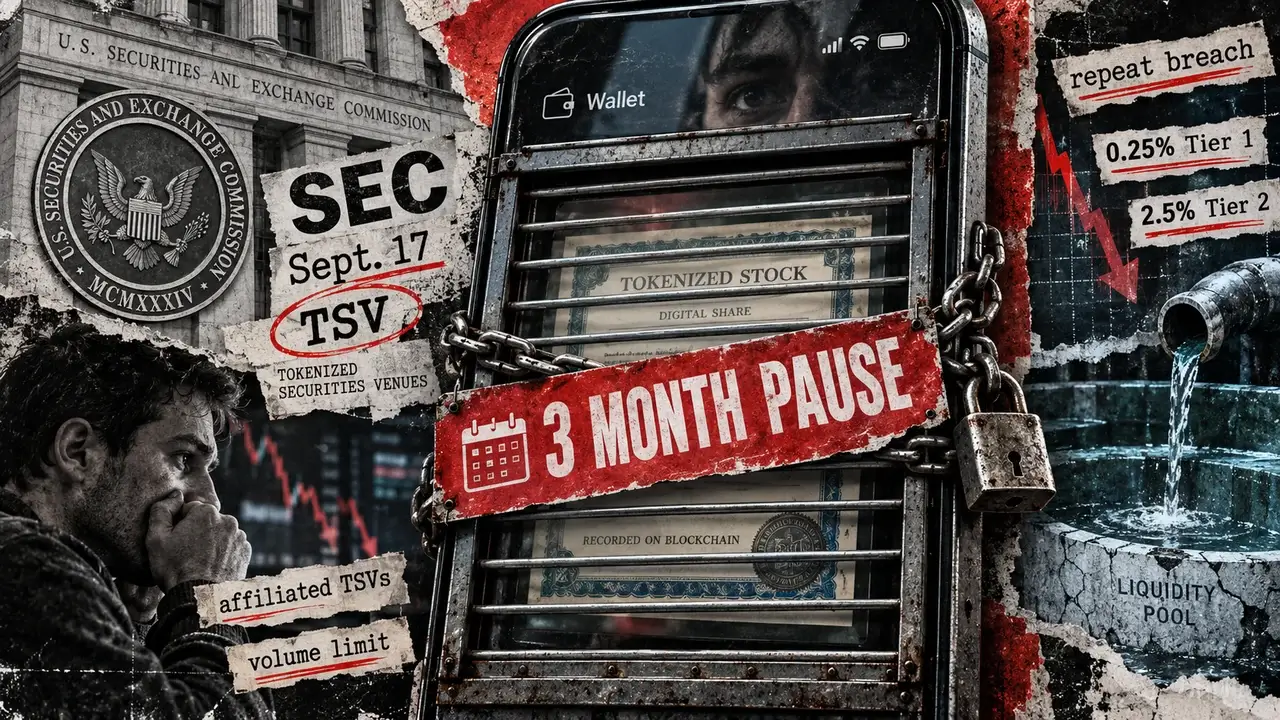
The SEC's September 17 framework for experimental Tokenized Securities Venues, or TSVs, introduces trading restrictions that could significantly impact investors. When a tokenized stock's trading volume repeatedly exceeds regulatory limits, trading can halt for three months on that exchange and its affiliates.
Understanding Tokenized Stocks
Tokenized stocks represent ownership or claims on company shares recorded on a blockchain rather than through traditional financial institution chains. However, tokenization takes multiple forms. Some tokens preserve shareholder rights including dividends and voting power, while others offer only synthetic exposure to a stock's price without conferring ownership rights.
The SEC's framework requires that qualifying tokenized stocks preserve the economic and governance rights of their traditional equivalents. Trading occurs through automated market makers—software systems that let investors trade against pools of assets supplied by other participants rather than matching orders between individual buyers and sellers.
How Volume Limits Work
The SEC's framework imposes different trading volume thresholds based on stock category:
- Tier 1 (S&P 500 and Russell 1000 stocks): exchanges can offer up to 750 symbols with a per-stock limit of 0.25% of the traditional stock's prior-month average daily share volume
- Tier 2 (other eligible securities): exchanges can offer up to 250 symbols with a per-stock limit of 2.5% of average daily volume
For example, if a traditional stock averaged 10 million shares daily, the Tier 1 tokenized allowance would be 25,000 shares in average daily volume. These are averages, not single-day limits.
Consequences of Breaching Volume Limits
When a stock exceeds its volume threshold, enforcement escalates. The first breach triggers a grace period requiring the exchange to ensure future compliance. Each subsequent breach mandates an immediate three-month trading pause for that stock across affiliated exchanges. The clock runs from the breach date, though other stocks can continue trading.
Exchanges can voluntarily pause trading earlier to avoid breaching the threshold and must notify participants immediately of any pause.
Practical Concerns for Investors
The SEC imposed these volume limits to minimize risks to the broader stock market during its observation period, including the possibility that pool prices diverge from traditional share prices. In a limited-inventory pool, simultaneous buy orders can push token prices upward even when broader market sentiment hasn't moved.
For investors, the three-month pause creates a liquidity risk independent of token ownership. A trading halt could disrupt plans to sell, even while the investor retains the asset. Moving a token to another wallet doesn't automatically solve the problem—the investor would need an eligible trading venue for that specific instrument or a redemption process under the token's terms.
Before purchasing tokenized stocks, investors should seek detailed information from providers about what happens if an exchange stops trading their token, including custody arrangements, how shareholder rights transfer, permitted transfer routes, any redemption options, and associated costs.