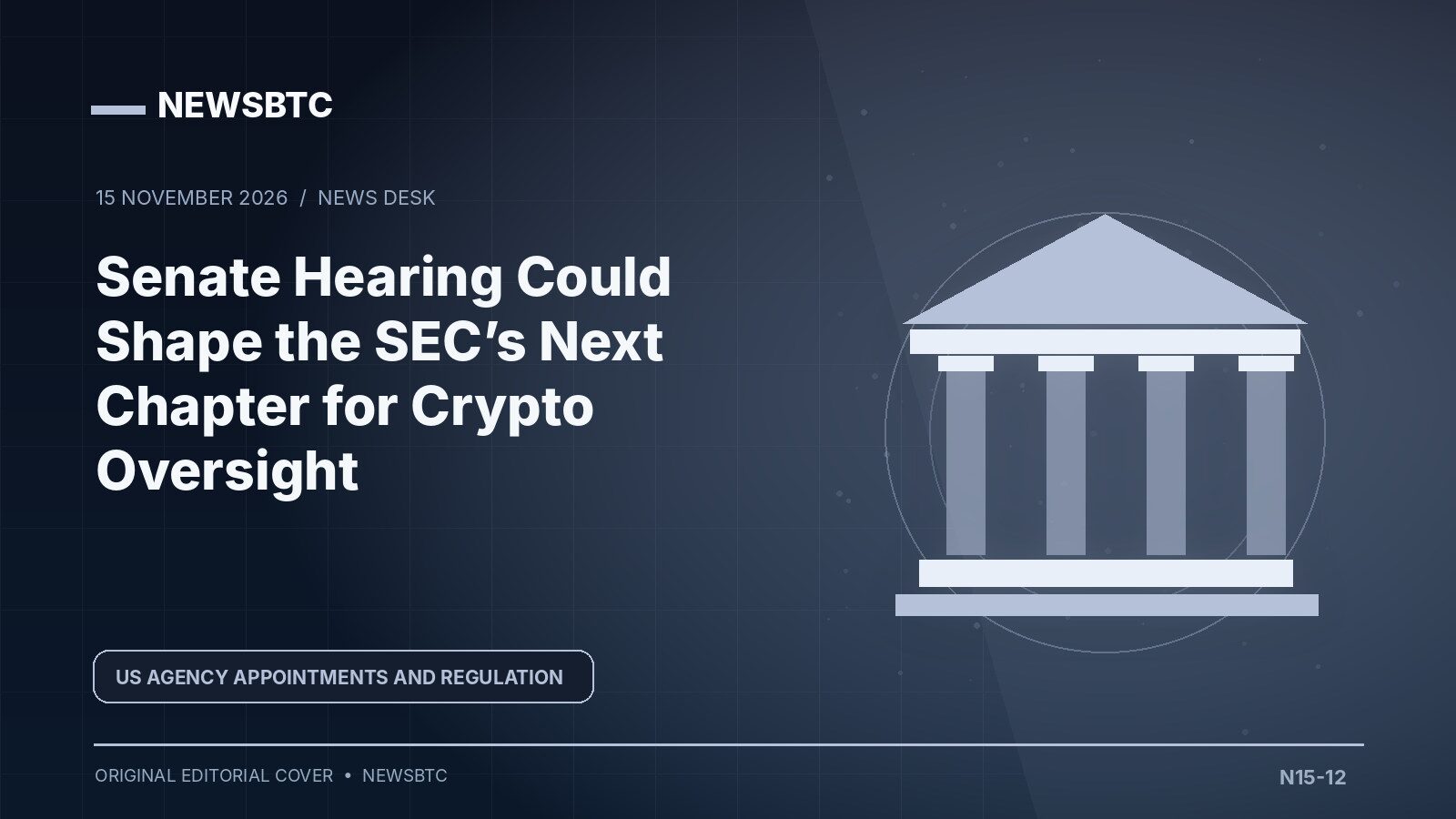
The US Senate Banking Committee is preparing to examine nominees for positions at the Securities and Exchange Commission, with a hearing scheduled for Thursday, November 19. The proceedings put personnel decisions back in the spotlight as industry participants seek clearer rules on token offerings, custody and trading venues.
CoinDesk reported that the Banking Committee had scheduled the hearing involving SEC nominees Steven Levine and Kristin Johnson. Senators are expected to have an opportunity to question the candidates on their approach to securities regulation. Their actual remarks should be judged from the hearing record rather than predicted in advance.
The same reporting discussed separate nominees for roles at the Commodity Futures Trading Commission. The CFTC appointment process is not identical to the SEC's, and a hearing for one agency should not be read as an automatic timetable for the other. Both agencies affect digital-asset activity, but their legal jurisdictions and responsibilities differ.
Why appointments matter for crypto
Businesses building token markets often want to know which rules apply before launching a product. Questions can include whether an asset or particular transaction falls within securities law, how intermediaries should register and what disclosures are expected. Regulatory staff and commissioners shape policy through rulemaking, enforcement decisions and public guidance, while courts and Congress also have important roles.
A change in personnel can influence priorities, but it does not instantly rewrite the rules. Existing statutes remain in force, earlier litigation can continue and new policy proposals may need formal procedures. For a company considering a US product launch, a nomination is a signal to monitor rather than a substitute for legal advice or an enacted regulation.
The debate extends beyond the SEC
Prediction markets and derivative instruments illustrate the difficulty of drawing clear regulatory lines. Earlier NewsBTC coverage of litigation involving Coinbase, Kalshi and the CFTC demonstrated how novel products can trigger disputes over oversight and market structure. The SEC and CFTC do not necessarily reach the same questions through the same legal framework.
International developments also show that the United States does not set standards in isolation. European tokenisation discussions covered by NewsBTC show regulators elsewhere trying to align traditional financial protections with new technology. US appointees will face the task of balancing market integrity, investor protection and innovation against a global competitive backdrop.
What the hearing can and cannot tell investors
Specific answers about custody, market intermediaries, token distributions and enforcement philosophy would be more informative than general pledges to support innovation or protect consumers. Written responses and subsequent votes are also worth watching. Yet even a persuasive performance at a hearing offers no guarantee of confirmation or a particular policy outcome.
The near-term event is clear: November 19 provides a public checkpoint for the SEC nominees. What follows may shape the regulatory conversation over months and years. Treating a personnel hearing as an immediate market catalyst would be a much bigger claim than the available evidence supports.