Senate Republicans have released the final version of the CLARITY Act ahead of a Sept. 15 procedural vote on whether to proceed with consideration of the legislation. The revisions address ethics enforcement, stablecoin safeguards, and developer protections.
Ethics Restrictions on Federal Officials
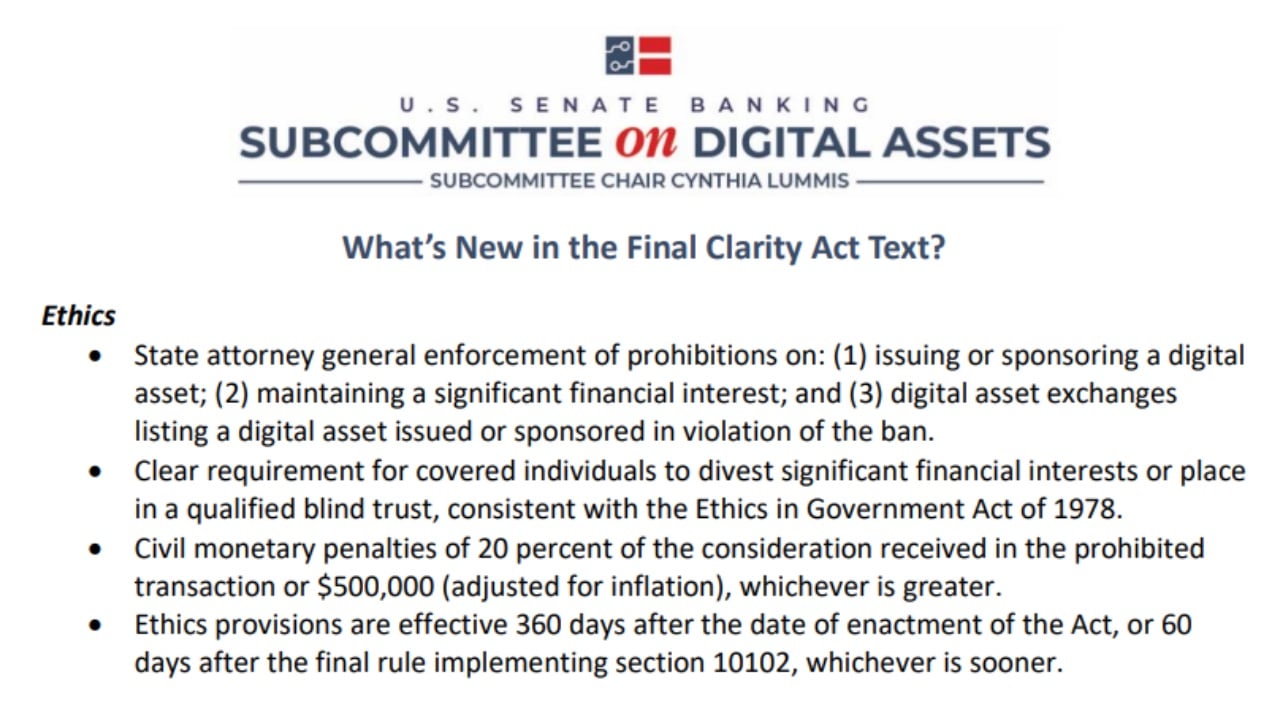
U.S. Senators Cynthia Lummis (R-WY), John Boozman (R-AR), and Tim Scott (R-SC) released the final draft on Sept. 14. The ethics provisions would prohibit covered federal officials and their spouses from issuing or sponsoring digital assets in exchange for consideration, or maintaining significant financial interests in them. Affected individuals would be required to sell such interests or place them in qualified blind trusts.
State attorneys general would be empowered to enforce the restrictions, including a ban on exchanges that list assets issued in breach of the rules. Violators would face civil penalties equal to 20% of the consideration received in the prohibited transaction or $500,000, adjusted for inflation, whichever is greater. The ethics provisions would take effect 360 days after enactment or 60 days after the final implementing rule, whichever occurs first.
Stablecoin Reward Limits
Rather than imposing immediate restrictions, the final draft creates a conditional mechanism that could restrict rewards offered to payment stablecoin holders only if community banks experience substantial deposit flight. The Treasury secretary would need to document such a finding in writing before issuing rules. The special authority would expire 18 months after enactment, serving as a temporary circuit breaker.
Developer and Validator Protections
Miners and validators would receive protections under the final draft that earlier versions did not include. Developers would be protected from registration as money transmitters, treatment as money-transmitting businesses, and classification as financial institutions under the Bank Secrecy Act. The revision removes references to the federal criminal statute governing unlicensed money-transmitting businesses, which the sponsors describe as creating a strong civil safe harbor for developers.
Digital commodity exchanges, brokers, and dealers would face tighter guardrails on affiliate trading and conflicts of interest.
State Opposition and Sept. 15 Vote
A coalition of attorneys general from 17 states and the District of Columbia has challenged provisions they argue could weaken state registration and enforcement authority, urging senators to vote against the current version unless those powers are preserved.
The cloture motion on the motion to proceed to H.R. 3633 is scheduled to ripen Sept. 15 at 2:15 p.m. EDT and requires 60 votes to invoke. Approval would move the Senate toward formally taking up the CLARITY Act but would not pass the legislation or activate any of the new rules. If cloture succeeds, senators would still complete action on the motion to proceed before debate and passage votes could occur. The House would also need to approve the same legislative language before the measure could reach the president.