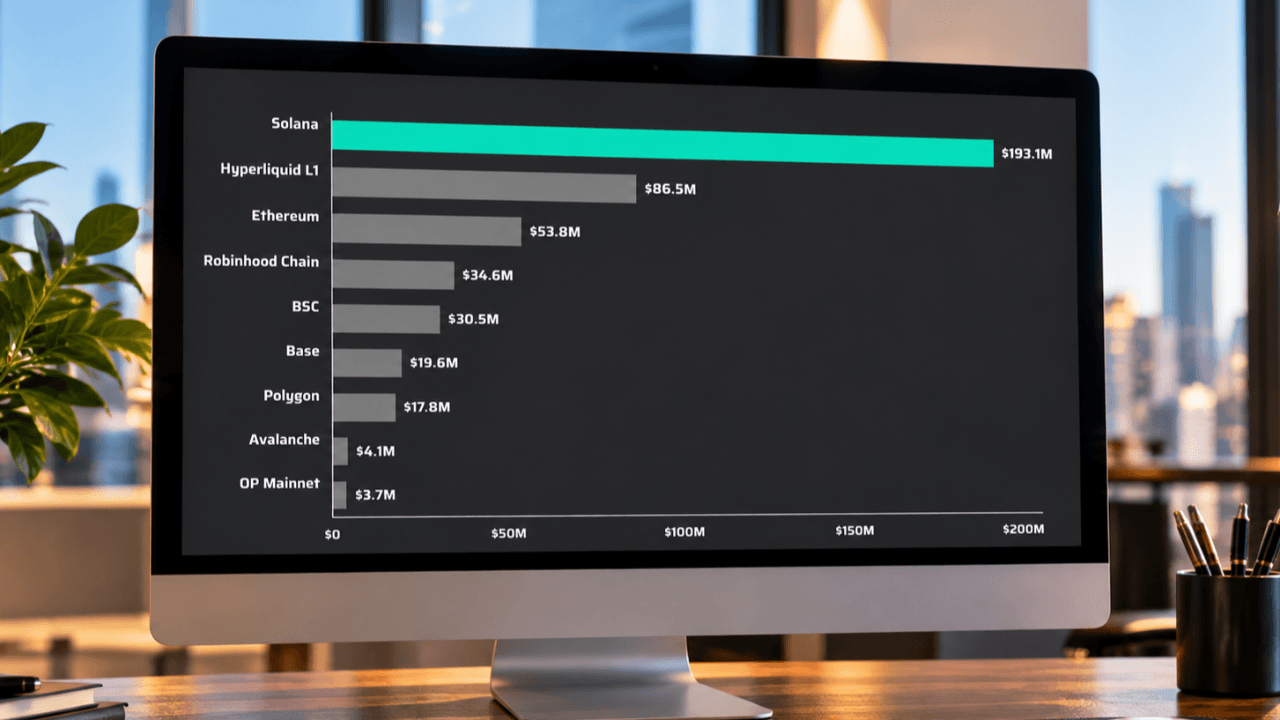
Solana has emerged as the highest-grossing application ecosystem in crypto, with apps generating $193.1 million in revenue over the past 30 days, according to research from Castle Labs. This figure nearly doubles Hyperliquid's $86.5 million, with Ethereum following at $53.8 million.
The platform's revenue engine is expanding beyond its initial growth driver. While roughly 80% of Solana application revenue still originates from consumer applications such as launchpads, trading terminals, and collectibles, the network is showing signs of economic diversification.
Consumer Apps and Revenue Distribution
Pump.fun, a token launchpad, remains the largest revenue generator, producing approximately $39 million in trailing 30-day revenue—roughly 20% of all Solana application revenue. Its associated exchange, Pumpswap, contributed an additional $15 million.
However, Solana's consumer economy is becoming less concentrated. Weekly consumer-app revenue ranged from $13.5 million to $42.6 million over the past year, with a median of $18.2 million. Eight of the ten largest applications from late 2025 remained in the top ten by the third quarter of 2026, while the top three applications' combined share of consumer revenue declined from 64% to 50.2%, indicating that newer products are capturing meaningful market share.
Real-World Assets Growth
A significant structural shift is occurring in tokenized real-world assets on Solana. The RWA market value climbed more than 600% in one year, growing from approximately $700 million to $4.37 billion. By comparison, Ethereum's RWA market expanded from $15.5 billion to $16.6 billion over the same period.
Tokenized stocks on Solana jumped from $63 million to $455 million, driven by platforms including xStocks and Backpack. More than $65 million of tokenized equities are already generating yield, while broader active RWA value in Solana DeFi exceeds $500 million, representing approximately 8% of the network's total value locked.
Testing Durability Beyond Speculation
Solana still depends heavily on speculative consumer activity, yet the ecosystem is adding lending, tokenized credit, equities, and yield-bearing assets alongside this core. The platform's next phase will be evaluated not solely by the volume of new meme coin launches, but by whether consumer revenues can coexist with deeper lending markets and productive real-world assets. If this occurs, the current $193 million monthly app revenue could represent a sustainable base rather than a cyclical peak.