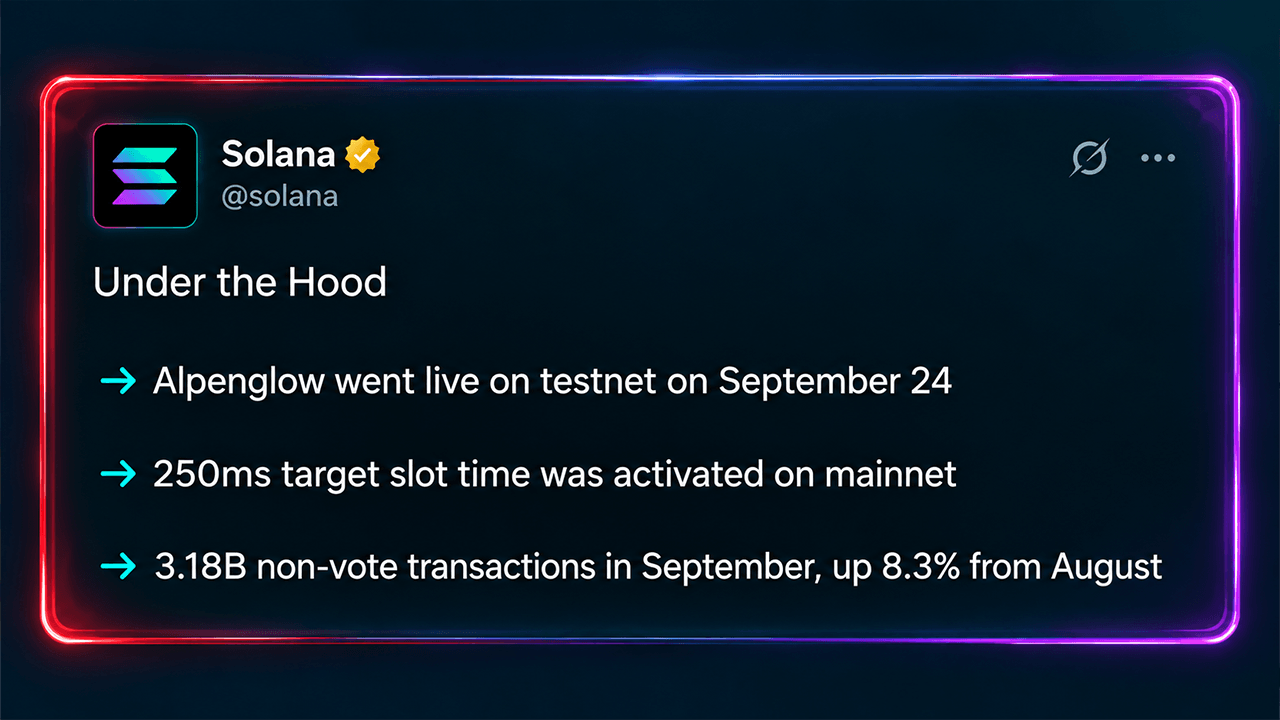
Solana Prepares for Major Consensus Overhaul
Solana-focused research and development firm Anza has announced that the network's Alpenglow upgrade is scheduled to activate on Wednesday, October 21, 2026, at approximately 14:50 UTC. Developers and documentation indicate that the upgrade is designed to make transaction finality roughly 99% faster, reducing it from the current 12.8 seconds to about 150 milliseconds.
Solana co-founder Anatoly Yakovenko previously commented on the upcoming changes after testnet implementations began, telling the public they were not ready for the update. The network currently utilizes a scheme known as TowerBFT, which requires validators to submit votes directly through the blockchain, consuming network capacity and time.
Votor Replaces Onchain Voting
Alpenglow introduces a replacement system called Votor. Instead of placing every vote on the blockchain, validators will communicate directly with one another and combine their votes into smaller records to confirm agreements more efficiently.
The network will transition over an 18-minute period where blocks contain validator votes rather than ordinary user transactions. Once the validator set reaches at least 82% of staked SOL, the layer-1 network will officially switch to Votor.
Alpenglow consists of two major components, but only Votor is scheduled for the October 21 activation. The second component, Rotor, aims to change how new blocks are distributed among validators to make communication more efficient, though it does not yet have an activation date.
Market Context
Despite the upcoming technical changes, Solana's native token, SOL, has experienced downward price movement. As of mid-October 2026, SOL has traded near $106, marking a 10% decline over a two-week period and remaining approximately 64% below its all-time high of $293 recorded in January 2025.