Stablecoin applications increasingly route around Ethereum and Solana's native tokens through fee abstraction, a technical approach that hides native-asset requirements from end users while preserving them at the network layer.
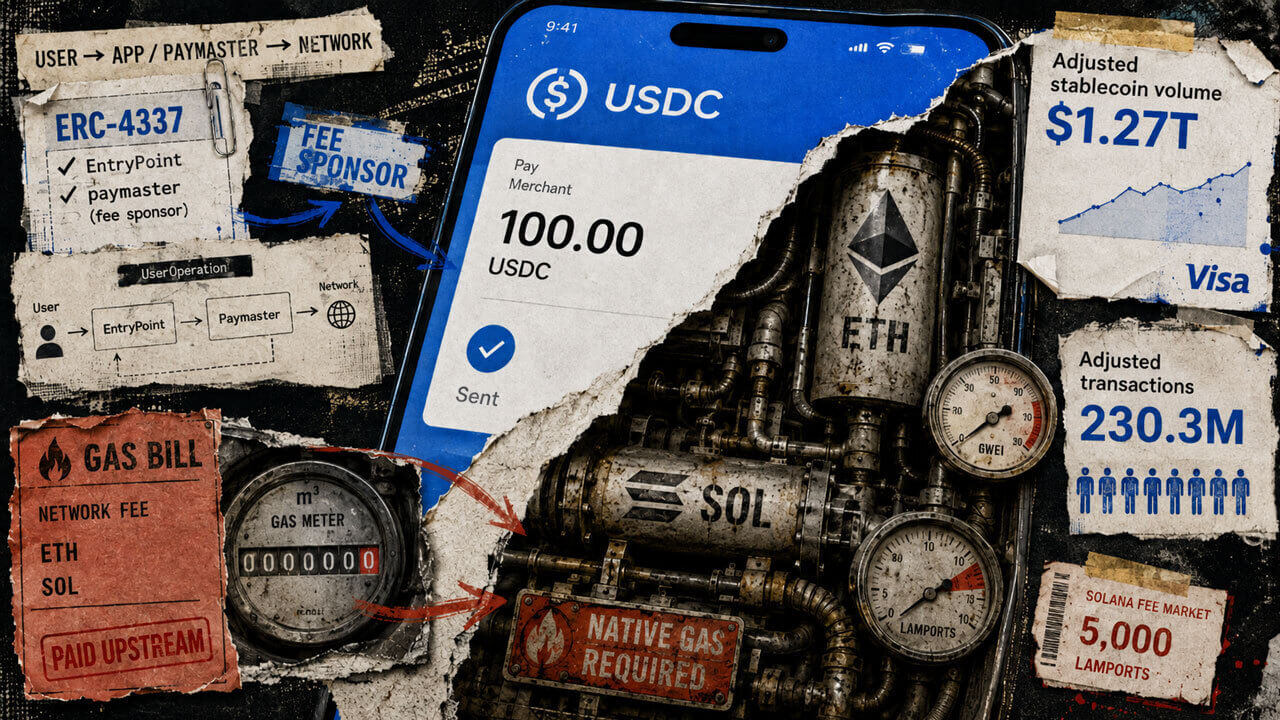
The technology works by separating three roles traditionally bundled in a single wallet: a user authorizes a transaction, an intermediary funds its execution, and the network charges its native fee. On Ethereum, account abstraction protocols like ERC-4337 enable paymasters to cover gas costs while maintaining required ETH deposits. On Solana, applications can designate alternative fee payers, allowing users to transact in stablecoins like USDC while sponsors pay SOL fees behind the scenes.
The scale of stablecoin activity underscores the significance of this shift. Visa's Onchain Analytics dashboard recorded approximately $1.3 trillion in adjusted stablecoin volume and 230.3 million adjusted transactions over a 30-day period ending August 27. Before adjustment, the same window showed roughly $6.8 trillion and 1.75 billion transactions.
Who Bears the Gas Cost
Fee abstraction concentrates native-token demand among application providers and infrastructure operators rather than individual users. Coinbase and Alchemy manage ETH deposits for Ethereum transactions, billing users in USDC or fiat. Kora similarly abstracts Solana fees, accepting SPL token payments or subsidizing costs through service margins.
Paymasters must maintain sufficient native-currency balances to cover operations, with requirements determined by gas limits, fee settings, transaction volume, and operational buffers. Similarly, Solana fee sponsors need SOL for transactions but recover costs through their own billing models applied to stablecoin payments.
Native-Token Economics Remain Unchanged
Ethereum's protocol still requires ETH for state-changing transactions, burning base fees while sending priority fees to validators. Solana's protocol mandates SOL for every transaction, with a 5,000-lamport base fee split between burning and validators, plus optional priority fees.
The architecture shifts operational responsibility upstream to fewer payers managing aggregated fee requirements rather than distributing it across millions of users. As stablecoin adoption expands, native-token demand becomes concentrated among wholesale payers rather than retail participants.
The effect on aggregate token demand remains unmeasured. Solana activity could expand while SOL value capture stays limited if stablecoin users require little native asset beyond fees. Similarly, Ethereum could host a large stablecoin economy while base-chain revenue remains comparatively thin.