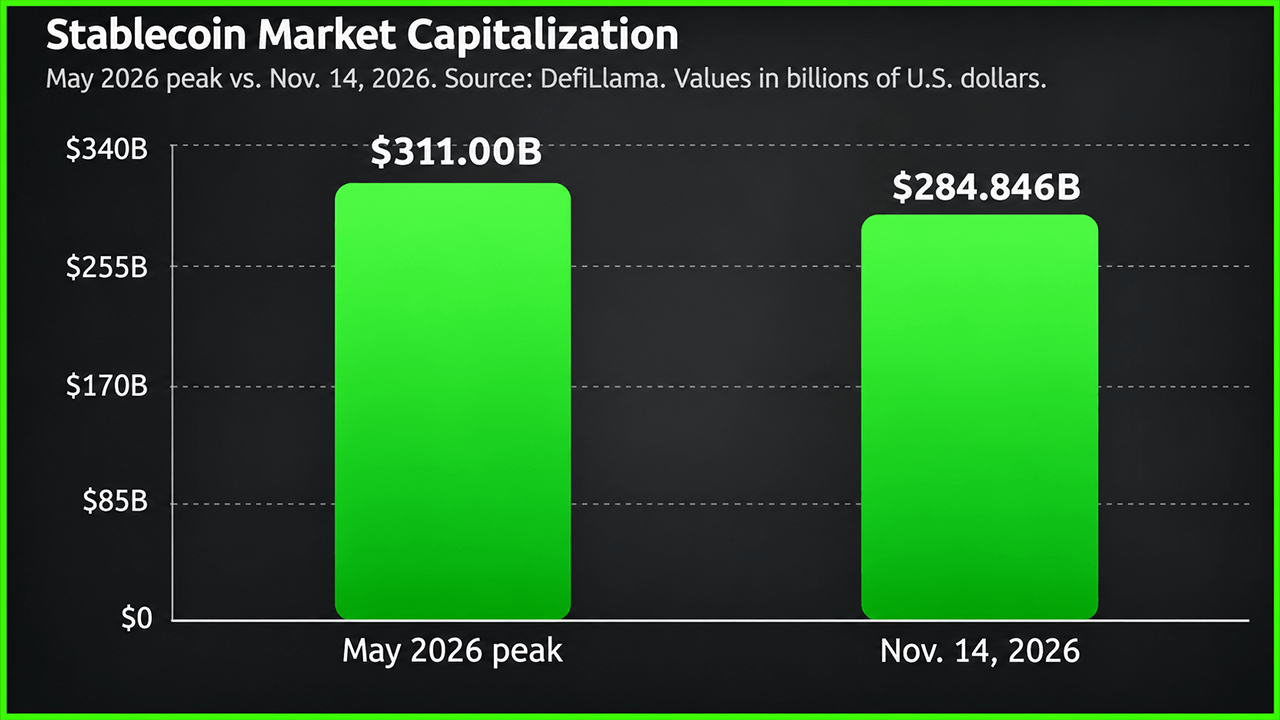
The stablecoin market has declined significantly from its May 2026 peak, with capitalization falling $26.15 billion to $284.846 billion, according to market data collected on November 14. The contraction extends beyond stablecoins to tokenized U.S. Treasury funds, which have also retreated, creating pressure across two key segments of blockchain-based dollar liquidity.
Stablecoin capitalization has fallen 8.41% from its May high, retaining approximately 91.59% of that earlier valuation. Over the preceding 30 days, the sector declined 5.36%, with smaller declines of 1.52% over seven days and 0.27% in the previous 24 hours.
Market Leaders Show Mixed Performance
Tether and Circle's USDC remain the dominant stablecoins, commanding 85.8% of total stablecoin supply despite both recording monthly declines. Tether's USDT holds $175.222 billion after declining 4.7% over 30 days, while Circle's USDC sits at $69.201 billion following a 4.9% monthly contraction.
Performance has been uneven across the broader sector. Several competitors experienced sharper reductions: Aave's GHO stablecoin declined 61.47%, USD.AI retreated 54.56%, and World Liberty Financial's USD1 shed 24.79%. Conversely, some stablecoins expanded during the period, including Ripple's RLUSD, which gained 15.12%, and Open USD, which advanced 18.52%.
Tokenized Treasuries Also in Retreat
Tokenized U.S. Treasury funds collectively represent $13.91 billion in value following a 5.36% decline over 30 days. The category includes 123 distinct assets held across 86,320 accounts, with the ten largest products accounting for approximately 85.4% of distributed value.
Major institutional products experienced varied performance. Blackrock's BUIDL fund declined 24.39% to $1.654 billion, while Wisdomtree's WTGXX recorded a 36.43% decline and Invesco's USTB fell 26.63%. Other products moved in the opposite direction, with Franklin Templeton's BENJI expanding 88.38% and Ondo's SHVon climbing 43.84%.
Interpreting Market Contraction
Stablecoins and tokenized Treasuries function as trading capital, settlement instruments, and collateral throughout cryptocurrency markets. Declining supply can indicate redemptions and reduced purchasing power available for digital assets. However, falling capitalization does not necessarily indicate widespread capital flight from cryptocurrency markets.
Institutional reallocations, transfers between issuers, and changing collateral preferences can influence supply without corresponding withdrawals from the broader ecosystem. The simultaneous contraction in both categories warrants attention, though it alone cannot establish where redeemed capital ultimately moved.