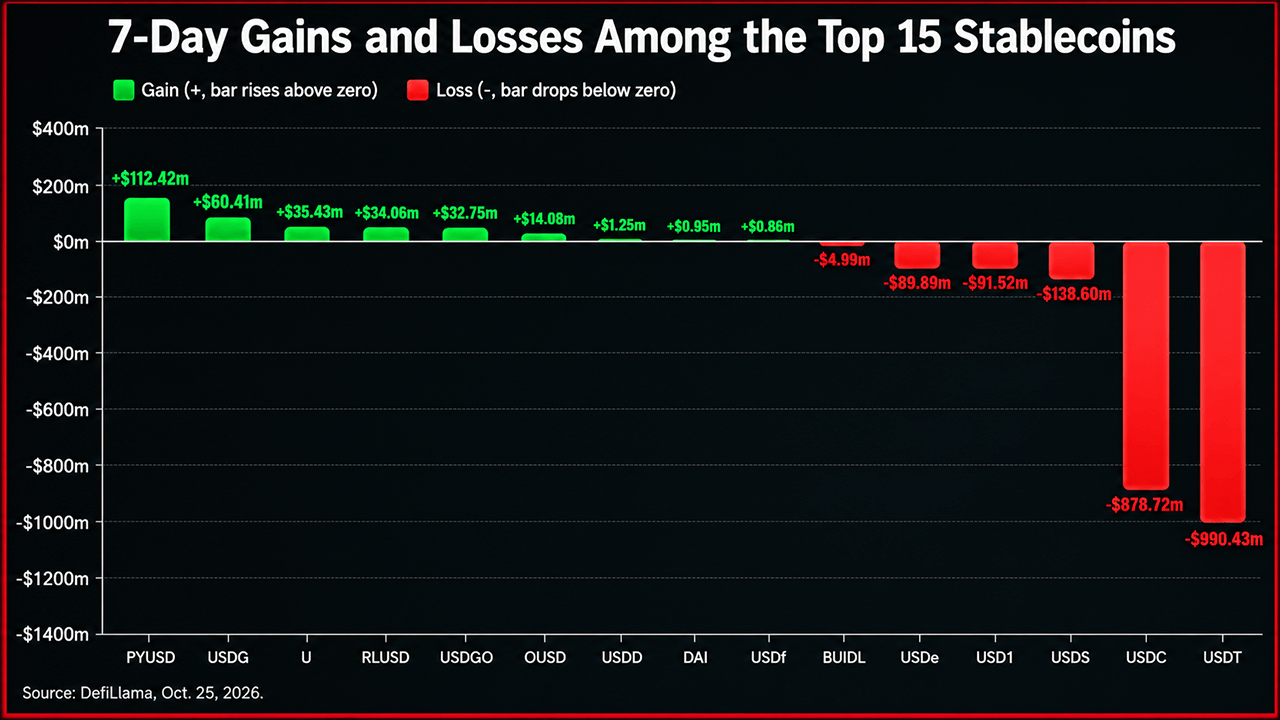
The stablecoin market has contracted by $12.73 billion since May 22, slipping to $300.36 billion as of Oct. 25, according to Defillama data. Tether's USDT and Circle's USDC dominate the retreat, with USDC alone losing $4.69 billion over 30 days.
Yet the familiar argument that a shrinking stablecoin supply spells trouble for crypto prices faces a complication: not every disappearing digital dollar has actually left the market.
USDC Takes the Biggest Hit
USDT, the largest stablecoin, carried a market capitalization of $182.423 billion, down $990.43 million over seven days and $1.29 billion over 30 days. It still commands 60.74% of the market.
USDC fared considerably worse. Its capitalization stood at $71.743 billion after shedding $878.72 million in one week and $4.69 billion over the month. Among the 15 largest stablecoins, the combined seven-day contraction reached approximately $1.90 billion.
The 13 tokens with available Defillama monthly figures registered a net $5.82 billion decline, with USDC accounting for roughly 80% of that total. Other prominent names joined the retreat: Ethena's USDe lost $305.61 million over 30 days, while World Liberty Financial's USD1 shed $444.67 million, a 10.10% decline.
Not every token shrank. Paypal's PYUSD added $239.53 million over 30 days, and Falcon's USDf expanded by $511.16 million, a 42.32% increase.
Why the Contraction Draws Attention
Stablecoins function as cryptocurrency's ready cash, allowing investors to move between digital assets without repeatedly returning to traditional banking channels. When users mint stablecoins, circulating supply generally expands. When holders redeem tokens for fiat currency, supply contracts, potentially removing capital that might otherwise purchase bitcoin, ethereum or other cryptocurrencies.
That relationship helps explain why traders interpret sustained stablecoin contractions as a bearish liquidity signal. Historical episodes offer supporting evidence: stablecoin expansion accompanied the 2020-2021 bull market and the subsequent recovery, while the contraction following Terra's 2022 collapse coincided with a prolonged cryptocurrency downturn.
Bitcoin's price near $80,000 adds another wrinkle, sitting considerably below its October 2025 record near $126,000. Still, the supply figures alone cannot establish whether redemptions caused selling pressure or simply followed deteriorating market conditions.
Tokenized Treasuries Complicate the Picture
Tokenized U.S. Treasury products, including Blackrock's BUIDL and Ondo's USDY, represent yield-bearing alternatives to traditional payment stablecoins. Their combined capitalization also contracted, slipping from $16.2 billion on Aug. 12 to $14.65 billion on Oct. 25, a $1.55 billion decline, according to rwa.xyz data.
Treating those redemptions as equivalent to stablecoin withdrawals misses a critical distinction. Treasury investors might redeem positions to acquire stablecoins, purchase risk assets or return capital to conventional financial accounts. The direction of that money matters more than the redemption itself.
Even within stablecoins, declining supply does not automatically establish an exodus. Regulatory conversions, changing collateral preferences and faster transaction turnover can alter balances without producing an equivalent reduction in available trading liquidity.
A Harder Question for Traders
The contraction is real, and USDC's multibillion-dollar retreat warrants attention. But aggregate supply is a blunt instrument for measuring investor intentions. Exchange-level balances, issuance patterns, redemption destinations and capital moving into yield-bearing instruments offer a more complete picture of deployable liquidity.
For traders treating every disappearing stablecoin as a bearish omen, the question is not simply how many digital dollars remain, but whether those dollars have left the market or merely moved elsewhere.