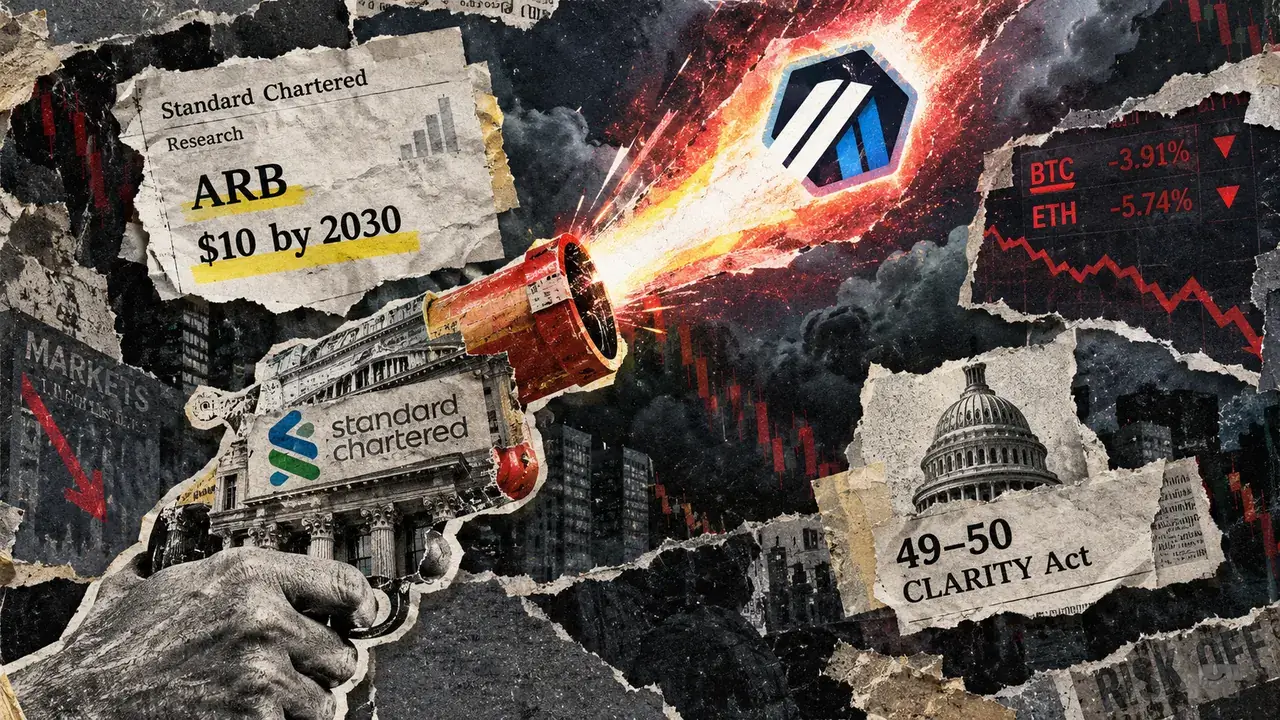
Standard Chartered initiated coverage on Arbitrum's ARB token on September 15 with a $10 price target for 2030, implying roughly 70 times upside from its then-price near $0.13. On the same day, ARB gained up to 9% while Bitcoin fell around 4% and Ethereum fell 5.74% following the Senate's failure to advance the CLARITY Act.
ARB's movement against the broader market coincided with the bank's coverage initiation, raising questions about whether institutional research notes have become tradable events themselves in cryptocurrency markets.
The Arbitrum Investment Thesis
Standard Chartered's price target moves through intermediate steps from $0.50 in 2026 to $1.50 in 2027, $3.50 in 2028, $6.50 in 2029, and $10 by end of 2030. The underlying case rests on Arbitrum becoming infrastructure for tokenized traditional finance, anchored by the Arbitrum Expansion Program, under which chains built on the Arbitrum stack remit 10% of net protocol revenue back to Arbitrum.
Robinhood Chain serves as a flagship example. Standard Chartered projects tokenized assets reaching $4 trillion by end of 2028, up from roughly $340 billion today.
Measuring the Market Response
Standard Chartered's note reached the public feed at 7:50 a.m. ET, with ARB then trading near $0.13. On a same-session basis, ARB gained 5.77% while Bitcoin fell 3.91%, Ethereum fell 5.74%, and an equal-weighted basket of rival layer-2 tokens fell 7.45%, resulting in abnormal returns of 9.68 percentage points against Bitcoin and 13.21 percentage points against its own peer group.
In August, other tokens showed varied responses to Standard Chartered coverage: UNI rose 22.5% around initiation, MORPHO gained more than 13%, and AAVE added 5.6%, while LINK fell 0.8% around its initiation. The timing does not prove causation, but the pattern warrants examination.
Questions About Institutional Credibility
Standard Chartered has cut targets sharply when its thesis stopped working, including a 65% reduction to its XRP price target, strengthening the case for treating initiations as short-term catalysts regardless of long-term accuracy.
ARB stands as the cleanest case, since it moved against Bitcoin, Ethereum, and its own sector peers simultaneously. Standard Chartered's research appears most likely to produce abnormal repricing when it attaches an institutional valuation framework to an under-covered DeFi or infrastructure token.
Future Value Accrual Remains Uncertain
Arbitrum reported $6.19 million of first-half 2026 income at gross margins above 97%, alongside more than $70 billion in average monthly stablecoin transfers. After Robinhood Chain went live in July, users paid a record $3.75 million in fees on September 1; AEP licensing fees contributed $360,000 in July.
ARB holders currently have no direct claim on the network revenue Arbitrum generates. The bank's 70x case depends on that value-accrual gap eventually closing through some future governance or buyback mechanism that does not yet exist.