A new study of the XRP Ledger's network architecture suggests a straightforward modification could substantially improve its resilience against targeted attacks aimed at disrupting consensus.
According to an August 26 arXiv paper, the XRP Ledger's consensus mechanism depends on trusted validators successfully exchanging messages through a peer-to-peer network. Researchers modeled how adding extra random connections between nodes could maintain validator communication even if attackers remove highly connected network hubs.
Key Findings
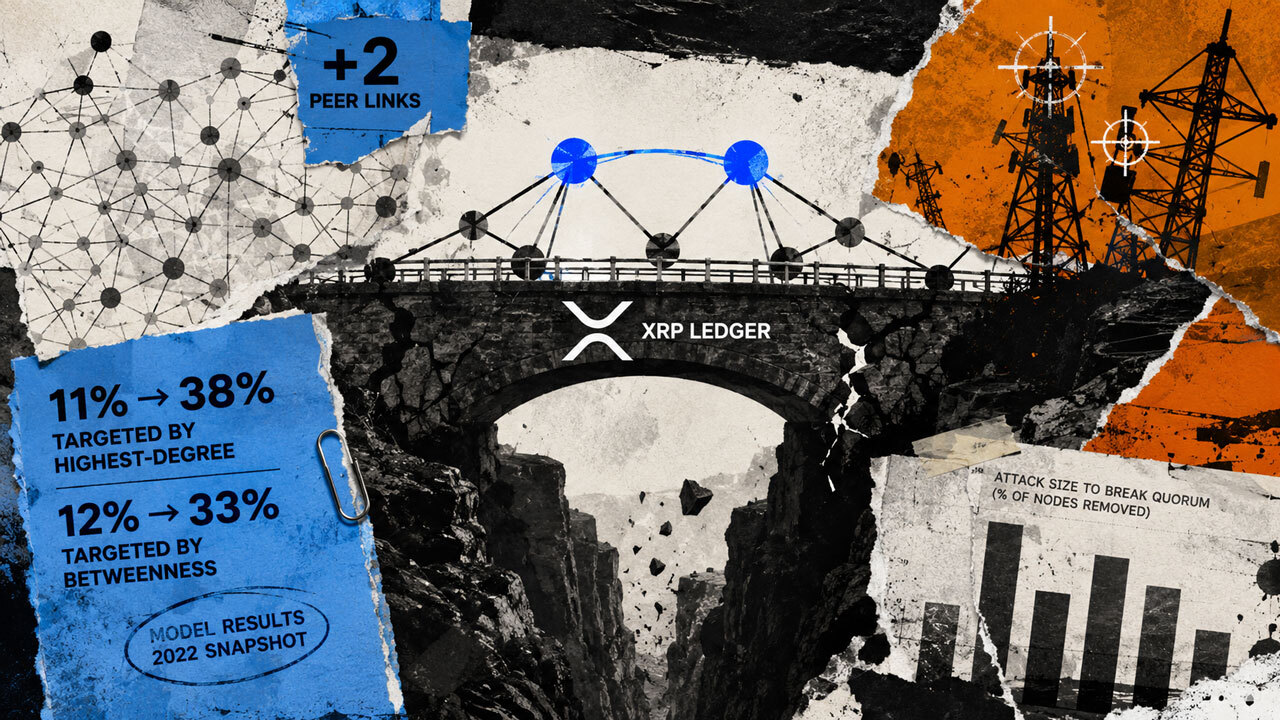
The study tested a method called random K-out augmentation, where each node creates between two to three new connections to randomly selected peers. On a representative 2022 network snapshot with 952 nodes, the results showed substantial improvements:
- At 60% network participation with two additional connections per node, the number of nodes an attacker must remove to disrupt consensus rose from 11% to 38% under targeted attacks on high-degree nodes
- Under attacks prioritizing nodes that control many shortest paths, the threshold increased from 12% to 33%, representing a 2.75-fold improvement
- At higher participation levels, three additional connections per node matched or exceeded protection provided by more extensive network rewiring
The random augmentation approach preserved approximately 85% similarity with the original network structure, while more aggressive rewiring strategies altered the network far more substantially.
Limitations and Real-World Considerations
The research used network data collected over two months in 2022, and the authors acknowledge significant gaps between their model and current conditions. The XRP Ledger's live network now shows different node counts and topology characteristics, requiring updated measurements and testing.
Implementation would face practical challenges beyond the network model. The current software maintains default limits on peer connections, and increasing connections requires coordination among node operators. Additional peers would increase bandwidth consumption, and operators may prefer private connections for security reasons.
The authors released their simulation code and data, but emphasized that the 9%, 12%, 33%, and 38% thresholds remain theoretical outputs. Testing the approach on the mainnet XRP Ledger would require current network topology data and operational trials of how random peer connections are selected, accepted, and maintained in practice.