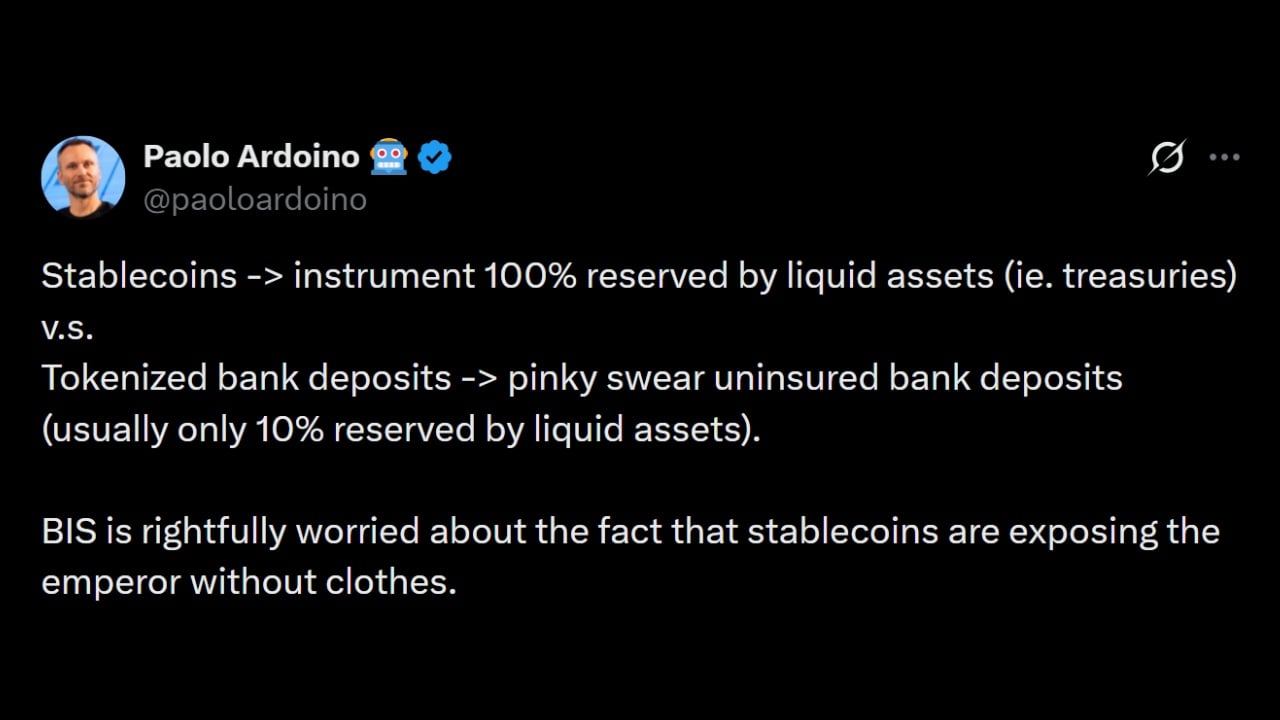
Tether CEO Paolo Ardoino issued a pointed rebuttal to recent remarks from the Bank for International Settlements, asserting that stablecoins represent a more trustworthy form of money than tokenized bank deposits due to their full collateralization with U.S. Treasuries.
BIS Promotes Tokenized Deposits Over Stablecoins
Pablo Hernandez de Cos, General Manager of the BIS, had stated that stablecoins are not an effective substitute for fiat money, citing issues including poor redeemability, supply problems, interoperability challenges, and their potential to facilitate criminal activity. De Cos instead advocated for tokenized bank deposits as a more direct path to leveraging tokenization while preserving the foundations of the existing monetary system.
Ardoino Calls Out Fractional Reserve Risk
Ardoino countered that the BIS's concerns reflect unease over stablecoins exposing the fragility of fractional-reserve banking. He noted that stablecoins are almost fully backed by U.S. Treasuries, whereas tokenized bank deposits are typically supported by only about 10% in liquid assets.
"Why someone should choose to put his savings into a fractional reserve product while stablecoins are fully reserved?" Ardoino asked, framing the BIS position with the expression "the emperor has no clothes."
Stablecoin Growth and Emerging Market Adoption
Tether's USDT has surpassed a market capitalization of $183 billion. Ardoino highlighted that several economies rely heavily on USDT for both domestic and international commerce, underscoring the asset's growing role outside developed markets.
Legislative Stakes and Deposit Flight Fears
The dispute arrives amid debate over the Digital Asset Market Clarity Act, known as the CLARITY Act, in the United States. Banking interests have expressed concern that the legislation could accelerate deposit flight to stablecoins if crypto exchanges are permitted to issue rewards on those products. Ardoino acknowledged the possibility, stating that the question of what happens if people realize stablecoins are safer and move their savings into them is now in the "find out phase."