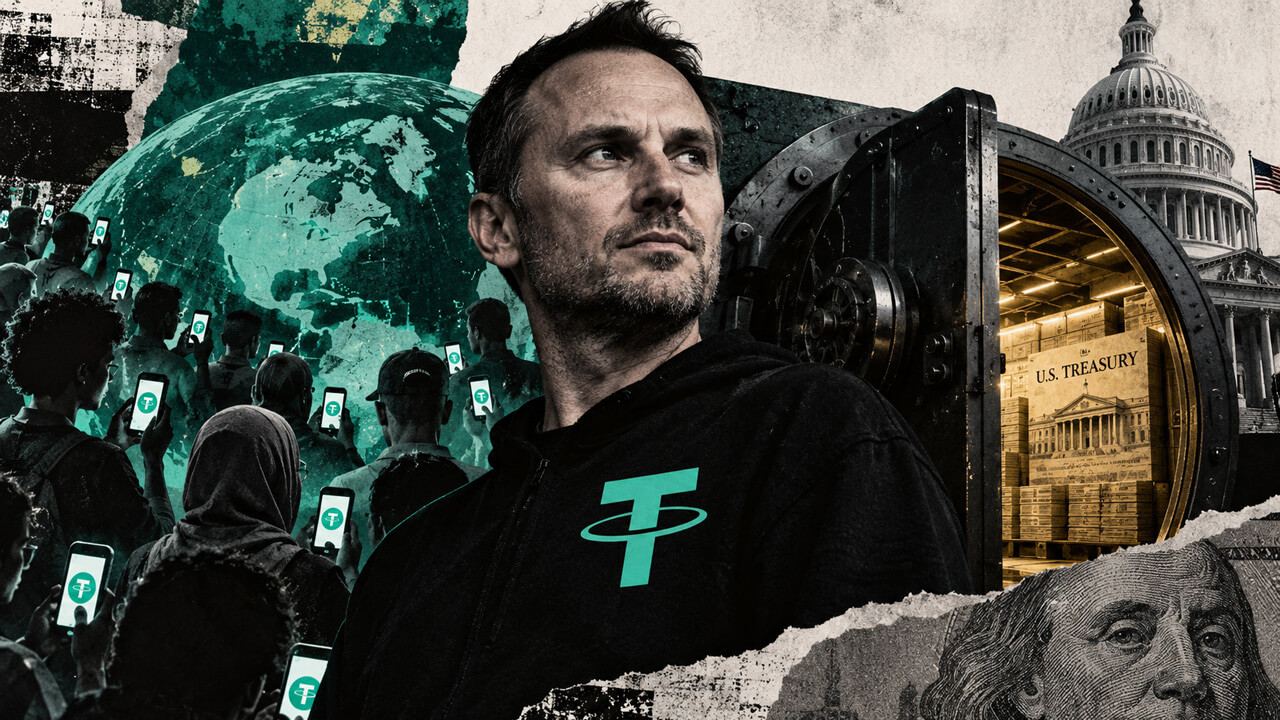
Tether CEO Paolo Ardoino recently argued that the company has created "the decentralized ownership of the US debt" through 650 million people holding USDT stablecoins who are "basically holding some US Treasuries." His stated concern was concentration risk—hundreds of millions of users are unlikely to collectively sell US debt simultaneously, unlike a foreign government might.
The macroeconomic argument has merit. Demand for USDT provides Tether with capital that it allocates partly to Treasury-heavy reserve portfolios. However, the framing conflates distinct legal relationships. According to Tether's own documentation, users own USDT tokens, verified customers hold a contractual right to redeem with Tether, and Tether International owns and manages the actual reserve assets.
The 650 Million Figure
The 650 million user count comes from Tether itself and is not independently verified. In an August 13 audit announcement, the company reported that more than 650 million users across emerging markets rely on Tether daily without publishing its methodology. Tether's methodology acknowledges that one person can control multiple wallets and includes estimates of people holding USDT through centralized services. The company's 2025 fourth-quarter report estimated 534.5 million users using a comparable approach.
What USDT Holders Actually Own
Tether's terms define the right to redeem tokens as a personal contractual right, administered by Tether and requiring customer verification. According to Tether's Relevant Information Document, after a customer sends fiat currency and receives tokens, Tether holds or invests those funds in a basket of reserves that can change at Tether's sole discretion.
USDT holders own transferable tokens denominated in dollars. They do not own a pro rata share of the underlying reserves. Reserve assets sit on Tether's side of the structure, not the user's. Tether International owns these assets directly and is entitled to any investment gains above the token's face value. Holders receive redemption value equal to the token's face value, less fees, but not a share of portfolio gains.
Direct redemption access is narrower still. Tether's fee schedule sets a $100,000 minimum for direct acquisition or redemption with an additional cost of $1,000 or 0.1%, whichever is greater. Applicants must complete verification, and Tether retains sole discretion to approve or reject verification requests. Tether's legal terms permit the company to delay or suspend services, including redemptions, in various circumstances including suspected prohibited use, legal requirements, or risks Tether considers unacceptable.
Most USDT holders sell their tokens through secondary markets on exchanges rather than redeeming directly with Tether, transferring tokens to other buyers instead of reducing Tether's liabilities.
Treasury Holdings Remain Substantial
As of June 30, Tether International reported $187.751 billion in reserve assets against $183.642 billion in liabilities. The portfolio included $114.961 billion in direct US Treasury bills and $18.626 billion in overnight reverse-repurchase exposure collateralized by approximately $18.596 billion of US Treasuries—distinct positions that should not be combined.
The scale of Tether's Treasury exposure explains Ardoino's framing. Broad demand for USDT creates economic dependence on a company whose reserve allocation generates substantial demand for short-term government debt. However, distribution of USDT across wallets and platforms does not translate to distributed ownership of the underlying assets. Legal title to reserves, portfolio control, and investment returns above token face value remain centralized at Tether.