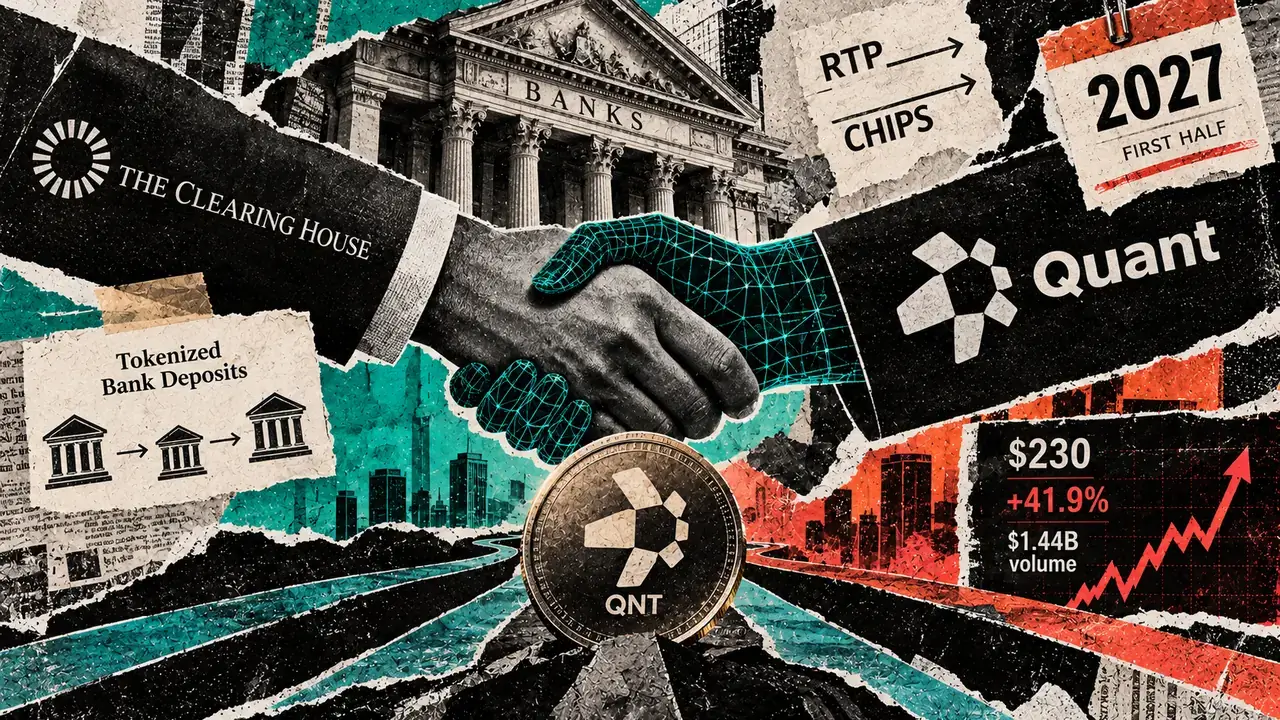
The Clearing House, a bank-owned US payments operator, has selected Quant to supply software for a network designed to facilitate tokenized bank deposits across institutions. The September 24 agreement marks a significant step toward implementing The Clearing House's On-Chain Money Initiative, announced in June.
Under the arrangement, Quant will provide the software layer that connects systems, orchestrates activity, and manages transactions on the network. The technology is intended to link the network to RTP and CHIPS, two existing Clearing House payment systems, while connecting to established fiat payment infrastructure.
The planned network would enable banks to clear and settle tokenized commercial-bank deposits, with these digital representations remaining claims on the issuing banks. Quant will also offer Tokenized Deposits-as-a-Service to participating US institutions through The Clearing House that lack their own tokenized-deposit capability. The network is expected to become available to participating institutions in the first half of 2027.
Uncertainty Surrounding QNT Token Requirements
A central question remains unresolved: whether transactions on the network will require or utilize Quant's QNT utility token. Neither The Clearing House nor Quant has stated that participating banks must acquire, hold, or use QNT, nor have they disclosed whether the token would be used for settlement, network fees, or as a burned asset.
Quant's published service terms indicate that fees for its products and services can be paid through multiple methods, including US dollars or QNT subscriptions. The company's FAQ explicitly states that platform fees can be paid in US dollars or subscriptions made with QNT, leaving fiat payment as an option.
While Quant's general terms define QNT as a utility token customers may use for products and services, the bank-network announcements do not establish a direct link between deposit transfers and QNT acquisition or use. Revenue to Quant from software and services would operate separately from demand for the utility token.
Market and Outlook
QNT experienced significant price volatility following the announcement. The token registered an intraday high of $373 on September 27 before retracing substantially, reaching an intraday low of $195.35 on September 28 before rebounding.
According to The Clearing House, its existing wire, ACH, check-image, and real-time-payment networks clear and settle over $2 trillion each day. The new tokenized deposits network aims to integrate with this established infrastructure.
The selection supports Quant's involvement in planned bank infrastructure, though the path from the network's future activity to demand for QNT tokens remains unspecified. Further disclosures about token requirements, fee mechanics, and transaction volumes could clarify expectations for QNT demand.