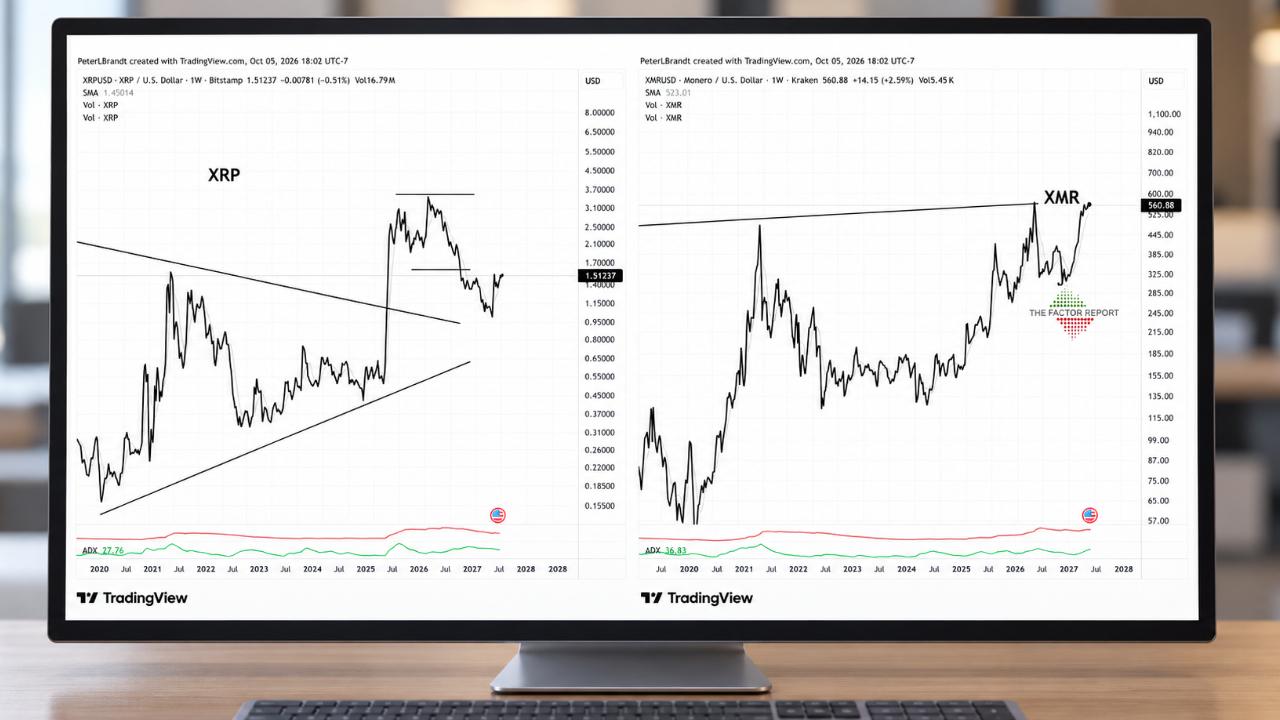
Veteran trader Peter Brandt identified a potential price target of $2.16 for XRP while highlighting technical obstacles to its advance. In an Oct. 5 post, Brandt, founder of Factor Trading, outlined his analysis comparing multiple altcoin charts and expressed a preference for Monero's technical position.
Brandt described Monero as his strongest choice among the altcoins examined, noting that he viewed all of its overhead supply as already absorbed. He characterized Monero as having "clear sailing ahead" in its chart setup.
For XRP, Brandt identified concerns that could limit gains. He noted the presence of substantial overhead supply above current market prices, which could result from investors who purchased at higher levels selling during a recovery. This supply overhang could create resistance and restrain further advances.
XRP Chart Pattern Analysis
Brandt identified a potentially bullish cup-and-handle pattern in XRP, which consists of a rounded recovery followed by a smaller pullback. He suggested this smaller formation might represent the right shoulder of a larger inverted head-and-shoulders pattern, a reversal configuration with three troughs where the middle trough is deeper than the others.
The $2.16 objective was derived using a measured move calculation based on daily closing prices. Brandt noted that the right shoulder remains poorly formed and abbreviated, making further development likely though not required. He cautioned that chart targets are not guaranteed and patterns can evolve differently than anticipated.
Comparison to Earlier Projection
The $2.16 daily target differs from a separate monthly XRP projection toward $5.40 that Brandt shared on Sept. 21. He did not present the $2.16 figure as a replacement for or midpoint toward the longer-term level.
Brandt emphasized that his analysis is based on price action and chart patterns rather than fundamental factors. He compared XRP unfavorably to Solana's SOL cup-and-handle pattern while noting that Ethereum and Stellar faced similar overhead supply constraints, though to varying degrees.