Papertrade's first weekend of live trading produced a stark lesson in high-leverage trading dynamics. One wallet generated profits exceeding $1.28 million during the exchange's initial hours, only to see $450,000 evaporate when 30 short positions were liquidated on Saturday night.
The trader executed 305 trades in the first eight hours after launch, with peak gains reaching $1.73 million before the sharp reversal. The wallet belongs to a trader with a significant track record on Hyperliquid, the decentralized derivatives venue that Papertrade builds on.
How Papertrade Operates
Papertrade launched live trading on HyperEVM on October 10, 2026, offering perpetual futures contracts with up to 1,000x leverage on Bitcoin and ETH. At that leverage level, a 0.1% price move against a position is sufficient to trigger liquidation.
The exchange operates without traditional liquidity providers. Winning traders are paid from a pool called the "Martingaler LP," funded entirely by trader losses and liquidations. Prices are derived from the midpoint of Hyperliquid's best bid and best offer, rather than an internal order book.
Traders who realize losses are compensated by minting PAPER, the platform's native token. While the liquidity pool remains below $2 million, the initial rate is 100 PAPER for every $1 lost. PAPER holders who stake their tokens earn a share of protocol revenue, which is generated by trader losses.
Launch Day Metrics
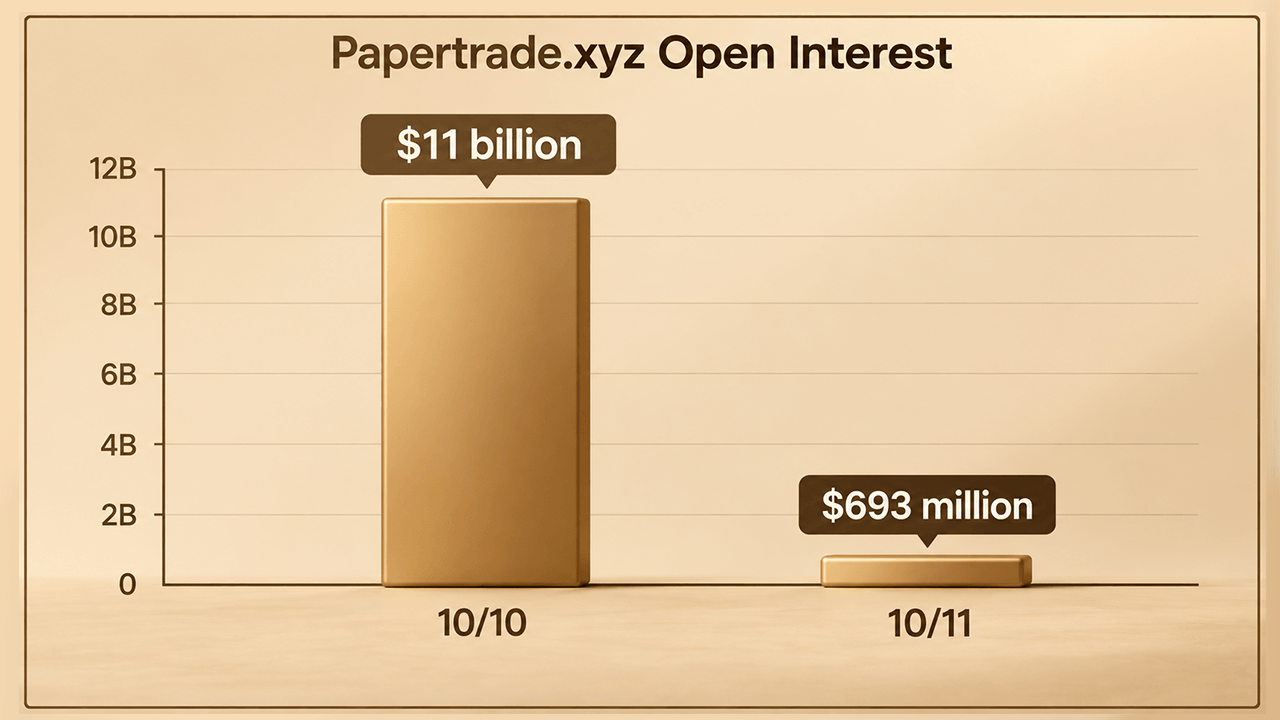
Pre-deposits exceeded $137 million from more than 11,000 addresses before trading commenced. On launch day, notional volume reached $14.4 billion, with open interest in BTC contracts hitting $3 billion.
Net realized trader losses on launch day were approximately $18.2 million to $18.6 million. Staker rewards, funded directly by these losses, totaled roughly $10.3 million to $12.6 million.
Structural Challenges Ahead
The exchange's pricing mechanism is drawing scrutiny. Using the midpoint of Hyperliquid's BBO as a price feed creates a potential manipulation vector, particularly at 1,000x leverage where minimal distortions can trigger liquidations.
Liquidity constraints present another concern. Because payouts depend on a pool filled only by trader losses, a sustained period of winning trades could strain the system and create payout delays during high-leverage trading phases.
For PAPER stakers, returns depend on a steady stream of trader losses. If traders become more cautious following early wipeouts or migrate to other platforms, the revenue supporting staking rewards could diminish.