Trezor has enabled clear signing across its hardware devices through the adoption of the ERC-7730 standard. The development was confirmed by both Trezor and the Ethereum Foundation on September 8, extending a broader security initiative to a new set of hardware devices.
Previously, users relied on blind signing, where transactions appeared on computer screens as descriptions like a token swap, but the actual data sent to the wallet arrived as unreadable hexadecimal calldata or a raw hash. This gap left users vulnerable if their computer was compromised, as they had no way to verify the transaction details directly on their physical device. The Ethereum Foundation has linked this vulnerability to major crypto thefts, including the $1.5 billion Bybit breach.
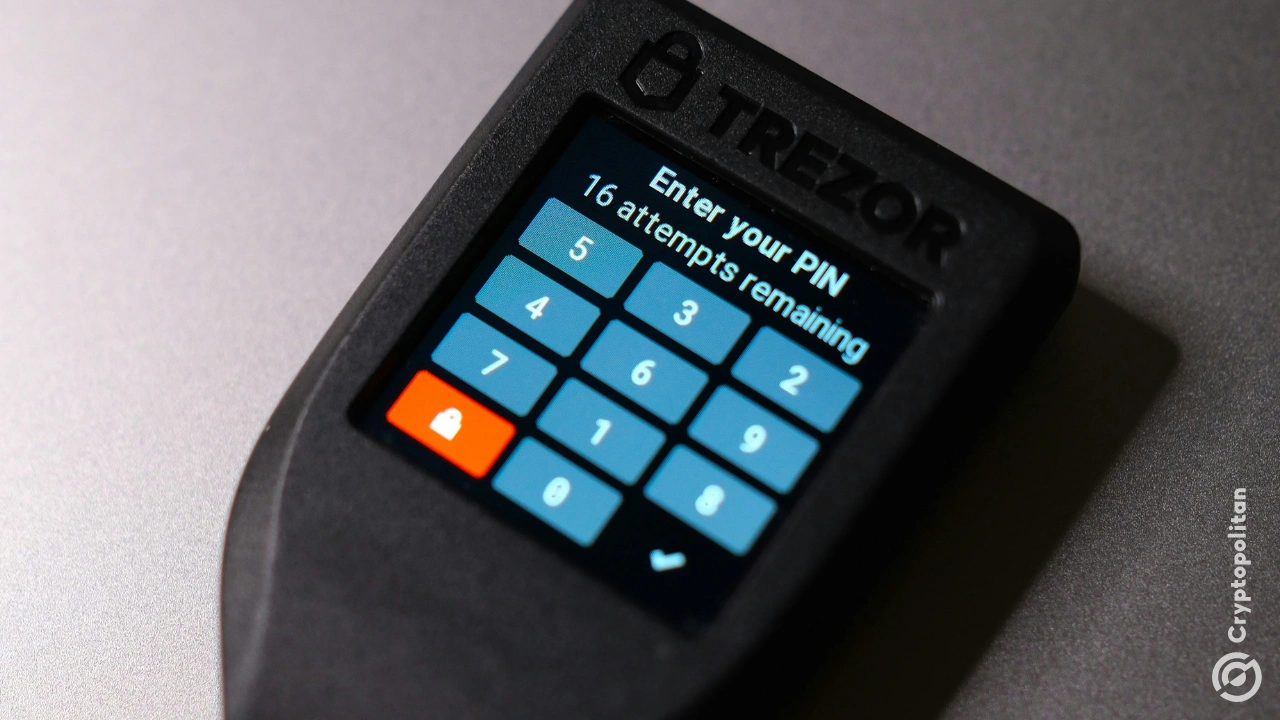
With clear signing active, a supported Trezor device decodes smart contract transactions and displays the actual action, tokens, amounts, and destination on the device screen. Trezor stated that the feature works automatically without requiring users to install or toggle settings, functioning through Trezor Suite, WalletConnect, and Trezor Connect while keeping the standard workflow unchanged.
The feature is available on the Trezor Safe 7, Safe 5, Safe 3, and Model T, though the Trezor Model One is not supported. At launch, supported protocols include 1inch, Aave, Lido, Tether, LiFi, and Hyperliquid, with additional networks in development.
The ERC-7730 standard was originally created by Ledger as an internal feature before being formalized in 2024. Governance was later handed over to the Ethereum Foundation to maintain neutrality. Descriptors for the standard are stored off-chain in a registry at clearsigning.org, allowing existing contracts to adopt the format without requiring redeployment. An attestation layer allows independent auditors to verify that a descriptor matches the behavior of a contract, while the Ethereum Foundation's Trillion Dollar Security Initiative acts as the steward of the registry.