Federal Crypto Ambitions and Legal Constraints
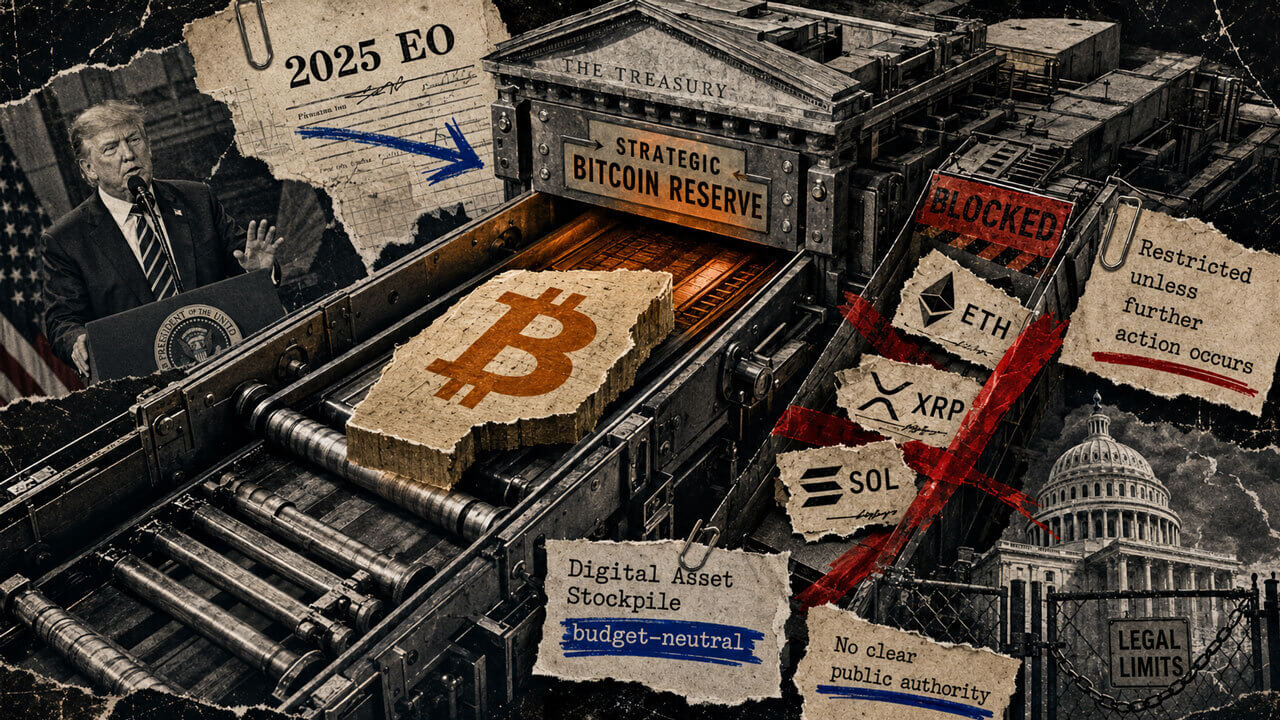
President Donald Trump stated that the United States is considering accumulating significant amounts of Bitcoin and other cryptocurrencies. However, current federal law and funding mechanisms limit how the administration can increase these holdings without congressional approval.
Under a 2025 executive order, the Treasury and Commerce departments are directed to develop budget-neutral acquisition strategies for Bitcoin. For non-Bitcoin assets such as Ethereum, XRP, and Solana, acquisitions are currently restricted to forfeiture and civil-money-penalty channels unless further executive or legislative action takes place. While a second executive order could potentially lift the restriction on altcoin acquisitions, Congress retains authority over federal appropriations and statutory investment powers.
Current Channels for Accumulating Digital Assets
Without a funded open-market purchase program, federal crypto holdings grow primarily through alternative legal routes:
- Forfeitures: Cryptocurrencies obtained through final criminal or civil forfeiture proceedings enter the Strategic Bitcoin Reserve or the Digital Asset Stockpile, though the timing and size depend on specific legal cases rather than policy targets.
- Gifts: Section 321(d) of Title 31 allows the Treasury secretary to administer donated personal property that aids Treasury's work. Because Bitcoin qualifies as personal property, this presents a plausible route for accepting donated BTC.
- Tax Payments: Section 6311 of the Internal Revenue Code allows the Treasury to receive taxes through commercially acceptable means chosen by the Secretary, though the IRS does not currently accept digital assets and retention authorities remain unresolved.
Proposals Requiring Congressional Action
Several legislative proposals and alternative financing ideas have been introduced to establish scheduled federal crypto accumulation, but none have yet become law:
- The BITCOIN Act proposes adding Bitcoin to the Exchange Stabilization Fund and establishing a program to purchase 200,000 BTC per year for five years.
- The Bitcoin for America Act would expressly allow federal taxes to be paid in Bitcoin and direct those funds into the reserve.
- The American Reserve Modernization Act of 2026 would authorize the Treasury to sell or convert non-Bitcoin stockpile assets to increase the Bitcoin reserve or reduce national debt.
Other concepts, such as utilizing tariff revenue, gold certificate revaluations, Federal Reserve open-market authorities, or a proposed sovereign wealth fund, similarly require explicit congressional authorization before funds can be directed toward purchasing digital assets.
Without congressional action to create scheduled purchase authority and dedicated financing mechanisms, federal crypto holdings will likely continue to grow irregularly through existing legal channels rather than a predictable, multibillion-dollar sovereign buying program.