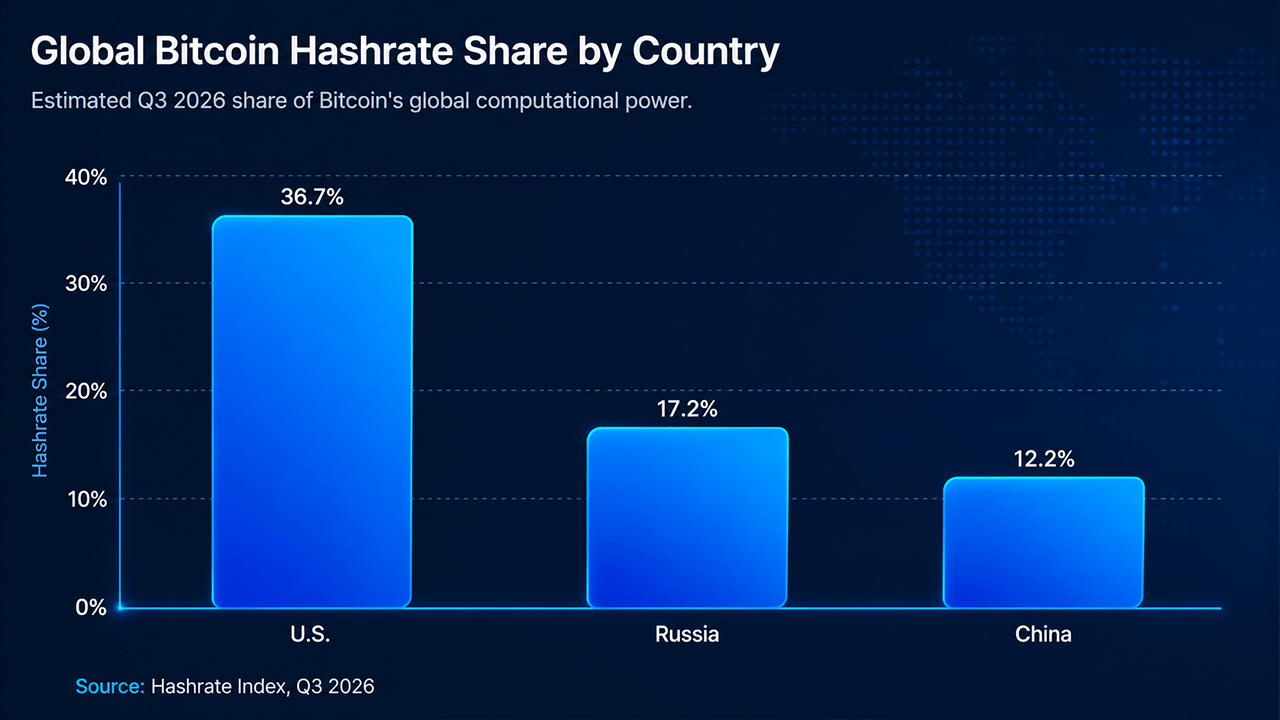
The United States has seen its share of Bitcoin's hashrate decline by 0.823 percentage points during the first eight weeks of 2026's third quarter, according to hashrateindex.com data. The U.S. began the year commanding 37.523% of the network's total hashrate but has fallen to 36.7% as of late August.
Despite remaining the world's largest Bitcoin mining hub, the U.S. has lost approximately 55 exahash per second (EH/s) of computational power since January. Russia and China, the second and third largest mining nations, have both increased their global share despite experiencing absolute losses in hashpower.
Global Mining Shifts
Russia held 16.417% of Bitcoin's hashrate at the start of 2026 and now commands 17.2%, though its actual computational capacity fell from 175 EH/s to 162 EH/s. China expanded its share from 11.276% to 12.2% while its hashpower decreased from 125 EH/s to 115 EH/s.
Bitcoin's total network hashrate has declined significantly, falling from above 1,000 exahash per second at the beginning of the year to 892.35 EH/s as of late August.
Regional Changes
Paraguay emerged as an outlier among major mining nations, increasing its global share from 4.034% to 4.7% and gaining 1 EH/s of hashpower. Other jurisdictions experienced declines: Kazakhstan dropped from 2.064% to 1.6%, Oman fell from 3.002% to 2.8%, and Ethiopia decreased from 2.58% to 2.4%.
Canada saw a modest decline from 2.627% to 2.6%, losing approximately 4 EH/s over the eight-month period.
Hashprice Recovery
Bitcoin mining profitability has increased substantially. The daily revenue per petahash per second jumped 27.42% over 30 days, rising from $31.66 to $40.34. This recovery in hashprice could attract new mining operations globally and further reshape the industry's geographic distribution.