Tokenized Assets vs. Traditional Equities
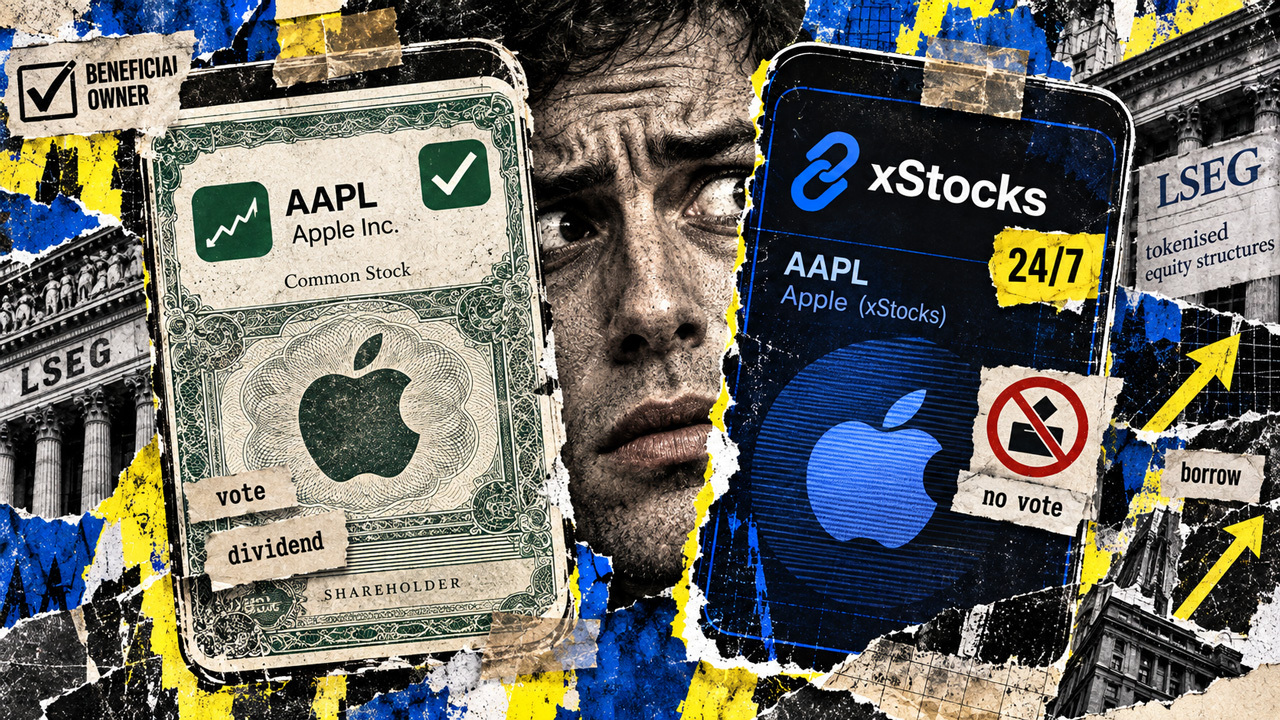
Two investors opening different investment apps might see the same company name and a similar price, yet hold entirely different assets. While both benefit if the asset price rises, the distinction between holding direct shares and holding a token designed to follow those shares determines what the owner is actually entitled to receive or control.
Familiar tickers and buy buttons make transactions look and feel like buying stocks, even when the underlying contract differs. The London Stock Exchange (LSE) is exploring ways to bring shares onto blockchain networks while preserving shareholder rights, announcing plans in September alongside Payward regarding structures still under assessment and subject to regulatory approval. Separately, the LSE plans to list xStocks on its LSE 24 venue in 2027, pending approval.
What Direct Ownership Entitles You To
Shares represent ownership interests in companies. Common shareholders typically participate in a business's financial fortunes, vote on certain corporate decisions, and receive eligible dividends. If a business fails, shareholders hold a residual claim, receiving whatever remains after higher-ranking claims are settled.
Most investors do not appear personally on every record administering these rights; instead, brokers typically hold shares through nominees, making investors beneficial owners. Tokenization introduces another way to maintain and transfer records using digital units on a blockchain network. Companies could use this technology for their own shares, where transferring tokens transfers the shares themselves, preserving existing rights.
The Structure of Third-Party Token Products
A more complex arrangement occurs when an unrelated third party creates a product linked to a company's shares. In these scenarios, a business buys shares, keeps them with a custodian, and issues tokens intended to track the value of those holdings. The original company has not necessarily issued anything new or entered a direct relationship with the token buyer.
For example, Kraken's xStocks documentation notes that tokens are backed by underlying equities, but holders do not receive underlying shareholder voting rights. Dividends are reflected through adjustments to effective holdings rather than separate cash payments, and the tokens cannot be transferred into ordinary brokerage accounts as underlying shares.
Comparison of Share and Token Structures
- Ordinary shares through a broker: Investors hold beneficial ownership with voting rights subject to share class and account terms, and dividends are normally credited through the account.
- Company-sponsored tokenized shares: Investors hold the share itself if legal records and token transfers are integrated, with voting and dividends determined by the share class and issuer arrangements.
- xStocks: Investors hold separate tokens providing price exposure without underlying shareholder votes under published terms, and economic benefits are reflected in adjusted holdings.
Trading Mechanics, Borrowing, and Stability Risks
Tokenized products can offer convenience, fractional investing, and extended trading hours, such as weekend markets when traditional exchanges are closed. However, trading during closed hours can cause token prices to diverge from the stock's last quoted price due to fewer ways to offset exposure.
Tokenization can also make borrowing against securities more accessible through automated applications. A Financial Stability Board assessment in 2024 examined how easier collateral use could expand borrowing and transmit losses, though it judged tokenization's scale at the time too small to pose a material financial-stability risk.
Ultimately, while tokenized products can lower transaction friction and broaden market access, the rights, protections, and underlying legal contracts ultimately determine the value and security of the investment.