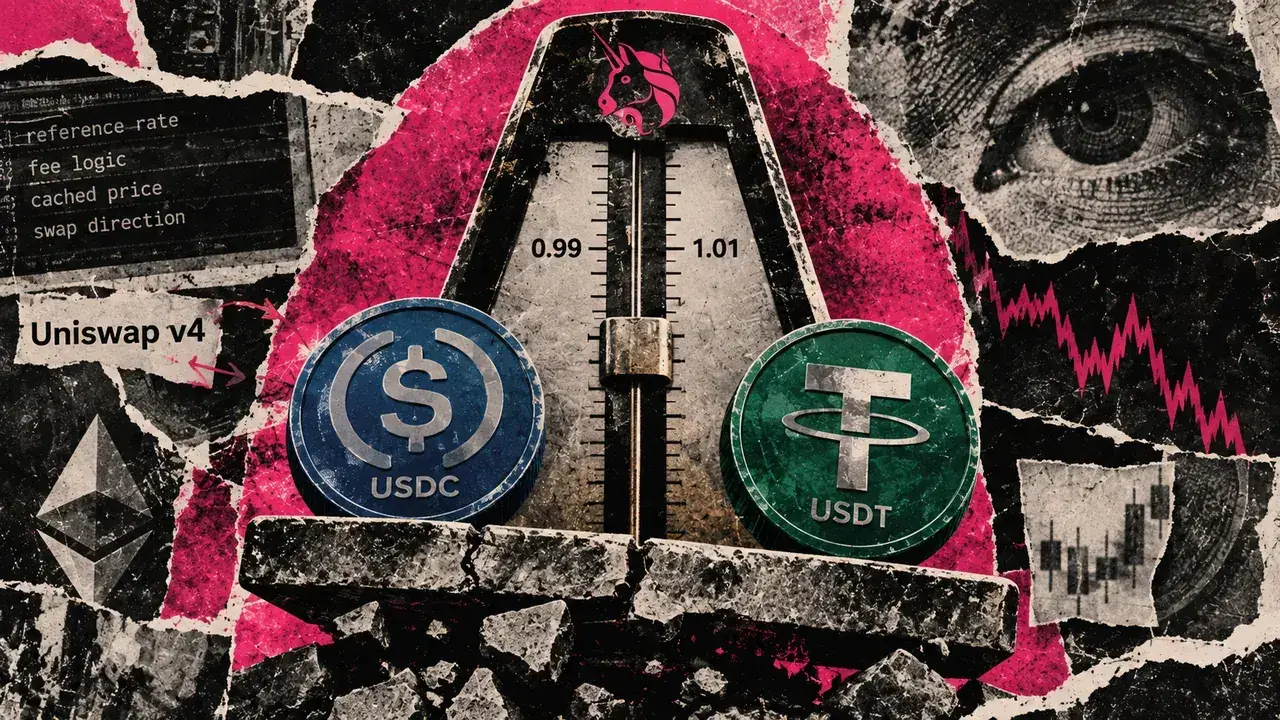
Uniswap's StablePair fee hook, deployed on Ethereum in September for USDC/USDT and USDC/USDG pools, is designed to capture rebalancing profits for liquidity providers. However, the mechanism contains structural limitations that could reduce LP returns when stablecoin values diverge from their configured reference rates.
How StablePair's Fee Model Works
The hook compares a pool's cached price against a stored reference rate to classify trades as either moving the pool toward or away from equilibrium. Trades moving toward the reference face fees that decay over time within a block, while trades moving away are charged zero fees. This design aims to capture the "vast majority" of rebalancing profit by offering progressively better terms for corrective trades.
Three Structural Vulnerabilities
Stale Price Data Within Blocks
The first swap in each block caches the pool price used for subsequent fee calculations. If the market price crosses the reference midblock, later trades receive stale classification inputs. This can assign fees to the opposite direction than intended until the next block arrives, disrupting the fee mechanism's function.
Inability to Detect Token Depegging
StablePair's fee logic uses only the pool price and configured reference rate—it lacks access to external price feeds or issuer solvency data. If one stablecoin loses its economic value while the reference assumes one-for-one exchange, trades reflecting genuine price discovery may be incorrectly classified as temporary imbalances and charged zero fees. An LP holding a weakening token sees its inventory value decline without fee income to offset the loss.
Inventory Exposure and Composition Risk
When the pool executes away-from-reference trades at zero fees, LPs are left holding more of the weaker asset without corresponding fee compensation. The mechanism cannot protect against composition changes when underlying token values shift, and fee income alone does not restore value lost to token devaluation.
Current Pool Activity
As of September 30, the USDC/USDT StablePair pool held approximately $6.1 million in total value locked with $117.9 million in 24-hour volume. The USDC/USDG pool showed $2.6 million TVL and $8.7 million in volume. The source data notes that comparable return analysis would require synchronized observations across multiple metrics including active liquidity ranges, fee income, and inventory valuation over identical periods.
Governance and Security Constraints
Uniswap governance controls the reference rate and fee configurations. While the hook's permanent address permissions prevent callbacks that could block LP withdrawals or alter swap amounts to skim fees, these restrictions do not guarantee the market value of tokens LPs ultimately receive. OpenZeppelin reviewed a non-upgradeable version's core fee mechanism in February 2026, but later upgradeable features and governance roles remained outside that review scope.
For LPs, StablePair represents a different pricing model for supplying liquidity to rebalancing pools. The decision to participate depends on whether the asset pair justifies the configured reference rate and whether earned fees adequately compensate for inventory held.