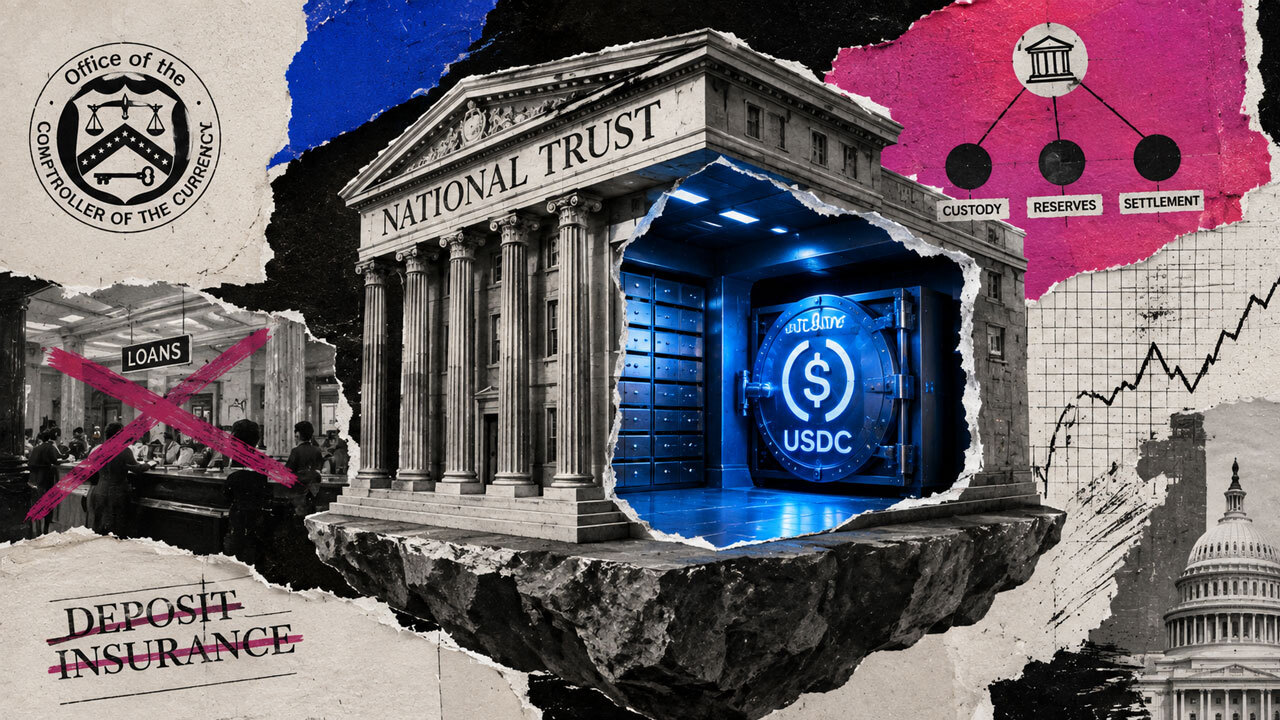
A new class of federally chartered institutions is emerging in the United States, granting major digital-asset companies the regulatory shell of banking while separating it from traditional commercial banking models. Circle has secured a final federal bank charter for Circle National Trust, which will provide fiduciary digital-asset custody and manage stablecoin reserves. However, the charter does not include ordinary checking accounts, mortgages, or FDIC-insured savings accounts.
According to the Office of the Comptroller of the Currency (OCC), a wave of digital-asset companies—including Ripple, BitGo, Fidelity Digital Assets, Paxos, Bridge, Crypto.com, Coinbase, Morgan Stanley, and World Liberty Financial—have received varying levels of OCC approval. Many of these firms are still completing mandatory capital, governance, and compliance conditions required before officially opening.
The National Trust Model
While commercial banks combine deposit-gathering, payment accounts, lending, and asset-holding under one roof, national trust banks operate differently. Their primary focus is fiduciary work: holding property, administering assets, executing instructions, and maintaining records. According to OCC guidance, most national trust banks do not offer loans, accept traditional deposits, or carry FDIC insurance.
This structure aligns with the operational needs of digital-asset institutions, which require regulated entities to safeguard private keys, segregate customer property, administer tokenized assets, and connect transfers with conventional settlement. Comptroller Jonathan Gould noted that crypto-related activity was present in a majority of recent de novo charter applications, with 23 out of 40 applications submitted over an 18-month period including digital-asset business plans.
Approved and Pending Entities
The OCC's recent decisions encompass a mix of state trust conversions, new national trust banks, and final approvals:
- Circle National Trust: Received final approval on July 10, initially focusing on Circle custody and eventual USDC reserve management.
- BitGo, Fidelity Digital Assets, and Paxos: Received conditional conversion approvals on Dec. 12, 2025, to transition existing state trust companies.
- Ripple National Trust Bank and Bridge National Trust Bank: Received preliminary conditional approvals for reserve and custody functions.
- Coinbase National Trust Company and Foris DAX National Trust Bank (Crypto.com): Granted preliminary conditional approvals for institutional custody, trade settlement, and related transactional services.
- Morgan Stanley Digital Trust and World Liberty Trust Company: Granted preliminary conditional approvals for digital-asset custody, transactions, and token reserve administration.
Separating Control From Lending
By utilizing the national trust framework, crypto companies can replace fragmented custody maps with a single federal supervisor, bringing reserve operations closer to the issuer and reducing reliance on third-party commercial banks. Traditional custody banks face heightened exposure as crypto-native trust banks claim similar territory for tokenized assets using integrated software.
However, commercial lenders retain a distinct structural advantage: they can convert deposit funding into mortgages and small-business loans. A trust bank focused on custody cannot replicate local credit creation simply by holding Treasury bills and digital assets. This distinction creates a core policy trade-off, separating the supervision of tokenized property from the credit capacity that supports the broader economy.