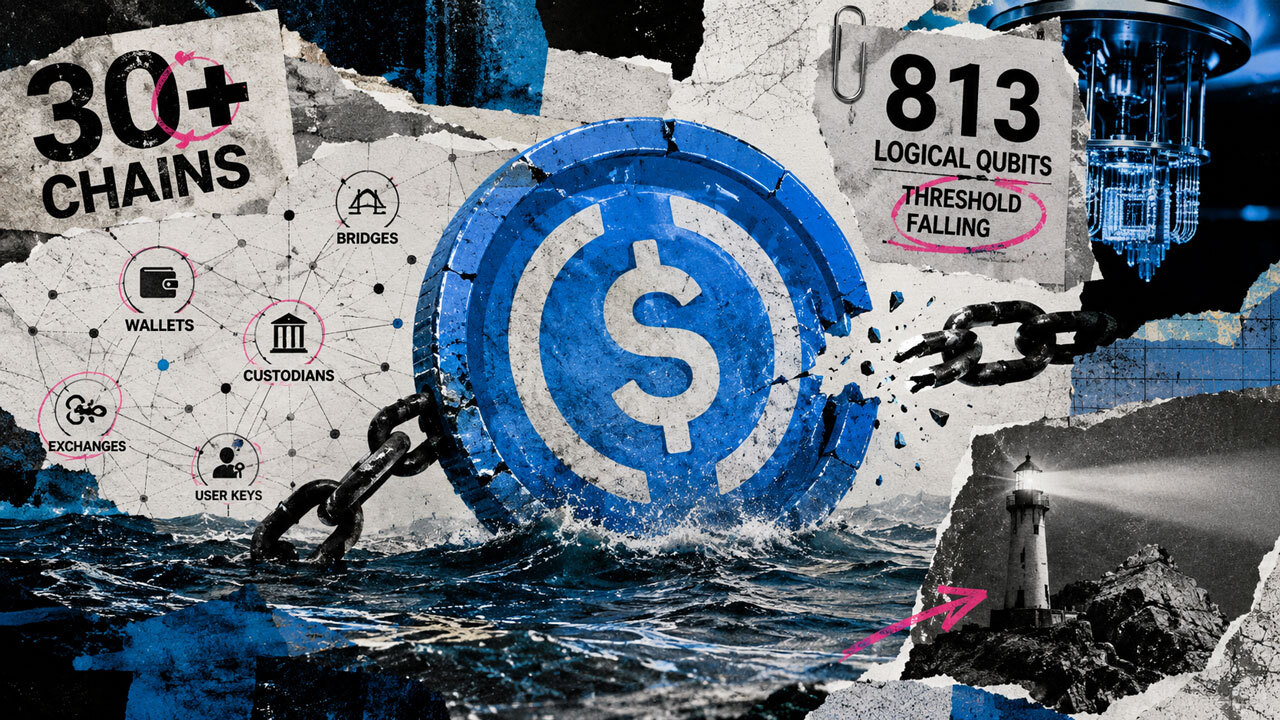
Circle issued a warning that quantum circuits designed to attack blockchain signatures are becoming more resource-efficient, with researchers achieving a record of 813 logical qubits in August 2026. The company is preparing for a migration to post-quantum cryptography, but the effort exposes a fundamental dependency problem across every network, wallet, custodian, bridge, and user account that holds USDC.
USDC operates across 37 mainnet deployments. While Circle can protect and upgrade the infrastructure it directly controls, it cannot unilaterally rotate customer private keys, modify a custodian's signing systems, or change the signature verification rules of Ethereum, Solana, and other host blockchains. A complete migration would require coordinated action across all these independent layers.
Understanding the Quantum Threat
The 813 logical qubit figure represents progress in circuit efficiency but does not provide a complete picture. Researchers have estimated that a 256-bit elliptic-curve attack could use fewer than 1,200 logical qubits under specific hardware assumptions, though this still represents a theoretical scenario rather than an immediate threat. The figure does not establish a timeline for when such an attack would become practical.
Circle's comparison with Google's Willow processor also requires clarification. While Willow is described as a 105-qubit processor, this refers to physical qubits used in a logical-memory experiment, not attack-ready logical qubits. The two metrics measure different aspects of quantum capability and are not directly comparable.
Migration Requirements Across Network Layers
Preparing USDC for post-quantum security involves multiple independent actors: Circle must upgrade its own issuer credentials; users and custodians must rotate keys using compatible wallet and blockchain systems; bridge operators must protect their signing and controls while coordinating across networks; and base-layer communities must approve and deploy protocol changes. Each represents a potential constraint on the overall timeline.
Arc, Circle's new blockchain, provides a controlled environment to test post-quantum support. Its documentation describes a precompile for verifying SLH-DSA signatures and includes a post-quantum wallet signature roadmap. However, adopting post-quantum support on Arc does not automatically secure USDC on Ethereum or 35 other mainnet deployments, each of which operates under independent governance.
The Coordination Challenge
A working migration requires more than a single activation date. Each operator would need an inventory of exposed keys, tested destination account types, hardware and software support for new signatures, and recovery policies for funds that do not move. During transition, both classical and post-quantum authorization would need to coexist to avoid splitting liquidity or trapping balances.
The weakest link may not be the chain with the slowest technical proposal but rather a custodian unable to rotate thousands of accounts quickly, a bridge whose emergency controls still rely on exposed keys, or users who never migrate before an old signature path is retired.
Standards and Timeline
NIST standardized SLH-DSA in FIPS 205 and recommends that organizations begin replacing quantum-vulnerable cryptography now. The 2035 horizon referenced by NIST concerns deprecation from standards rather than a predicted date of quantum threat realization. The practical trigger for migration is readiness across all layers rather than a specific deadline.
Circle's disclosure advances post-quantum preparation into operational planning and provides concrete alternatives for testing. However, securing USDC across its 37-network footprint requires that host chains, wallets, custodians, bridges, and users all move in coordination, with every remaining classical route eventually retired or deliberately contained.