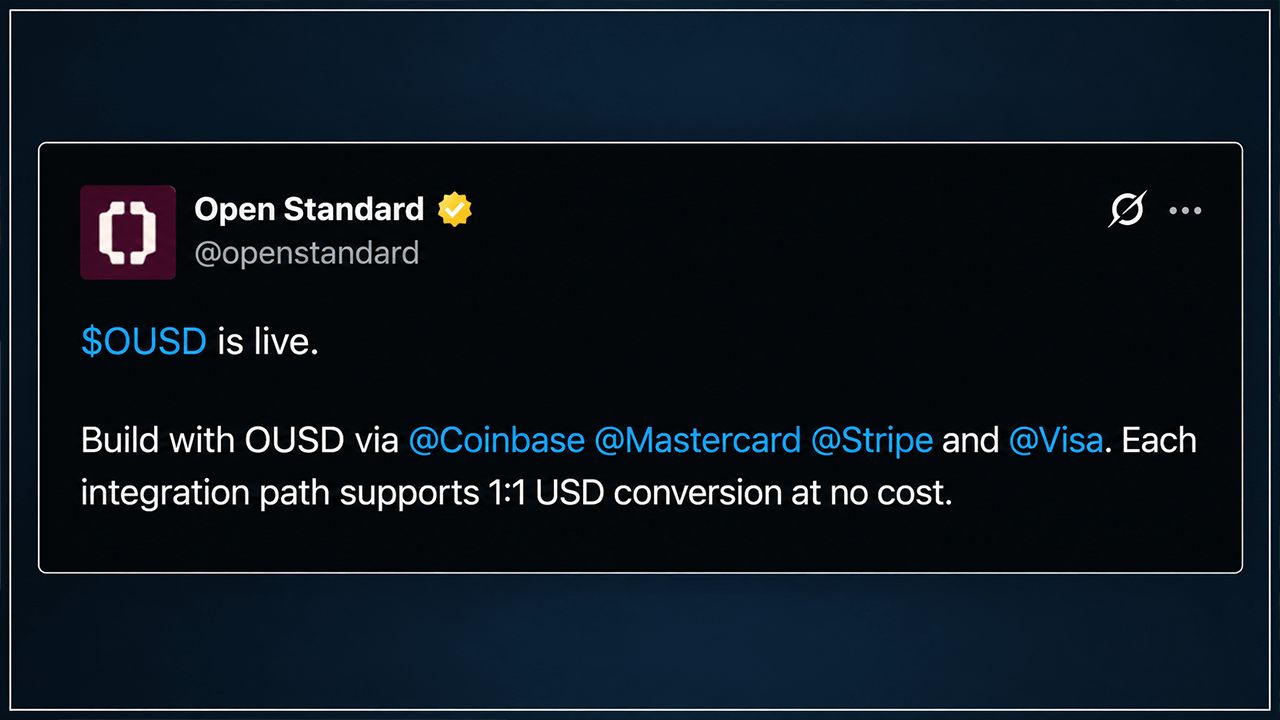
A new stablecoin called open usd (OUSD) launched Wednesday with more than $1 billion in committed liquidity from five founding partners: Coinbase, Mastercard, Shopify, Stripe, and Visa. The token went live natively across Ethereum, Base, Solana, and Tempo.
OUSD differs from existing stablecoins in its economic model. Businesses that pass know-your-business checks can mint and redeem OUSD at par value without fees or volume caps. Rather than the issuer capturing reserve income, participating companies receive most of the yield generated by the token's dollar-backed reserves.
Partners and Infrastructure
Open Standard announced the project with more than 140 committed companies in June. By launch day, the roster had grown to over 200 participants, including banks, card networks, fintech firms, commerce platforms, and crypto infrastructure providers.
The five founding partners hold equal initial equity stakes. Stripe-owned Bridge, acquired for $1.1 billion in 2024, issues the token and publishes monthly reserve attestations. Reserves are held at financial institutions including Blackrock, Lead Bank, and BNY Mellon.
Each blockchain where OUSD operates has a native version rather than bridged copies. Initial access runs through Stripe, Mastercard-owned BVNK, and the Visa Stablecoin Platform, with Coinbase support beginning October 1. Coinbase, Kraken, and Uniswap are the first exchange venues.
Early Liquidity and Adoption
On its first day, the Tempo network reported more than $400 million in OUSD liquidity. Tempo's leadership indicated the chain aims for roughly $1 billion in liquidity within a few months.
Aave Labs filed a proposal to add OUSD as a supply-and-borrow asset on Aave V3 Core and V4 Core Hub, though not initially as collateral.
Competitive Landscape
The partner roster includes major payments players such as American Express, Discover, Standard Chartered, U.S. Bank, Google, Ripple, and Western Union. UBS and Japan's SBI Holdings later joined. Circle, the issuer of USDC, is not a partner.
Executives from Visa, Mastercard, and Coinbase have stated they remain committed to supporting multiple stablecoins rather than replacing USDC.
Challenges Ahead
Despite strong backing, OUSD faces the fundamental challenge that distribution determines stablecoin success. Bridge retains upgrade, pause, freeze, and allowlist powers. The five founding companies control early equity stakes, and partners must meet undisclosed activity thresholds to earn ownership.
Established stablecoins USDT and USDC already have entrenched liquidity across major trading venues. The $1 billion in commitments and early Tempo liquidity must convert into sustained circulation for OUSD to gain meaningful adoption.