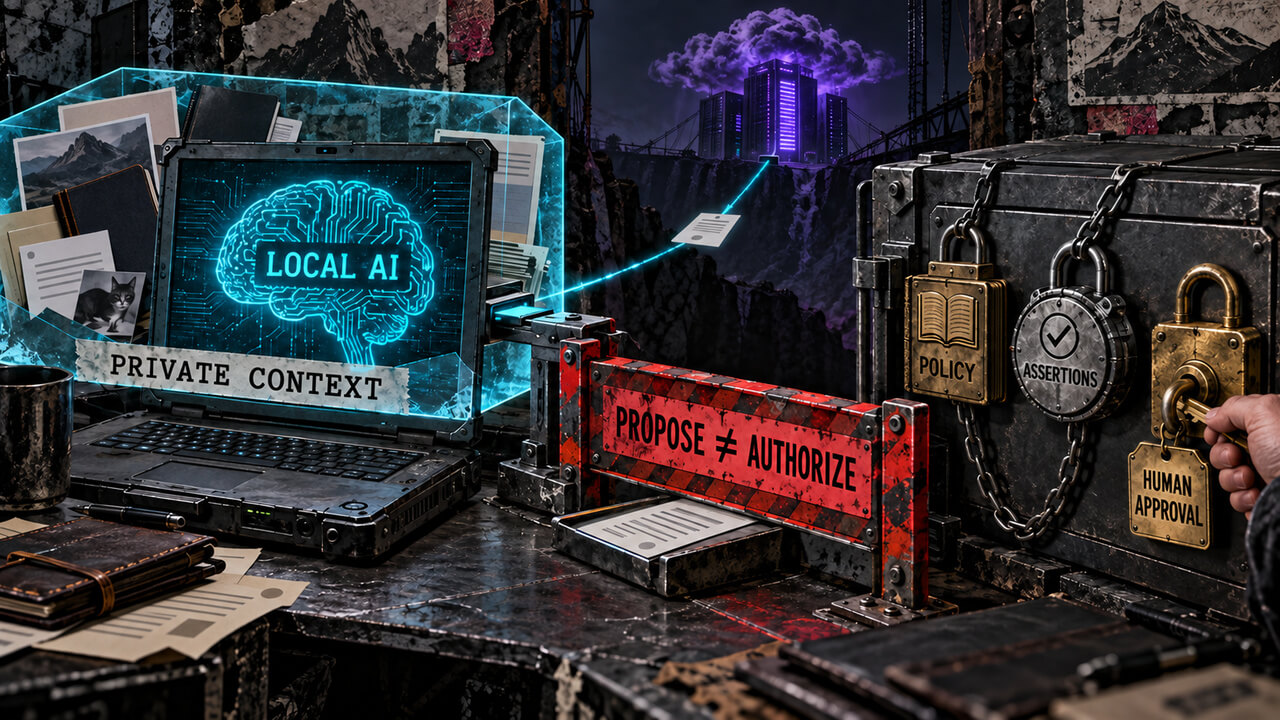
Ethereum co-founder Vitalik Buterin said on September 17 that local AI models are approaching a practical turning point for laptop deployment, though wallet software controlling crypto assets requires substantially stronger security measures before such systems can operate autonomously.
Buterin described recent improvements in models like Qwen 3.8 Flash and enhancements to llama.cpp as bringing local inference close to handling a large share of computing tasks on high-end laptops like the Strix Halo. His benchmark measurements showed input-processing rates ranging from 109.82 to 373.22 tokens per second and output generation between 18.42 and 33.37 tokens per second.
Privacy Benefits With Selective Remote Processing
For more advanced tasks, Buterin described a hybrid architecture where a local model coordinates requests to stronger remote systems while withholding the user's full personal context. This approach enables privacy protection while the ability to move funds remains behind separate, enforceable controls.
Under this model, a remote service receives only the specific question or context the local model selects, rather than every file, message, and wallet detail. The local system functions as both an information gatekeeper and assistant.
Progress From April to September
Buterin's assessment shifted significantly from April, when he described a narrower role for local AI limited to bounded tasks and familiar programming work. By September, he indicated that local models could serve as the main interface for a larger share of activity and determine when remote processing is necessary.
Qwen 3.8 Flash, released by Alibaba's Qwen team, is an open-weight multimodal mixture-of-experts model. Its architecture activates only a fraction of its parameters per token, lowering computational burden while maintaining capability across general knowledge, mathematics, coding, and reasoning tasks.
Wallet Authorization Remains Unresolved
Buterin emphasized that model capability benchmarks leave critical wallet security questions unanswered. A malicious instruction hidden in a website, message, or transaction description can still redirect the model's planning, and model reasoning alone cannot provide sufficient protection for asset control.
Buterin's prior wallet guidance placed authorization policy outside the language model itself, requiring a human-confirmation firewall for risky actions, deterministic limits on transaction amounts, and a human-plus-model two-factor approval rule for transactions.
Multi-Layer Security Architecture
Buterin outlined a security framework combining multiple authorization layers. Local inference protects context and converts natural-language intent into proposed actions. Deterministic permissions restrict recipients, contracts, value, and frequency. Transaction assertions, proposed under draft EIP-7906, inspect final state changes to verify that a swap changed only approved balances or that hidden token approvals did not appear.
The Ethereum Foundation previously disclosed funding for Steward, a fully local macOS smart-account wallet intended to run its light client and AI assistant on-device, though production deployment and independent audit status remain unestablished.
Buterin concluded that a crypto wallet can treat a local AI model as a capable interface, planner, and monitor, but trust must belong to controls the model cannot alter and to an approval path that keeps the user meaningfully in charge.