

Contrast the casual bartering of May 22, 2010, with the highly sophisticated financial environment of May 2026. Laszlo Hanyecz’s famous 10,000 BTC transaction was widely mocked for years as a foolish trade. It actually established the very first real-world pricing benchmark for an entirely new asset class.
Today, the economic landscape looks completely different. Bitcoin’s market cap now stands at a staggering $1.637 trillion, accounting for 60.5% of the entire digital asset space.
“Sixteen years after the first Bitcoin pizza purchase, Bitcoin Pizza Day continues to remind us how far this industry has come – from an experimental peer-to-peer payment to a globally recognized digital asset. As Bitcoin continues to gain broader recognition and institutional interest, this day reminds us that adoption is built over time: through real use cases, stronger infrastructure, financial education, and communities that continue to believe in the long-term potential of crypto,” says Rachel Conlan, CMO at Binance.
From a niche internet forum experiment to a globally recognized digital commodity, Bitcoin’s 16-year journey of value enlightenment highlights a massive structural shift. The asset has matured well beyond retail speculation, now anchoring modern portfolios, even among institutional investors.
The Influx of Traditional Finance
Professional investors now treat the asset, once bartered for pizza on a crypto message board, as a core component of their portfolios. Sentiment has shifted drastically from early skepticism to structural integration.

 
Rather than viewing the asset purely as a speculative vehicle, current market consensus aligns with the idea that “Bitcoin is a way to harness greed,” as Hanyecz once observed. He noted that this underlying incentive structure is what ultimately kept the decentralized network secure and running until Wall Street took notice.
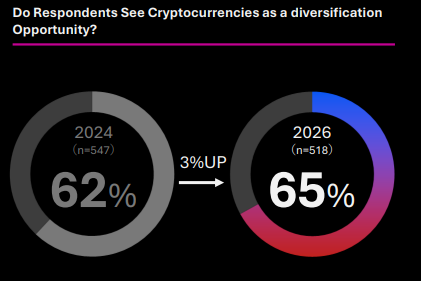
Institutional sentiment clearly backs up this observation today. A recent Nomura and Laser Digital survey indicates that 65% of institutional investors in Japan now view crypto as a crucial portfolio diversifier. The share of respondents with positive outlooks on the asset class over the next twelve months rose to 31%.
Financial institutions recognize the utility of a scarce, programmable monetary network. They are actively positioning their portfolios to capture long-term returns. This marks a definitive departure from the early days of isolated P2P experiments, bringing digital assets into formal investment strategies.
Corporate Treasuries and Capital Inflows
Market absorption mechanics look vastly different today than they did just a few years ago. Capital allocations reflect an environment where major corporations treat digital assets as digital real estate. Hard data demonstrates this finalized transition into traditional capital markets. According to SoSoValue, US spot BTC ETFs have seen cumulative net inflows of $59.72 billion.
Institutional players are moving far beyond mere market exposure, choosing to actively secure the asset on corporate balance sheets. Recent BitcoinTreasuries data shows that 1.22 million BTC, worth roughly $99.54 billion at current prices, is now held on the balance sheets of 196 public companies.
As institutional participants execute these large-scale treasury acquisitions, they increasingly rely on platforms offering deep liquidity and institutional-grade infrastructure. Binance’s continuous processing of over $82 billion in daily trading volume supports this high-volume market structure. It ensures that massive allocations can be executed with minimal market impact. Such consistent liquidity is vital for wealth managers and corporate treasurers navigating modern digital asset acquisitions.
Market Structure and Derivative Expansion
The trading environment itself has undergone a complete architectural overhaul. You can clearly see a sharp contrast between the simple peer-to-peer forum bartering of 2010 and the complex market structure we navigate today. Perpetual futures now play a central role in shaping the pace and structure of cryptocurrency trading. They provide the necessary market depth required for advanced hedging strategies.
The market has fully transitioned to the mainstream acceptance phase, driven by approved ETFs and regulatory frameworks that enable complex portfolio construction. Spot ETFs established a regulated baseline, while deep derivatives markets dictate price discovery across global exchanges.
Today’s market participants utilize these tools to manage risk and optimize capital efficiency in ways that early adopters could never have anticipated. It’s a maturation that ensures crypto can handle multi-billion-dollar daily volumes without systemic disruption. The underlying infrastructure has successfully scaled to match the precise demands of global finance.
The Final Stage of Value Realization
The 16th anniversary of Pizza Day highlights a finalized transition. What started as an obscure internet experiment has permanently cemented its position as a premium global asset. Institutional capital flows through regulated spot ETFs and widespread corporate treasury adoption validate the original proof of concept.
Strong market depth now supports complex financial strategies for sovereign wealth funds and multinational corporations alike. The trading infrastructure connecting these diverse participants provides the exact stability required for long-term capital allocation.
Evaluating the vast distance between a simple food delivery purchase and a highly liquid, trillion-dollar market reveals the true scale of this financial evolution. Those two pizzas purchased in 2010 cost tens of thousands of digital coins. They ultimately bought the foundation for a modernized global financial system.