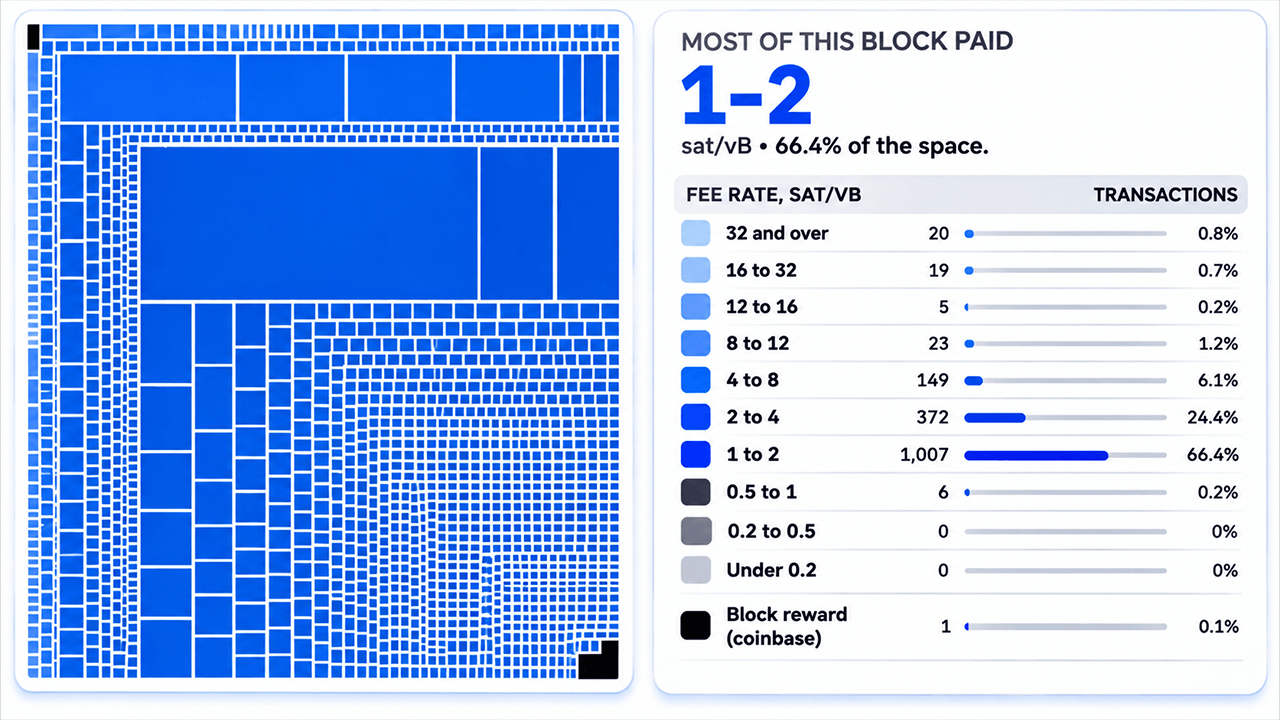
When a Bitcoin block reaches its capacity limit, the transactions left behind do not disappear—they compete for room in later blocks. Miners generally favor transactions that pay more per unit of space, while fixed capacity rules, independent validation and a constantly shifting fee market determine who gets confirmed and who keeps waiting.
A fixed amount of space, sold by auction
Bitcoin blocks are capped at 4 million weight units, a measurement introduced with Segregated Witness in August 2017. That works out to roughly 1 million virtual bytes (vB), though the actual volume of transaction data varies with how each block is composed. A typical block may hold several thousand transactions, and some data-heavy blocks can approach 4 megabytes in serialized size.
The network targets a new block about every ten minutes, but the process is not first-come, first-served. A transaction broadcast hours earlier can stay unconfirmed while one submitted seconds ago lands in the next block. The deciding factor is usually the fee.
Miners sort by fee rate, not payment size
Miners and mining pools choose which transactions go into the blocks they propose, and their choices typically follow economic incentives rather than the age of a transaction, the size of a payment or the identity of the sender. Fees are measured in satoshis per virtual byte (sat/vB), so users pay for the block space their transactions occupy.
The source illustrates the logic with two competing transactions. One takes up 200 vB and pays 1,000 satoshis, or 5 sat/vB. The other takes up 150 vB and pays 1,500 satoshis, or 10 sat/vB. Even though the second pays only 500 more satoshis overall, it offers double the fee rate while consuming less space—making it more attractive to a miner maximizing fee revenue.
Selection is not always transaction by transaction. Some transactions depend on earlier unconfirmed ones, forming parent-child relationships that mining software evaluates together based on their combined economic value. Mining pools can also accept transactions through private arrangements or include transactions for reasons unrelated to advertised fees. The fee market shapes selection without imposing an absolute order.
Nodes, not miners, enforce the limits
Every miner and every Bitcoin full node independently checks new blocks against the network's consensus rules. A block that exceeds the permitted weight limit is rejected by validating nodes that enforce those rules. Developers can propose changes and pools can support them, but altering consensus requirements ultimately depends on adoption and enforcement across the network.
What happens to transactions that miss the cut
Excluded transactions ordinarily remain in the mempool, where unconfirmed transactions wait for potential inclusion. There is no single centralized queue: each participating full node maintains its own mempool and applies local policies on acceptance, storage and relay. Different nodes may hold and rebroadcast different sets of transactions, and block explorers may display distinct collections of unconfirmed activity—so a payment visible on one explorer might be absent from another node's mempool.
Bitcoin Core traditionally defaults to a 300-megabyte mempool memory limit, though operators can change that setting. When a pool fills, the software begins removing less economically attractive transactions, taking the fee rates of related transactions into account. This eviction process stops unconfirmed activity from consuming unlimited memory, and a node that drops low-fee transactions effectively raises its minimum acceptance fee, making similarly priced transactions harder to place until congestion eases.
Bitcoin Core's default transaction expiration period is 336 hours, or 14 days, but transactions can vanish from individual mempools much sooner during intense competition. Eviction does not mean the bitcoin itself has disappeared: a dropped transaction has not moved its inputs onchain, and the sender can potentially rebroadcast it or build a replacement as long as the relevant coins remain unspent.
Why congestion sends fees soaring
The economic effects become most visible when demand outpaces the pace of confirmation. Blocks arrive in batches when miners find valid blocks, while transactions arrive continuously. When demand persistently exceeds capacity, unconfirmed transactions pile up across fee levels.
During the April 2024 halving, the launch of the Runes protocol drove intense competition for block space. Block height 840,000 carried a median fee rate of roughly 200 sat/vB. By comparison, block 970,789 recorded a median fee rate of about 0.28 sat/vB—a stark illustration of how far the market price of priority can move without any change to Bitcoin's capacity limit.
A full block is not evidence of a malfunction, and an overflowing mempool does not mean the network has stopped processing transactions. Congestion instead reflects fixed settlement capacity meeting unpredictable demand. Miners can favor profitable transactions, users can bid through fees and developers can propose efficiency improvements, but no single participant can unilaterally rewrite rules enforced by independent nodes.
Bitcoin's block space is finite by design, and access to it is negotiated through an open, competitive fee market.