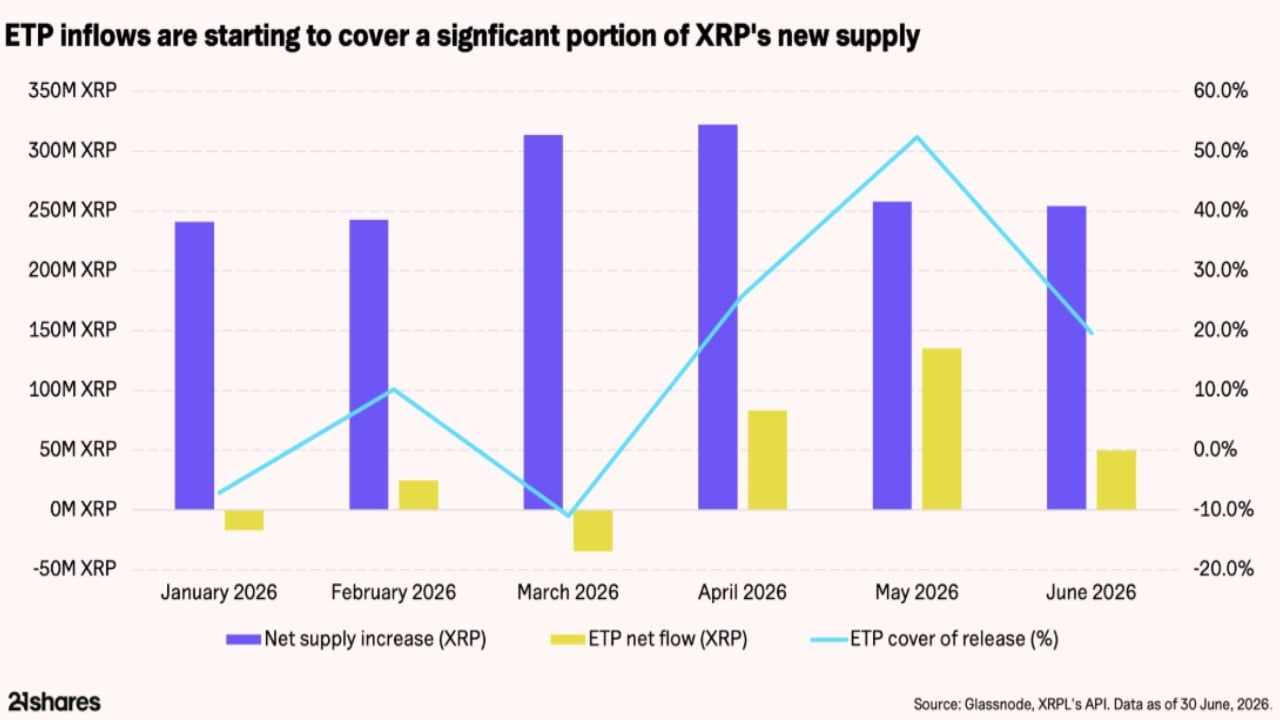
According to a report by 21Shares, XRP's circulating supply grew by 5.5% year over year through escrow releases, creating a supply dilution that current fee burns do not offset. The analysis noted that XRP holders face a net annual drag of 5.5% at current fee levels, estimating that network revenue would need to increase roughly 12,700-fold to offset one year of new supply at current market values.
During the first half of 2026, U.S. spot XRP exchange-traded products (ETPs) absorbed 14.8% of the increase in circulating supply, recording net selling during two out of six months. While ETP buying covered over half of the new supply in May, their annualized inflow rate amounted to roughly one-seventh of the annual net supply.
Meanwhile, the XRP Ledger (XRPL) reported an 81.6% year-over-year drop in revenue, falling from $6.43 million to $1.18 million. The majority of the decline stemmed from an 80.3% drop in swap pool fees on the automated market maker and a 69% fall in NFT royalties. Traditional transaction fees declined by 66.3% to $90,800. Under the ledger's structure, XRP paid for standard transactions is permanently destroyed, though only 10.6% of the reported $1.18 million reached holders indirectly through supply reduction.
Despite the drop in revenue, the network settled $159.9 billion during the first half of 2026. Growth was also observed in stablecoins and institutional tokenization. The supply of Ripple USD (RLUSD) reached $1.56 billion by June 30, with 52% held on XRPL, marking an expansion in the ledger's stablecoin base. Additionally, institutional activity advanced with the launch of tokenized funds and corporate deployments involving firms such as Aviva Investors, abrdn, Ondo Finance, and Societe Generale.