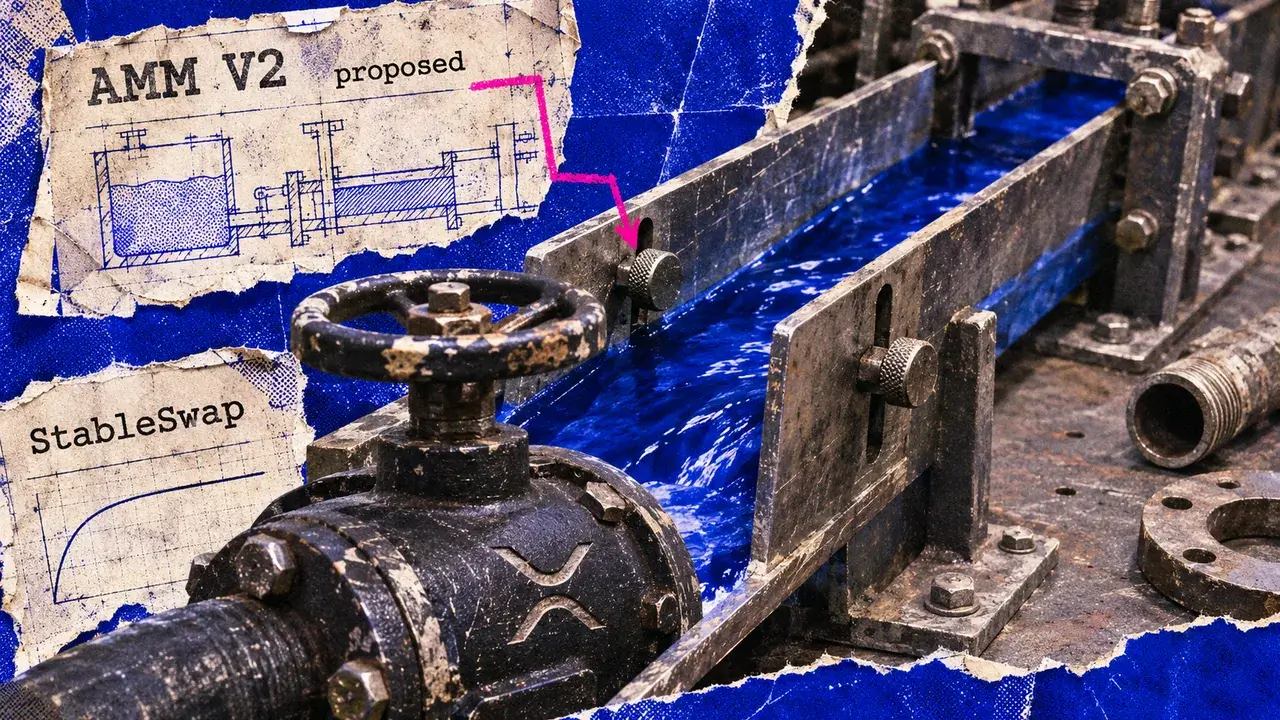
The XRP Ledger is considering a major upgrade to its automated market maker (AMM) system that could enhance trading efficiency without necessarily increasing demand for XRP tokens.
The proposed AMM V2 overhaul would allow creators of automated trading pools to choose how those pools price trades. This flexibility could provide traders with more usable liquidity from the same capital deposits and give XRP holders better execution and new ways to provide liquidity.
How the Upgrade Would Work
Currently, the XRP Ledger uses a constant-product-style pricing formula for automated market makers. The AMM Swappable Curves draft proposes three alternatives:
- StableSwap: Would concentrate depth near the expected price relationship between correlated assets, such as stablecoin pairs
- Concentrated liquidity: Would let providers allocate capital within specific price ranges of their choosing
- Binned liquidity: Would place assets at fixed prices, with trades moving to another price level when one is exhausted
The economic goal is to achieve more executable depth per unit of capital. For example, a stablecoin pool could serve trades near parity with less money spread across distant prices.
Trading Benefits Without Guaranteed Token Demand
A more efficient direct stablecoin pair could improve execution without XRP as a trading asset. Users would still face XRP transaction costs and applicable account reserves, which are separate from funding XRP inventory in a trading pair.
Even in XRP-paired pools, capital efficiency could work both ways. Less XRP could support a given amount of executable depth, while a larger, more active market could attract enough providers to increase total deposits.
Unproven Impact on XRP Holdings
The upgrade remains in the proposal phase. The discussion began in May, with the XRP Ledger Foundation updating its feasibility assessment on November 4. The roadmap includes rebasing, reopening implementation work, review, and audit before activation requires validator approval.
As of the Foundation's November 4 assessment, no issuer, wallet, exchange, or decentralized exchange front end had publicly committed to using the pools.
For XRP holders, stronger demand would require persistent additional XRP balances tied to funded use across relevant pools and routes. Better execution alone could arrive before any additional holding demand becomes evident, and larger pool balances could reflect capital moved from elsewhere rather than new investment in XRP.