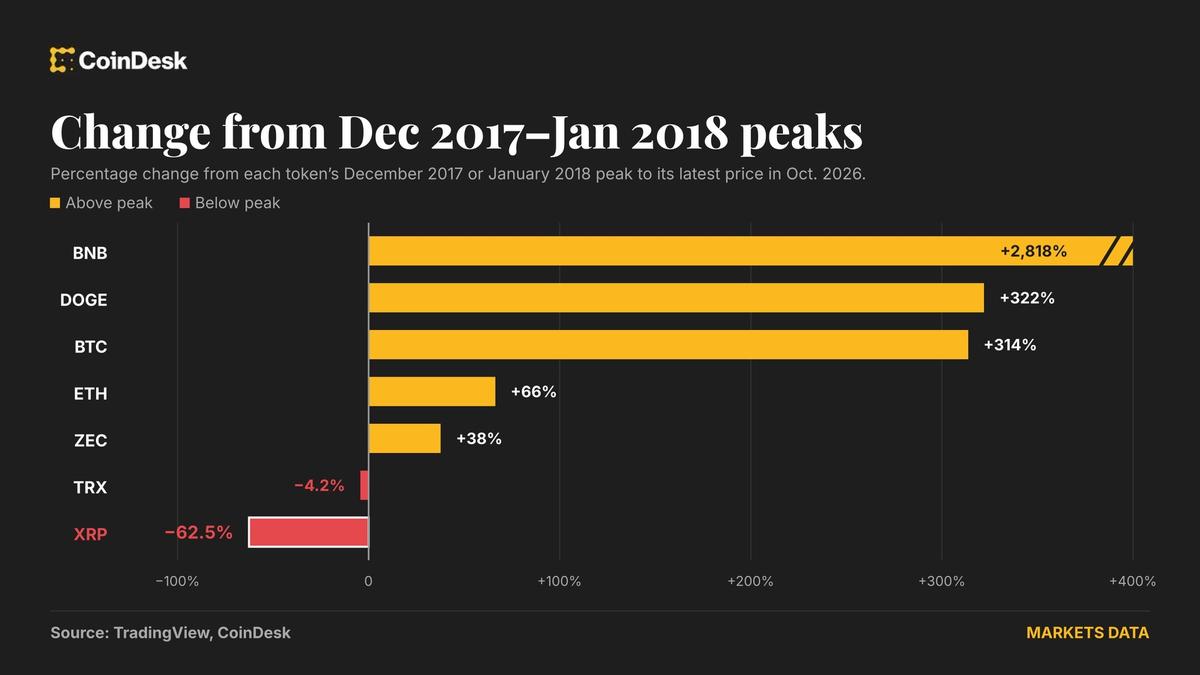
XRP remains one of crypto's notable laggards, trading around $1.33—down 62.5% from its January 2018 peak of $3.55. The contrast is stark: bitcoin has climbed 314% since its December 2017 high, ether is up 66%, dogecoin is up 322%, and BNB has surged approximately 2,800%. Zcash is up 38%, while tron sits roughly 4% below its peak.
An investor who purchased XRP at its early 2018 peak remains underwater nearly nine years later, despite the token briefly reaching $3.66 in July 2025 before declining sharply.
Supply Expansion and Diluted Value
Circulating XRP supply expanded 63% between 2017 and 2026, growing from 38.7 billion to 63.1 billion tokens, while total market value fell only about 3%. This expansion means each token represents a smaller share of roughly the same total value.
According to analytics firm Nansen, the mathematics are straightforward: more tokens in circulation means each coin's proportional value diminishes. When measured by total market capitalization rather than price per token, XRP's recovery appears more substantial, though the circulating supply increase still pressures the per-token price.
Institutional Investment Lag
Exchange-traded funds have opened institutional access to digital assets, but XRP funds have significantly underperformed comparable products. Bitcoin and ether ETFs attract over $1 billion in investor money on single days; XRP ETFs have accumulated just $1.80 billion in total since their debut nearly a year ago.
Trading activity has weakened across multiple metrics. XRP spot trading volume is down 53.5%, perpetual futures volume has declined 44%, and active addresses on the network have decreased 10.7%.
Sector Focus and Competitive Disadvantage
Ripple has concentrated on cross-border payments infrastructure and trade financing rather than pursuing sectors that have attracted greater capital flows, including decentralized finance, AI tokens, and memecoins. This strategic focus has limited XRP's exposure to popular investment narratives that have driven gains in competing assets like ethereum and solana.
Extended Regulatory Uncertainty
The Securities and Exchange Commission sued Ripple in December 2020, alleging the company raised $1.3 billion selling XRP without proper registration. A federal judge ruled in 2023 that exchange sales were not securities offerings but institutional sales were. Ripple paid a $125 million penalty in 2024. The case concluded in August 2025 when both sides dropped their appeals.
The prolonged legal battle contributed to XRP's failure to recover during the 2021 bull market, when Coinbase suspended trading. Since regulatory appeals ended in August 2025, XRP has declined approximately 59%, compared to 32% for bitcoin and 44% for ether.
Broader Context
XRP is not the only cryptocurrency from the 2018 top ten trading below its early January 2018 levels. Of the other nine assets in that period's top ten, six have fallen further below their 2018 highs.