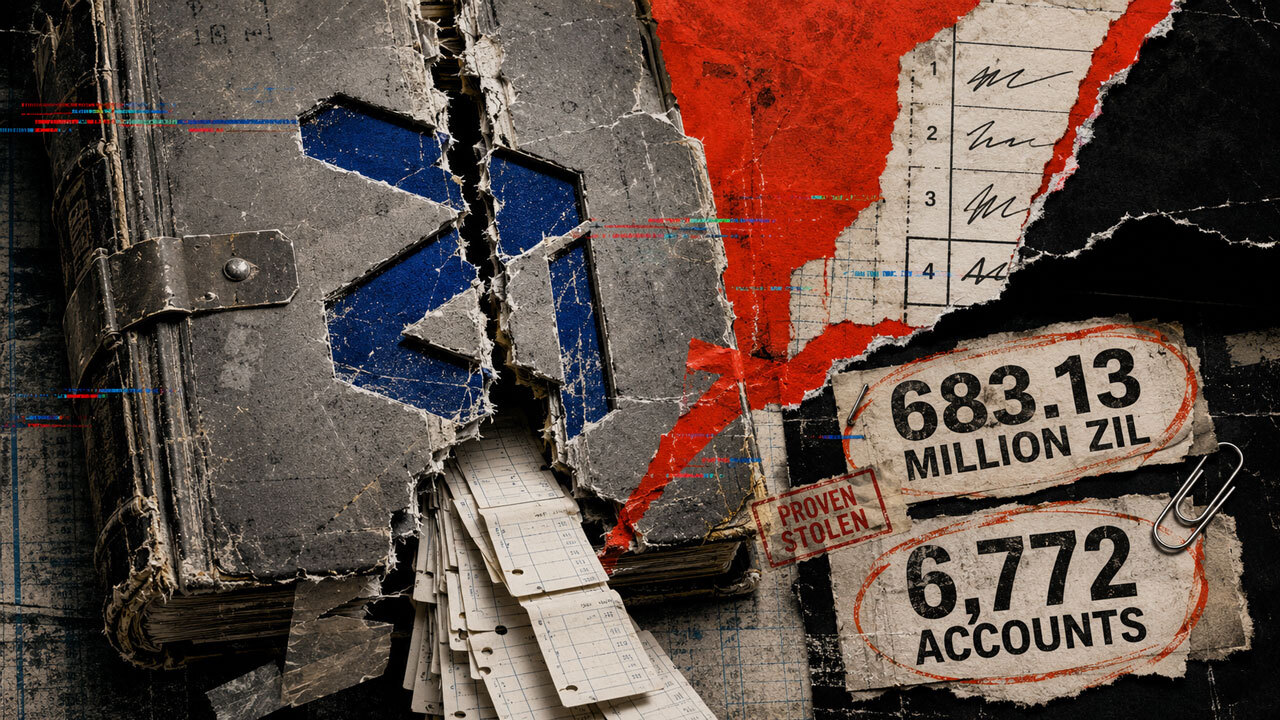
A security post-mortem released by Zilliqa has revealed that a Ledger application bug exposed at least 6,772 accounts and enabled the theft of 683,130,969.66 ZIL across 66 successful attack-window transactions. The disclosure measures the scope of an incident that led to the pausing of legacy transactions while holders await migration to the Zilliqa EVM.
The post-mortem separates 51 drained accounts from the 6,772 accounts whose private keys were proven to be exposed. While the total number of affected individuals remains unquantified, the figure for compromised accounts and stolen funds represents a measured exposure floor that could rise if investigators confirm additional theft transactions.
Entropy Discarded in Signing Buffer
According to Zilliqa, the application generated 40 random bytes but copied the incorrect 32 bytes into its signing buffer, retaining eight bytes of zero padding and discarding eight bytes of entropy. This error forced the high 64 bits of every affected nonce to zero.
The flaw meant that four or more biased signatures produced by the legacy Ledger application for a single account allowed an attacker to reconstruct the private key from public blockchain data in seconds using ordinary hardware. Because previously published signatures cannot be revoked, correcting the application protects new keys but cannot secure those already exposed.
Zilliqa noted that the bulk scan behind its published count required at least five native signatures in a single signer era. Because the mathematical exposure floor is four biased signatures, accounts with exactly four signatures were omitted from the bulk population count. A live per-address checker uses tighter parameters to report four-signature cases.
Timeline and Migration Plans
Historical reconstruction by Zilliqa dated the first proven theft to March 4. Months later, on July 19, KuCoin reported anomalous outgoing transactions from one of its cold wallets. The attacker executed their final transaction at 09:19:09 UTC on July 20, and Zilliqa disabled legacy transactions at approximately 12:59 UTC that same day.
Regarding responsibility, Zilliqa stated that it wrote the original affected application implementation, though the flaw persisted through years of maintenance under Ledger without detection by either party. The active incident was ultimately brought to light by KuCoin's report.
The vulnerability is confined to the application's legacy, non-EVM signing path. Zilliqa EVM activity, recovery phrases, assets held on other blockchains via the same hardware device, and listed software-wallet signing paths remain outside the disclosed scope.
An August 20 status update indicated that recovery efforts will involve migrating every legacy holder to the Zilliqa EVM while retiring the legacy side. A launch date for the migration tool has not yet been announced, as the timeline depends on completing an external security audit, reviewing findings, and finishing asset tracing and exchange coordination.