The computational demands of artificial intelligence are creating strain on electrical grids across the United States. AI data centers consume enormous amounts of electricity, with some large campuses using as much power as small cities. When multiple data centers arrive faster than new transmission infrastructure can be built, the mismatch creates pressure on utilities to find new solutions.
One emerging approach involves shifting non-urgent computing work to periods when electricity is more abundant. A demonstration in Texas shows how this might work in practice. Luxor Energy, a company with origins in Bitcoin mining, partnered with Bentaus, a software provider that controls power consumption on computer chips, to test demand response on a single Nvidia B200 chip used for AI inference tasks.
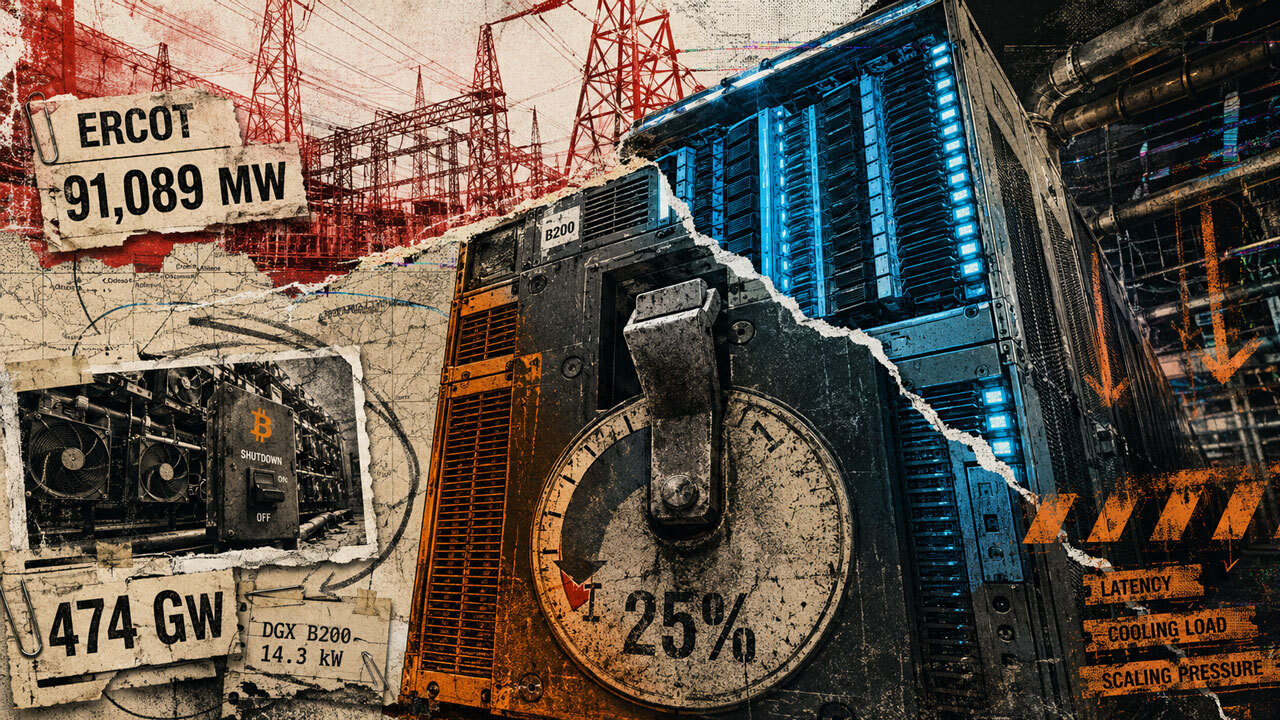
During the test, the chip's power draw fell to roughly 25% of normal within half a second when software restrictions were applied. The companies reported no failed jobs or lost work, and the chip returned to full speed when the restriction ended. However, fewer requests were processed during the reduced-power period, meaning customers experienced longer wait times for some responses.
The Texas Grid Crunch
Texas illustrates the urgency of the problem. The Electric Reliability Council of Texas (ERCOT) reported that on July 22, electricity use reached a preliminary record of 91,089 megawatts. Gov. Greg Abbott stated that ERCOT was reviewing requests to connect more than 474 gigawatts of new electricity use, with approximately 90% coming from data centers.
According to a Lawrence Berkeley National Laboratory estimate published this year, data centers could consume 11.8% of US electricity by 2030, with estimates ranging from 9.5% to 15.3%. The International Energy Agency expects data centers to account for roughly half of the increase in US electricity use through the end of the decade.
Building new transmission lines remains slow. In advanced economies, transmission lines typically take four to eight years to complete, and waits for critical equipment like transformers and cables have doubled over the past three years.
Bitcoin Mining as Precedent
Bitcoin miners demonstrated that computation can be interrupted when electricity becomes scarce or expensive. When power prices spike, miners can shut down operations and resume almost immediately when prices normalize, since no customer is waiting for a response.
An ERCOT review in April identified crypto miners as the primary price-sensitive participants in one of its emergency demand-response programs. For miners, the calculation is straightforward: when electricity costs exceed potential Bitcoin earnings, operations stop.
Luxor's experience in Bitcoin mining positioned it to explore similar flexibility for AI workloads. The question now is whether machines serving customers can adopt the mining industry's responsiveness to electricity prices.
Challenges and Solutions
Implementing demand response across entire data centers involves significant complexity. Large AI operations run thousands of interdependent chips, and slowing one group can create delays that ripple through nearby systems. However, not all computing work requires immediate processing or full speed.
Time-sensitive tasks like interactive services and safety systems could continue at normal capacity, while less urgent work such as internal experiments, indexing, or overnight processing could flex with grid conditions. Some workloads could even shift to data centers in regions with more available electricity.
Making this work requires reliable measurement and verification. Utilities need to know how much power a data center would have used without restrictions, confirm actual reductions through meter data, and understand how long reductions can last and what happens when systems ramp back up.
Customer contracts become essential in this framework. Data centers could offer lower rates for flexible workloads in exchange for the ability to reduce power during grid emergencies, while keeping mission-critical services uninterrupted.
Texas is also reconsidering how it sets transmission charges for large users. Current rules based on four summer peaks may miss hours when the grid faces greatest stress, with regulators proposing a shift to monthly 30-minute peaks instead.
The Larger Implication
The core insight is that not every computation carries equal urgency. An image might take longer to render or a training job might shift to the next day when the grid is stressed, while time-sensitive services continue normally.
If data center operators can convert this flexibility into dependable, measurable power savings that utilities can count on, AI's substantial electricity appetite could become manageable within existing grid constraints. The next phase of AI expansion could depend as much on using power efficiently as on finding sufficient capacity to begin with.