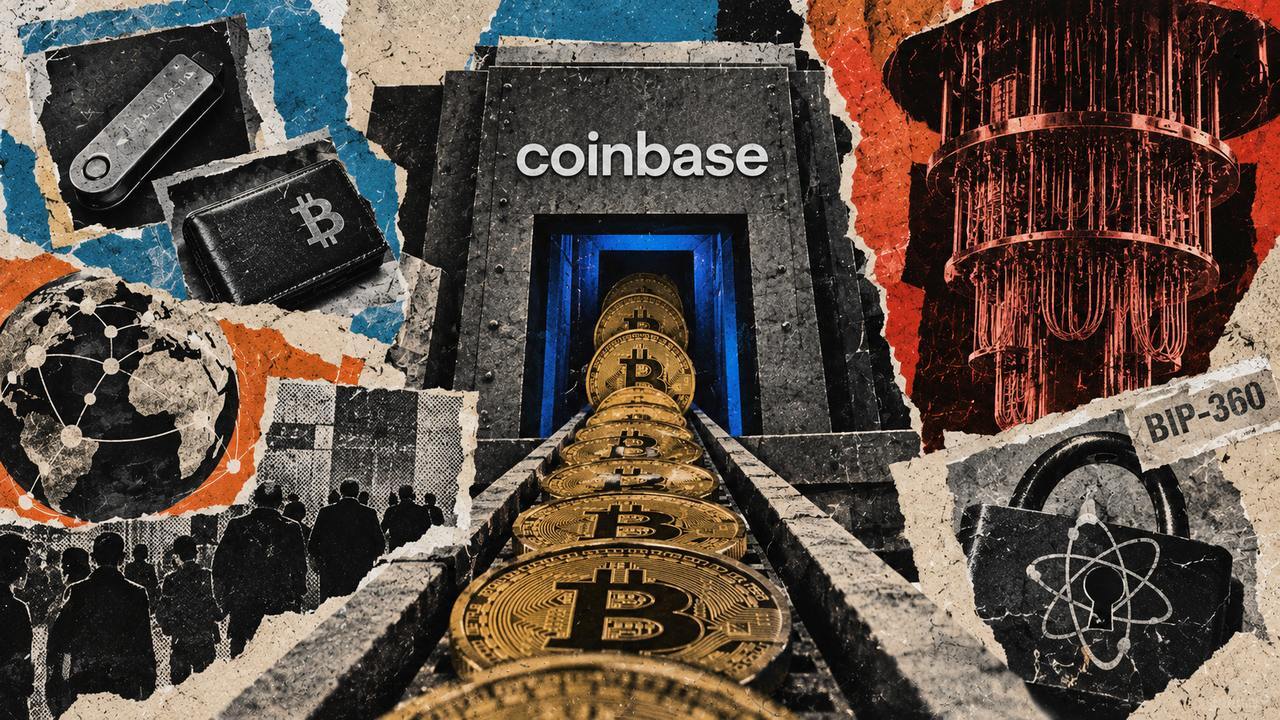
Bitcoin's future quantum-safe upgrade will require exchanges, custodians, and wallet providers to adopt new security standards while maintaining normal operations for deposits, withdrawals, and fund recovery. This operational challenge became a focal point after Coinbase hosted a post-quantum Bitcoin workshop in September with Stanford and Localhost Research, bringing together developers, cryptographers, institutional custodians, and hardware-wallet experts. The closed-door session found no consensus on a specific post-quantum approach, identifying tradeoffs around transaction size, hardware performance, key management, and adoption complexity.
A May study by Glassnode quantified the scope of the challenge: approximately 1.6 million BTC, or 8.1% of total supply, sits in exchange-related outputs with visible public keys on-chain. This visibility creates two types of quantum risk. An at-rest attack would target keys that remain visible on-chain over time, while a short-exposure attack would exploit the brief window between transaction broadcast and confirmation when public keys are revealed.
Glassnode's broader analysis found 6.04 million BTC, or 30.2% of issued supply, had public-key exposure at rest. Of this total, 1.92 million BTC faced structural exposure by design, while 4.12 million BTC faced operational exposure from practices such as address reuse. Exchange balances represented the largest segment of operationally exposed coins.
Active custody creates a path forward
Unlike dormant or lost private keys, exchange-held coins offer a near-term opportunity for risk reduction. Exchanges can employ address hygiene, change-output rotation, and reserve management to lower operational exposure before Bitcoin adopts new cryptographic standards. A March Google Quantum AI paper distinguished between active holdings that can migrate and abandoned assets whose owners cannot produce valid transactions, turning exchanges into a measurable test case.
BIP-360, a draft Bitcoin Improvement Proposal, offers one approach to long-exposure reduction. The proposal would add Pay-to-Merkle-Root, or P2MR, as a new SegWit output type through a soft fork. P2MR preserves Taproot-style script functionality while removing the key-path spend, allowing funds to be committed to script trees without leaving public keys visible by default. The proposal leaves the short-exposure window open and does not specify a post-quantum signature algorithm, creating an optional destination for existing balances while development of cryptographic standards continues.
Testing deployment layers
Recent experiments have begun addressing specific engineering questions. On August 19, Blockstream Research published benchmarks showing that several hardware wallets could generate hash-based post-quantum signatures, though the study excluded post-quantum firmware verification and other signature families. BitGo and Silence Laboratories conducted a post-quantum transaction simulation in May using ML-DSA inside a multi-party computation workflow, covering distributed key control and policy enforcement, though this remains unproven in production deployment.
These tests isolate distinct layers of migration: a device's ability to produce a signature, a custody platform's ability to enforce policy, and Bitcoin's ability to verify new algorithms. Each layer can succeed independently while combined migration remains incomplete.
Parallel tracks toward readiness
Progress does not require an immediate quantum threat. Custodians can reduce key reuse, map exposed balances, and test changes to key generation and backups. Hardware makers can benchmark candidate schemes, and developers can evaluate protocol proposals alongside signature algorithms that address short-exposure risk.
The 1.6 million BTC in exchange custody represents a tangible cohort with both the ability and the burden to demonstrate large-scale migration. Success in this segment would address a material slice of Bitcoin's exposure, though dormant coins, ecosystem consensus, and the final cryptographic choice would remain as separate challenges.