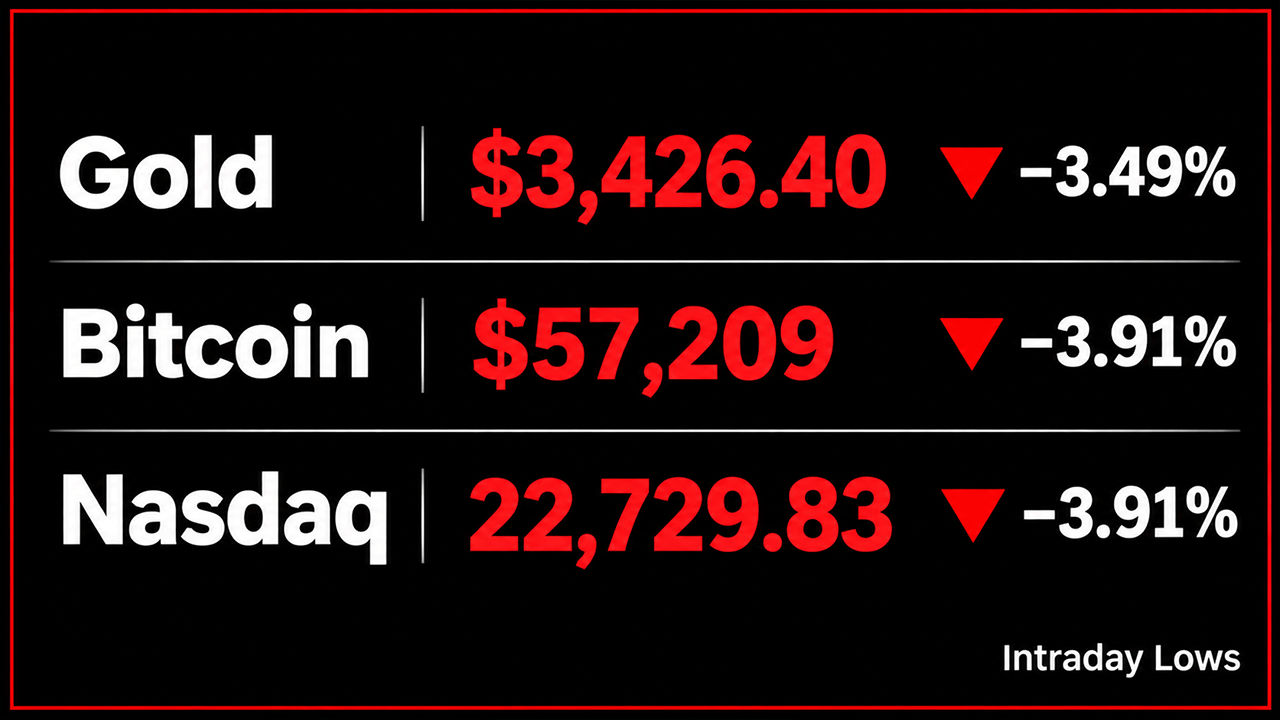
Bitcoin fell below $58,000 on Wednesday morning, touching a session low of $57,500 as a selloff in U.S. stocks and AI-linked shares spilled into crypto markets.
As of 9:50 a.m. ET, the Nasdaq Composite was down 4.3%, the S&P 500 had lost 3% and Nvidia had shed 8.7%.
Stronger growth, hotter inflation
The Bureau of Economic Analysis revised third-quarter GDP growth to 4.3% at an annualized rate, up from 3.4% and nearly double the 2.2% recorded in the second quarter.
The PCE price index rose 3.8% year-over-year in October, up from 3.6% in September and matching a three-year high set in May. Core PCE rose 3.3%, compared with expectations of 3.2% and September's 3.1%.
Consumer spending increased in dollar terms in October but was flat after adjusting for inflation, Navy Federal Credit Union chief economist Heather Long told AFP, saying: “America's inflation problem is bigger than an energy shock.”
After the inflation release, traders priced in a 98% probability of a quarter-point rate increase in December, according to CME FedWatch data. The Fed held rates at 3.75% to 4% in October after raising them in September for the first time in three years. Traders are also betting on further tightening in 2027, with another increase expected as early as January.
Tariff proposal adds to uncertainty
The Trump administration, through the Office of the U.S. Trade Representative, proposed tariffs targeting 14 economies, including China, the European Union, Japan and South Korea, following investigations into policies that encourage manufacturing production beyond market demand.
The proposed rates vary by country and product, with duties of up to 20% on some Chinese imports and up to 35% on Vietnamese goods. For the EU, the proposed 15% rate accounts for certain existing duties rather than simply adding 15 percentage points. The tariffs have not taken effect, and public hearings are scheduled to begin January 25.
If importers pass the additional costs to consumers, the duties could make the Fed's effort to bring inflation back to its 2% target harder.
AI trade under pressure
Nvidia closed Monday up 31.5% but lost more than 6% on Tuesday. Higher interest rates make it more expensive to finance data centers and reduce the present value of future earnings, both particularly relevant for AI companies spending heavily today in anticipation of profits years away.
The selloff began before Wall Street opened. South Korea's Kospi closed 6.16% lower, while spot gold fell 2% to $3,483.59 an ounce by 9:15 a.m. ET, according to Reuters.
Crypto losses and ETF outflows
Blockchain analytics firm Glassnode reported Tuesday that Bitcoin investors were realizing their heaviest losses since the collapse of FTX and the subsequent market crash in November 2022, relative to the money that flowed into the asset over the preceding year.
U.S. spot Bitcoin ETFs recorded $4.94 billion in net outflows this November through Tuesday, according to Decrypt's ETF tracker, already their worst month since launching in January 2024.
The Fed's next interest rate decision is scheduled for December 9.