Bitcoin traded near $59,300 on Wednesday morning, down roughly 2% in 24 hours, as an AI-driven selloff swept Asian equity markets and pressured risk assets across the region.
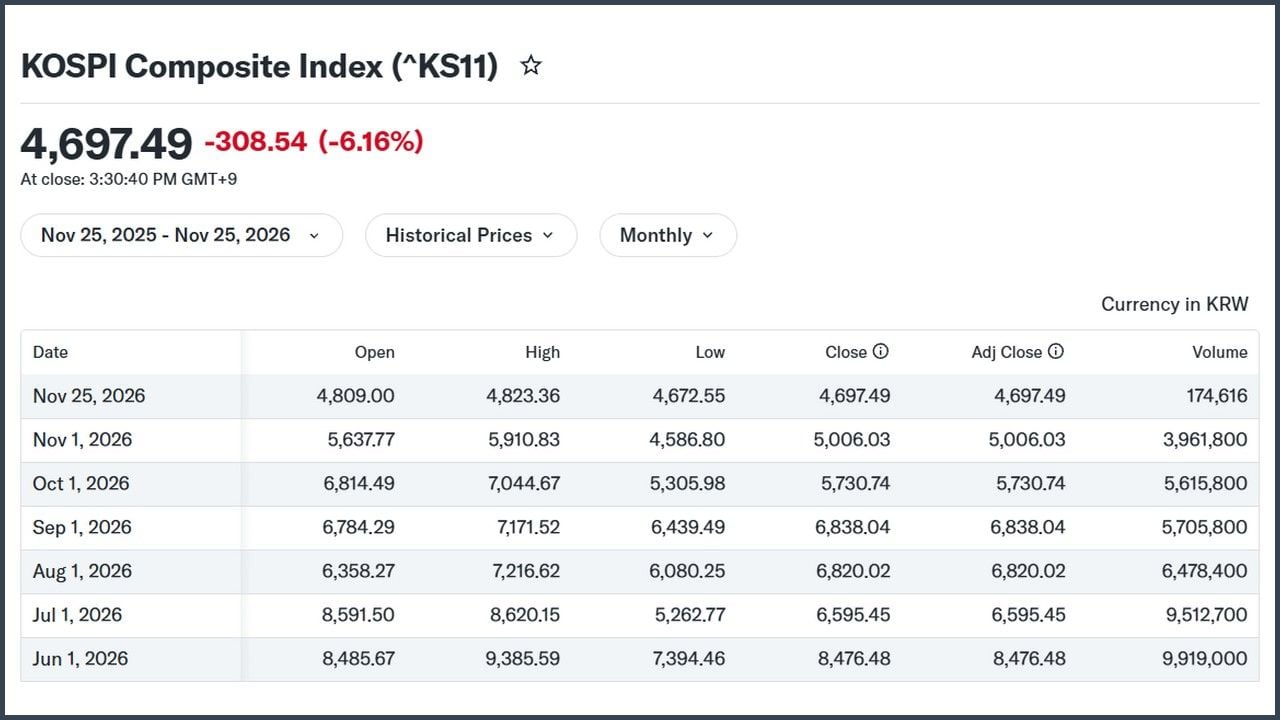
South Korea's KOSPI fell 6% to around 4,700 on Wednesday, erasing $186 billion in value and triggering its 62nd trading sidecar of the year—a temporary curb on program trading applied by the Korea Exchange when futures move sharply. The decline followed a 5% drop on Monday.
SoftBank, Japan's major tech investor, took the largest hit among regional AI-focused stocks, closing at $17.06, down 14.1% from the previous day's close of $19.55. Japan's Nikkei 225 fell 2.8% to 57,020, while Taiwan's main index dropped 4.5% to 38,301. China's Shanghai Composite declined about 1%, making it the calmest major market in the region. Analysts estimated approximately $750 billion was wiped from major Asian stock markets during the session.
Cryptocurrency moved in line with equities. Ether fell 2.2% to $1,660, XRP lost 3.3% to $0.92, and Hyperliquid's HYPE token dropped 7.5% to $58.91.
Bitcoin is down approximately 24% for November after opening the month at $77,582. The selloff marks the third time in a week that a Korean market crash has coincided with bitcoin weakness. Bitcoin bottomed near $55,100 on November 21.
Broader macro pressures contributed to the selling. U.S. spot bitcoin ETFs lost $570 million on Monday, with BlackRock's outflows reaching $1.6 billion over three days. Crypto ETFs shed approximately $6.38 billion over the past month.
Korea's retail traders, among the world's most active on local exchanges, are closely tied to market sentiment. A sharp KOSPI decline typically reduces available capital for risk assets among these participants.
Traders are watching $60,000 as resistance and November's $55,130 low as a potential floor. Thanksgiving trading in the U.S. on Thursday and a shortened Friday session could thin liquidity further.