Bitcoin perpetual futures markets display a consistent pattern of elevated trading activity every 15 minutes, according to a study by Korean policy researcher Chan Kim and Peter Reinhard Hansen of the University of North Carolina. The researchers analyzed trade data from six Binance futures markets—Bitcoin, Ethereum, XRP, Solana, Dogecoin, and Cardano—covering 1,400 days of trading from January 1, 2021, through October 31, 2024.
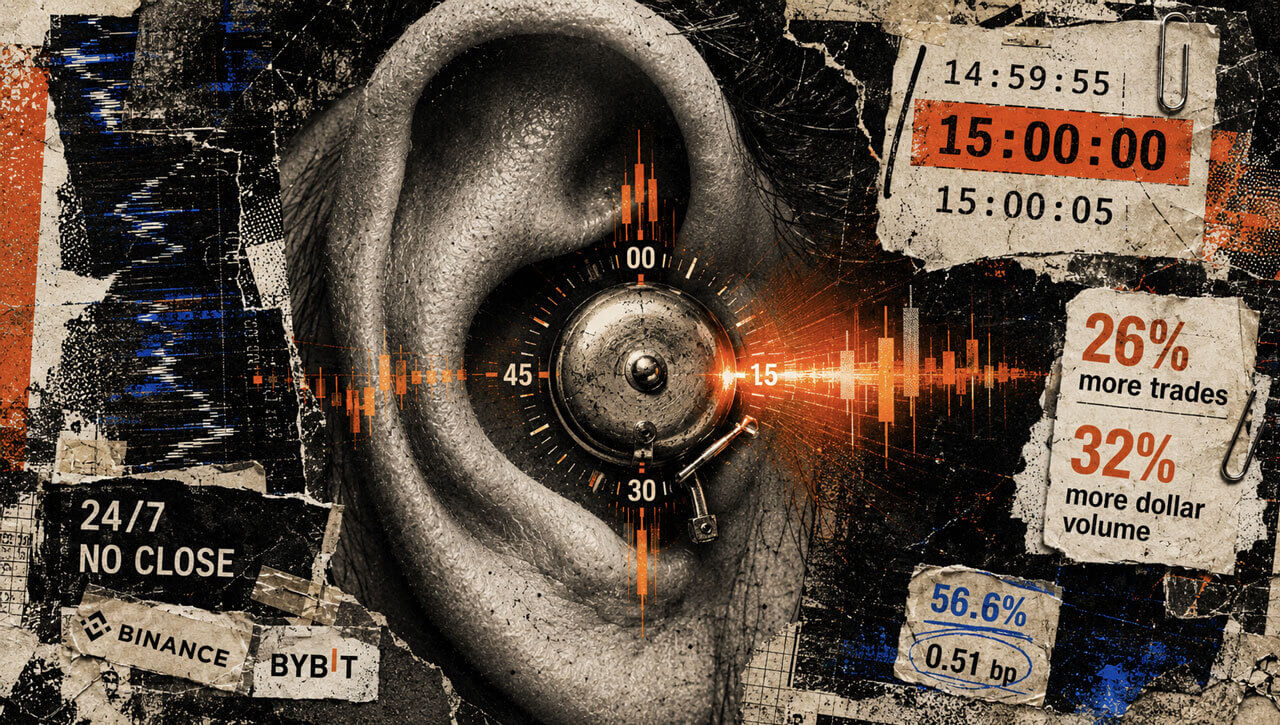
The pattern emerges at the top of each hour and repeats at the 15-, 30-, and 45-minute marks. During the first ten seconds of these intervals, trading volume increases by 32 percent and absolute price movement by 26 percent compared to ordinary ten-second windows. Bitcoin perpetual futures averaged $14.58 billion in daily contract volume during the sample period, while the pattern appeared consistently across all six studied contracts regardless of their individual trading size.
How Software Creates Market Rhythms
The surge stems from how trading software organizes continuous market data. Most trading applications convert price streams into candles covering one minute, five minutes, 15 minutes, or other standard intervals. When each candle completes, technical indicators recalculate and automated strategies receive updated instructions based on newly finished data blocks.
Perpetual futures, or perps, allow traders to bet on asset price movements using borrowed exposure. Unlike conventional futures that expire on set dates, perps remain open as long as the trader maintains sufficient collateral. Recurring payments between traders betting on higher and lower prices keep perp prices aligned with underlying spot markets.
Once enough automated systems begin following the same clock intervals, a convenient way of displaying data becomes embedded in market structure itself. Kim and Hansen described this as crypto's version of an opening bell—a synchronized moment when thousands of independent systems reach the same boundary, creating temporary congestion in an otherwise continuous market.
Evidence of Automated Trading
The researchers identified indirect evidence of machine participation by examining trade sizes. Humans tend to prefer round numbers such as 0.1 Bitcoin, while algorithms typically generate quantities based on formulas involving volatility, capital availability, or position targets. Round-sized trades became significantly less common during quarter-hour openings, with the effect five times larger at the top of the hour compared to ordinary minute boundaries.
Analysis of alternative exchange Bybit produced similar patterns, suggesting the phenomenon reflects broad electronic coordination rather than a feature specific to one platform or exchange.
Limited Profit Potential
Despite the predictable pattern, the identified price movement offers minimal trading opportunity. A model using available data before each quarter-hour correctly predicted price direction 56.6 percent of the time but generated average gross returns of 0.51 basis points per trade—roughly 0.0051 percent—before fees. With Binance charging 2 to 5 basis points per order, typical traders would lose money attempting to exploit the pattern.
The pattern did show predictive value over longer horizons. When buyer-initiated volume exceeded seller-initiated volume at a quarter-hour boundary, that imbalance was associated with returns over the following four to twelve hours, though this longer-term relationship may reflect accumulated information processing rather than a distinct trading signal.
Market Structure Without an Opening Bell
The findings illustrate how crypto markets, designed to operate continuously without traditional market closures, recreate synchronized trading moments through shared software conventions. Exchange APIs, default chart intervals, and automated strategy frameworks collectively produce recurring coordination points throughout the trading day, causing behavior resembling traditional market openings to repeat every quarter hour.