Two major Bitcoin mining firms have warned of coordinated attacks that siphon mining rewards by hijacking internet connections between miners and their pools, suggesting a long-dormant vulnerability is now being exploited at scale.
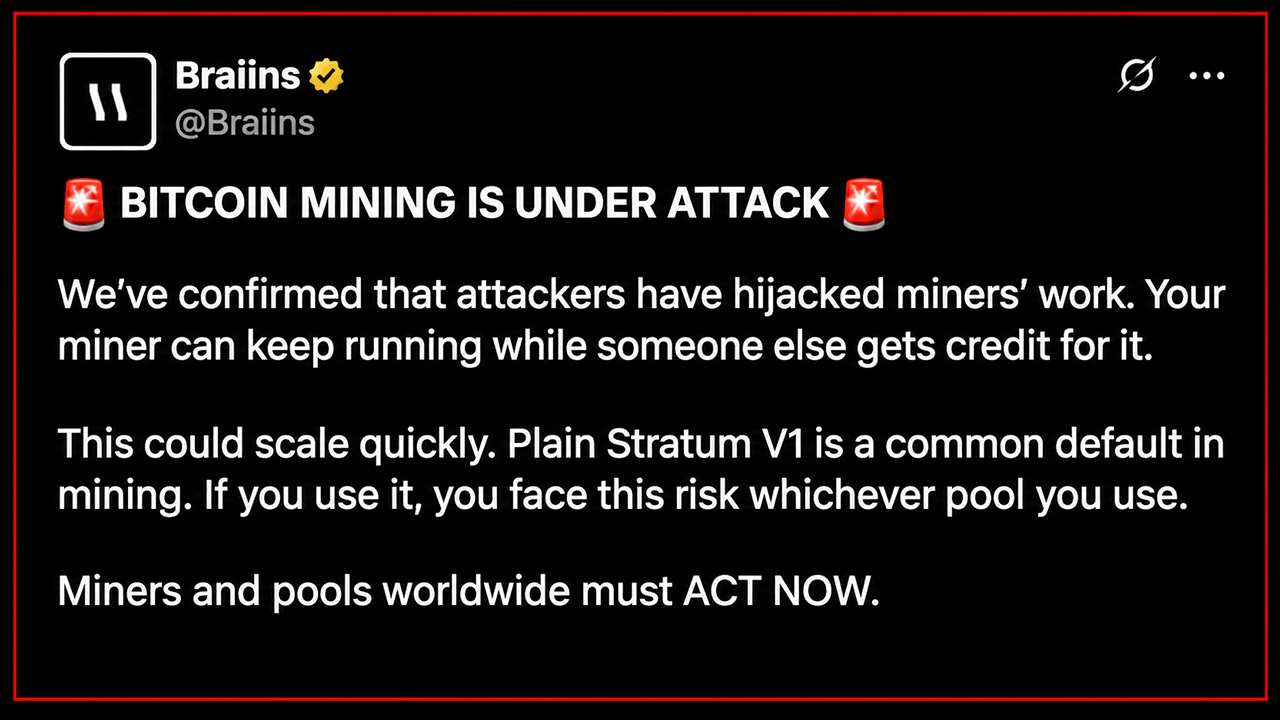
Mining software firm Braiins reported Wednesday that an attacker targeted more than a thousand mining sites in a single second on November 20, rerouting their connections to an impostor pool. The incident follows a similar attack reported by mining-services firm Luxor just days earlier.
How the Attack Works
The attackers do not need to breach individual miners or pool infrastructure. Instead, they exploit a weakness in Stratum V1, an unencrypted, plain-text protocol used to carry work between miners and pools. The protocol offers no mechanism to verify the identity of the server on the other end.
Attackers manipulate the Border Gateway Protocol, or BGP, the system that directs internet traffic between networks. By announcing a narrower, more specific block of addresses that includes a pool's connection point, networks that fail to validate the route forward miner connections to the impostor instead.
The attacker then impersonates the legitimate pool, feeds miners valid-looking work assignments, and claims the resulting shares under their own account at a separate pool. Hijacked machines continue operating at full capacity while their actual pool dashboards show zero hashrate, making the theft difficult to detect on-site.
Scale of Recent Attacks
Braiins traced initial incidents in early November across Latin America, primarily Brazil and Argentina, before a larger wave on November 20 predominantly affected European miners. The diverted hashrate ranged between 0.6 and 1.9 exahashes per second during individual attacks, with the amount growing more than tenfold over two weeks.
Braiins characterized the short, escalating bursts as the attacker testing capabilities, though both firms reported somewhat different technical mechanisms behind their respective incidents.
Historical Precedent and Industry Response
The technique is not new. Dell SecureWorks documented the same routing-based attack stealing approximately $83,000 in mining rewards in 2014. Braiins has warned about hashrate hijacking since 2020 as justification for adopting the encrypted Stratum V2 protocol.
For years, the industry treated such attacks as rare enough to tolerate. The two recent incidents within weeks suggest the threat landscape has shifted.
Braiins recommended that miners migrate to Stratum V2 or use Stratum V1 over TLS with certificate verification, eliminate plain-text backup connections, and pressure network operators to validate internet routes. The firm also released a free proxy tool for miners unable to upgrade immediately.
Braiins stated that any miner still using plain Stratum V1 "is a target, on any pool."