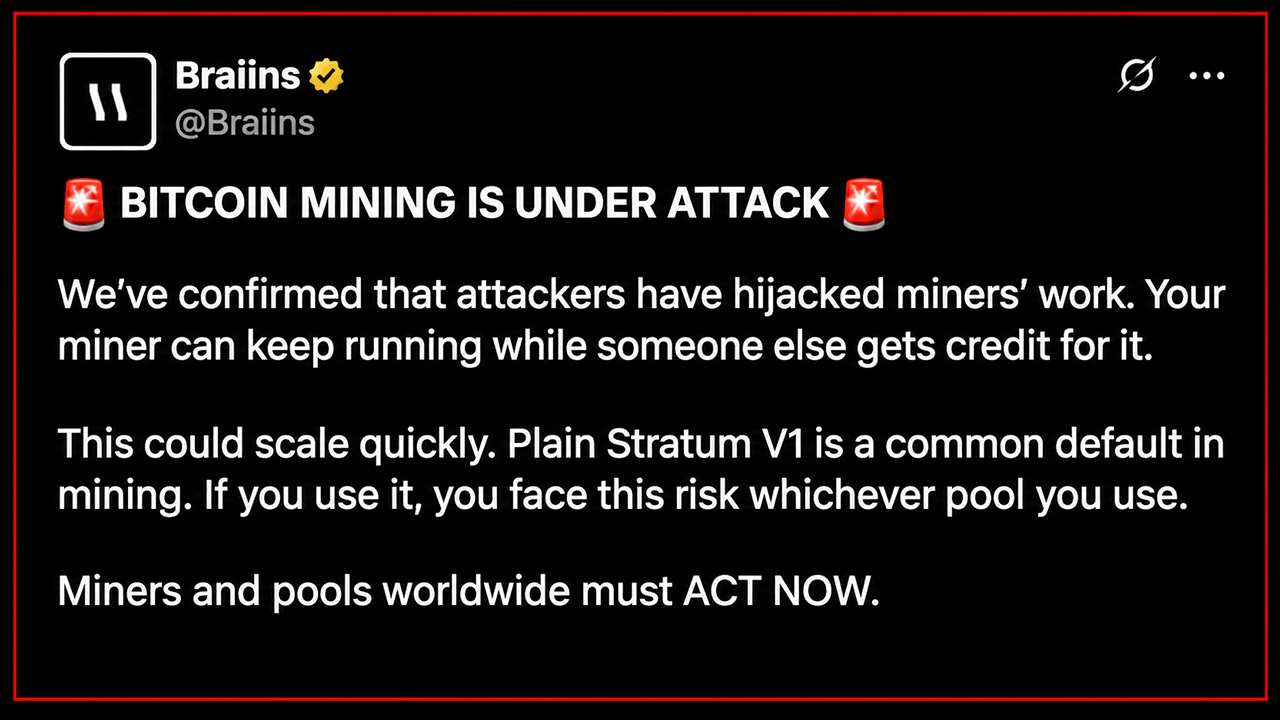
Bitcoin mining pool operator Braiins issued a security alert revealing a series of network hijacking attacks that redirected up to 1.9 exahash per second (EH/s) of computing power by exploiting longstanding security weaknesses in the Stratum V1 mining protocol.
The earliest incidents documented by Braiins occurred between November 7 and November 12, primarily affecting mining operations in Brazil and Argentina. Investigators identified 19 episodes involving between 120 and 400 mining sites per incident, with diverted computational power ranging from 36 to 174 petahash per second (PH/s).
By November 20, the attacks had grown considerably larger and shifted predominantly toward Europe. Braiins identified four episodes lasting between six and 49 minutes, each affecting more than 1,000 mining sites and redirecting between 0.6 and 1.9 EH/s.
How the Attack Exploited Outdated Protocol
Stratum V1, introduced in 2012, facilitates communication between mining equipment and mining pools. Its unencrypted implementation lacks a mechanism for miners to authenticate the server assigning their computational work, leaving mining revenue exposed to malicious network interference.
Braiins traced the European incidents to manipulation of the Border Gateway Protocol (BGP), the system responsible for directing internet traffic between independent networks. Fraudulent routing announcements diverted legitimate mining communications toward unauthorized infrastructure.
The investigation found that affected equipment continued operating at full computational capacity while legitimate pool dashboards recorded disappearing hashrate. Miners could continue consuming electricity without receiving credit for their work, with neither the mining pool nor the affected mining equipment directly compromised.
Distinction From Recent Luxor Mining Incident
The latest security disclosure follows a separate hashrate hijacking incident involving Luxor Technology earlier in November. On November 15, Luxor confirmed that unauthorized modifications to mining pool configurations through its Commander management platform affected just over a dozen customer accounts, with estimates suggesting approximately 13 EH/s had been redirected.
Unlike the Luxor incident, which involved unauthorized configuration changes, the attacks documented by Braiins intercepted communications between mining machines and their intended pools. No changes to mining configurations were necessary, and pool account balances and payout settings remained unaffected.
The underlying vulnerability has persisted for more than a decade. In 2014, Dell Secureworks documented a similar internet routing attack that diverted approximately $83,000 in cryptocurrency mining rewards.
Industry Recommendations
Braiins recommends that mining operators adopt Stratum V2, which encrypts communications and authenticates the identity of mining pools. Operators unable to migrate immediately can use Stratum V1 protected by Transport Layer Security (TLS), provided their firmware properly validates security certificates.
The company released Braiins OS 26.11 introducing TLS certificate and hostname verification alongside protections against automatic transitions to unencrypted connections. Braiins also introduced a free Stratum V2 proxy for equipment that lacks compatible firmware.
Testing revealed additional security deficiencies across firmware implementations, with two widely used implementations accepting invalid certificates despite offering TLS functionality, potentially exposing operators to impersonation even when communications appeared encrypted.
Braiins urged mining pools, firmware developers and internet providers to strengthen infrastructure security, while recommending that operators monitor discrepancies between locally reported hashrate and computational power credited by their pools.