Bitcoin's market cycle may be evolving away from its traditional four-year pattern tied to the network's halving events, according to analyst Willy Woo. Instead, the largest cryptocurrency could increasingly follow a 6-to-8-year rhythm more closely aligned with traditional finance's credit cycles and macroeconomic liquidity conditions.
Woo's analysis, shared on September 3, does not dismiss halvings as irrelevant. Rather, it suggests their influence on price is diminishing relative to the scale of capital now flowing through institutional channels.
Shrinking Supply Impact, Growing Institutional Holdings
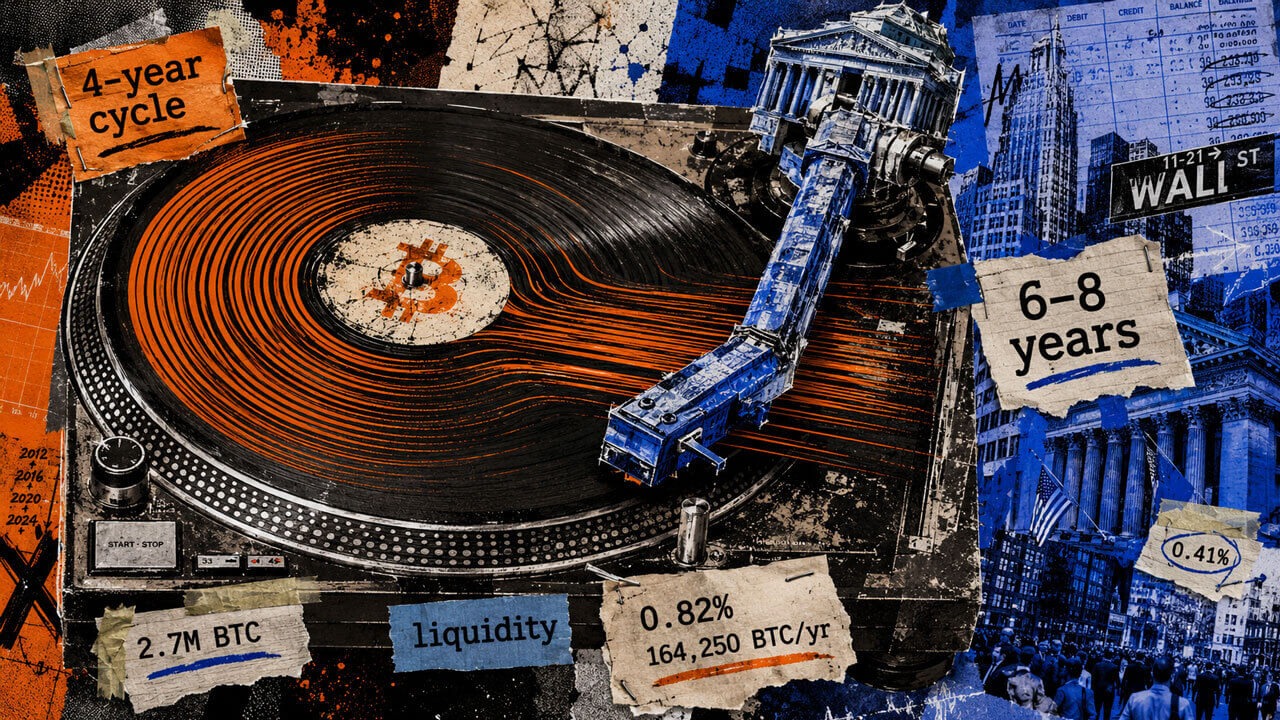
Bitcoin's April 2024 halving reduced the block reward to 3.125 BTC, bringing annual new issuance to approximately 164,250 BTC—representing about 0.82% of current circulating supply. The next halving, expected in 2028, would reduce annual issuance to roughly 82,125 BTC, or about 0.41% of today's supply base.
Meanwhile, institutional holdings have grown substantially. Public company treasuries hold more than 1.2 million BTC according to Bitcoin Treasuries data, while exchange-traded products globally control more than 1.5 million coins. Combined, these two groups account for more than 2.7 million BTC—more than 16 times the annual new supply miners currently produce.
A Shifting Framework, Not a Confirmed Pattern
Bitcoin's four-year cycle has always been approximate rather than strictly mechanical, with halvings, monetary policy and investor psychology overlapping across previous market periods. Recent institutional research has not declared the old framework obsolete.
Galaxy Research noted in June that the four-year pattern remained visible, though its amplitude was compressing. A 21Shares midyear review described the cycle as evolving rather than broken. Fidelity Digital Assets has similarly suggested that Bitcoin's larger market capitalization, broader institutional base and lower volatility could produce different cycle behavior compared to earlier periods.
Woo's thesis remains a developing framework rather than a confirmed replacement for existing models. The measurable shift already underway is clear: annual miner issuance is shrinking toward a fraction of total supply while institutional vehicles accumulate millions of Bitcoin. If that trend continues, future Bitcoin cycles may depend increasingly on the same credit and liquidity forces shaping traditional markets.