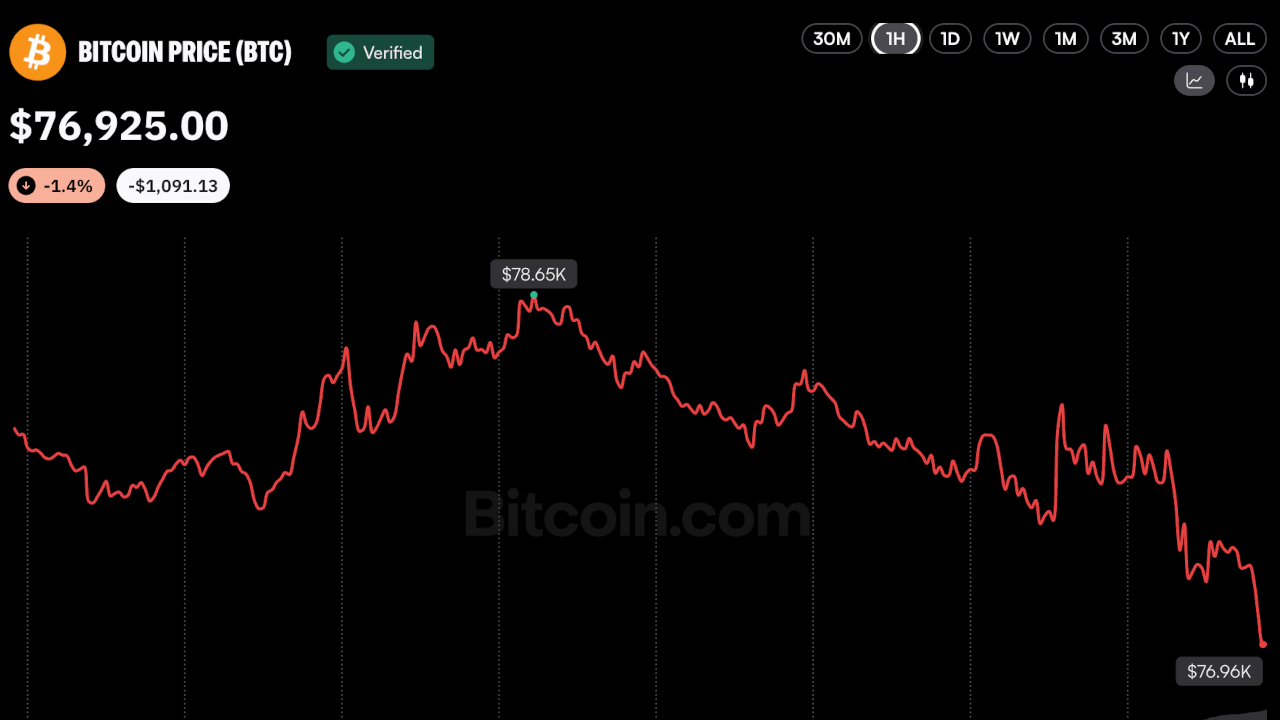
Bitcoin slipped below $77,000 on Monday, continuing a decline that follows the recent Binance hack. The price opened the day near $77,600, rose to a high of $78,750 before midnight, and then fell back to under $77,600 by mid‑morning. By 12:45 p.m. EST the cryptocurrency was trading just under $77,000, marking a daily loss of about 1.4% and leaving its market capitalization under $1.55 trillion.
Market activity and liquidations
Throughout the day Bitcoin’s price oscillated between $77,600 and $78,000 before a sell‑off pushed it to an intraday low of $77,143. Leveraged positions on Bitcoin fell sharply, with total exposure dropping to $69 million from more than $500 million on October 30. Short positions were liquidated for nearly $30 million, while long liquidations accounted for the remainder.
Across the broader crypto market, total liquidations reached $256 million, of which over $176 million were long positions.
Binance response
Binance announced that it had fully replenished assets lost in the hack using its own funds. The exchange stated that ten major tokens—including BTC, ETH, USDT, BNB, SOL, USDC, XRP, RLUSD, and ZEC—were backed at a 1:1 ratio and that a zero‑knowledge proof of its latest proof‑of‑reserves snapshot had been completed.
Additional security incident
Another exchange, Mercado Bitcoin in Brazil, reported a breach that an analyst estimated resulted in at least $46 million in stolen funds. The exchange said customer funds were not affected, though a final damage assessment had not been released.
Industry commentary
Critics highlighted the impact on leveraged traders, noting that more than $1.2 billion in long bets were liquidated after Bitcoin’s price dropped around 5% following the hack news. Alvin Kan, COO of Bitget Wallet, said the incident underscores broader custody risks beyond private‑key security and may lead some investors to reconsider exposure to centralized exchanges.
Kan also noted that while a temporary spike in withdrawals does not necessarily signal a lasting shift to self‑custody, any move toward self‑custody requires robust key management and real‑time threat detection.