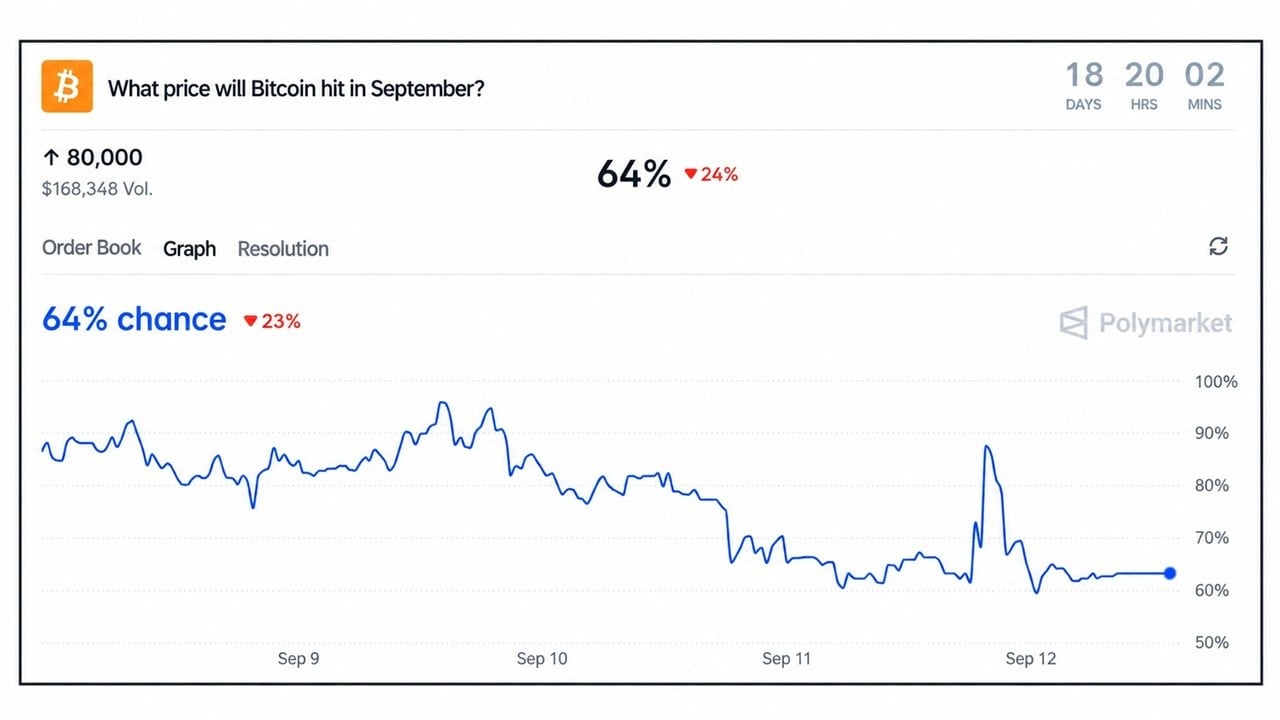
Bitcoin reached an intraday high of $79,890 on September 11 but fell short of breaking through the $80,000 level, even as U.S. stocks posted gains. The S&P 500 closed up nearly 1%, while Treasury yields remained elevated near levels unseen in years, maintaining pressure on risk assets.
Long-dated Treasury yields touched notable highs, with the 10-year yield briefly reaching 4.9915%, its highest level in almost three years, and the 30-year reaching 5.424%, a 19-year high. Although yields pulled back to approximately 4.95% and 5.341% respectively, they remained at demanding levels for risk assets. August core CPI rose 0.3% month-on-month, keeping monetary policy central to Bitcoin's near-term direction.
Digital asset trading firm QCP identified key price levels that will define Bitcoin's recovery. Support sits in the $76,300–$76,500 zone, while resistance remains at $80,000–$82,000. Weekend options activity showed elevated volatility, with September 12 Bitcoin options carrying at-the-money implied volatility near 46%, compared with 38%–40% across the rest of the curve.
The options market revealed mixed sentiment among investors. Call activity concentrated in September 12 expiries at $78,500 and $80,000 suggested upside interest, while steady demand for $75,000 puts expiring September 11 and September 18 indicated continued hedging against downside risk.
Fed Decision as Key Test
The Federal Reserve's September 15-16 meeting will serve as a verification event for Bitcoin's recovery prospects. Markets priced roughly an 85% probability of a quarter-point rate increase following the meeting. A break above $80,000–$82,000 after the announcement would strengthen the recovery case, while a loss of $76,300–$76,500 would weaken the consolidation narrative. The outcome will clarify whether Bitcoin's recent weakness stems from macro conditions or from resistance specific to the $80,000 level.